
Article
Sprinkler Testing & Maintenance
Oct 2026
Direct Answer
Sprinkler testing and maintenance help keep an automatic sprinkler system operational and ready to deliver its approved fire protection performance. A structured programme combines routine inspection, functional testing, preventive maintenance, defect correction, retesting and documented review. Activities should follow the approved design, manufacturer instructions and applicable project procedures.
1. Engineering Overview
Sprinkler Testing & Maintenance ensures that the automatic sprinkler system remains operational, monitored and capable of delivering the approved fire protection performance throughout its service life. Inspection, testing and maintenance should follow the approved design, manufacturer requirements and applicable project procedures.
2. Testing & Maintenance Cycle
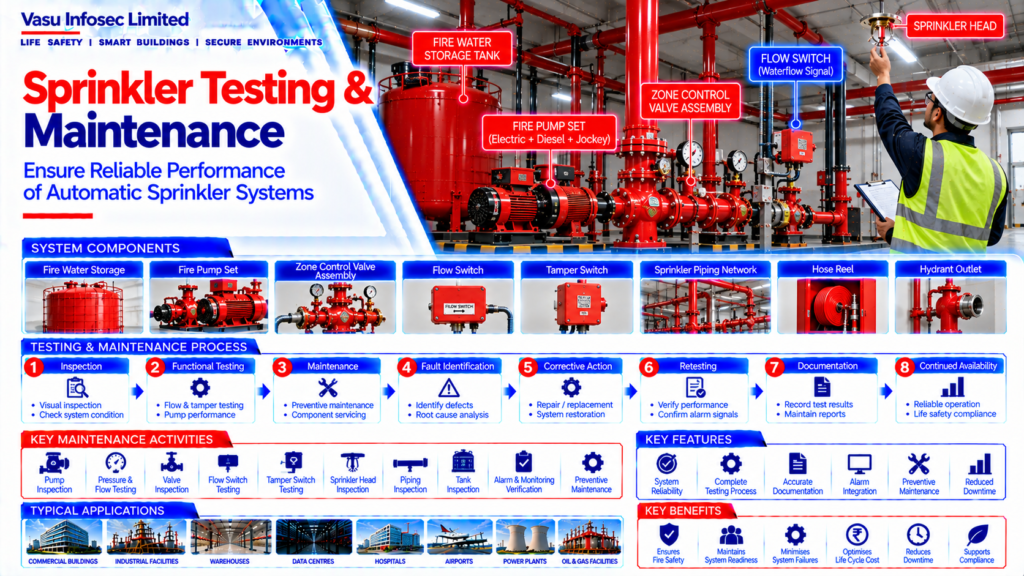
Routine Inspection → Functional Testing → Preventive Maintenance → Fault Identification → Corrective Action → Retesting → Documentation → Periodic Review → Continued System Availability
3. System Inspection
Routine inspection should identify leakage, corrosion, physical damage, obstruction, incorrect valve position, damaged sprinkler heads, abnormal pressure conditions and unauthorised modifications that may affect system performance.
4. Water Supply Inspection
Inspection should verify the fire water storage arrangement, available water level, tank condition, supply connections and associated valves. The required fire reserve should remain available for the approved fire protection demand.
5. Fire Pump Inspection
Fire pumps should be inspected for physical condition, controller status, pressure indication, suction and discharge conditions, valve position and abnormal leakage or noise. Pump availability should be maintained at all times.
6. Jockey Pump Inspection
The jockey pump should be checked for correct pressure maintenance, automatic start / stop operation and abnormal cycling. Pressure settings should remain coordinated with the main fire pump starting sequence.
7. Zone Control Valve Inspection
Zone control and alarm valves should be inspected for correct normal position, leakage, physical condition and supervisory status. Valve accessibility and identification should be maintained.
8. Flow Switch Testing
Flow switches should be functionally tested using the approved test arrangement. The test should confirm activation, signal transmission, alarm indication and restoration to normal condition.
9. Tamper Switch Testing
Tamper switches should be tested by controlled movement of the supervised valve. The test should confirm the correct supervisory indication and restoration after the valve returns to its approved normal position.
10. Sprinkler Head Inspection
Sprinkler heads should be inspected for:
- Physical damage
Corrosion
• Contamination
• Paint or coating
• Obstruction
• Incorrect orientation
• Displacement
• Unauthorised modification
11. Piping Inspection
Sprinkler piping should be inspected for corrosion, leakage, physical damage, inadequate supports, unauthorised modifications and conditions that could affect water distribution.
12. Pressure & Flow Testing
Pressure and flow tests should verify the operational performance of the sprinkler system against the approved design requirements. Test results should be recorded and reviewed for abnormal deviations.
13. Test & Drain Operation
Test and drain arrangements should be checked for accessibility and proper operation. Drainage should be safely routed and the system should be restored to the approved operating condition after testing.
14. Alarm & Monitoring Verification
The sprinkler system should be tested for correct alarm, supervisory and monitoring signals. Flow, tamper, pump and other applicable status signals should correspond with the approved Cause and Effect / monitoring schedule.
15. Preventive Maintenance
Preventive maintenance may include:
- Pump servicing
Valve servicing
• Instrument checks
• Flow switch maintenance
• Tamper switch maintenance
• Sprinkler head inspection
• Piping inspection
• Tank inspection
• Controller checks
16. Corrective Maintenance
Defects identified during inspection or testing should be documented and rectified through the approved maintenance process. Any affected function should be retested before the system is returned to normal service.
17. System Impairment
Where a sprinkler zone or associated equipment must be taken out of service, the approved impairment procedure should be followed. Required notifications, temporary controls and restoration activities should be coordinated before returning the system to service.
18. Protected Area Review
Changes within the protected area should be reviewed periodically.
Examples include:
- New partitions
Ceiling modifications
• New equipment
• Cable trays
• Storage changes
• Lighting changes
• HVAC modifications
• New obstructions
19. Design Change Control
Changes to occupancy, storage, sprinkler type, sprinkler spacing, pipe routing, water supply, pump capacity or zone configuration should be reviewed against the approved hydraulic and sprinkler design.
20. Documentation
Testing and maintenance documentation should include, as applicable:
- Inspection checklists
Pump test reports
• Flow switch test records
• Tamper switch test records
• Valve inspection records
• Sprinkler inspection records
• Pressure / flow test records
• Defect reports
• Corrective action records
• Retest records
• As-built drawings
• O&M manual
21. Engineering Objective
The engineering objective is:
Routine Inspection → Reliable Functional Testing → Preventive Maintenance → Early Fault Detection → Corrective Action → Retesting → Complete Documentation → Continuous System Availability → Reliable Automatic Sprinkler Fire Protection
Frequently Asked Questions
What is sprinkler testing and maintenance?
It is the inspection, functional testing, preventive and corrective maintenance, retesting and documentation used to help keep an automatic sprinkler system operational throughout its service life.
What should routine sprinkler inspections look for?
The source identifies leakage, corrosion, physical damage, obstructions, incorrect valve positions, damaged sprinkler heads, abnormal pressure conditions and unauthorised modifications.
How are flow switches tested?
Use the approved test arrangement and confirm switch activation, signal transmission, alarm indication and restoration to normal condition.
How are tamper switches tested?
Move the supervised valve in a controlled manner and verify the correct supervisory indication, then confirm restoration when the valve returns to its approved normal position.
What should happen when a defect is found?
Document and rectify the defect through the approved maintenance process, then retest the affected function before returning it to normal service.
What is required when a sprinkler zone is taken out of service?
Follow the approved impairment procedure, coordinate required notifications and temporary controls, and verify restoration before returning the system to service.
SEO & Publishing Details
| SEO title | Sprinkler Testing & Maintenance | Inspection and Functional Testing |
| Meta description | Learn how sprinkler testing and maintenance support system readiness through inspection, flow and tamper switch testing, preventive maintenance, defect correction and documentation. |
| Primary keyword | sprinkler testing and maintenance |
| Secondary keywords | automatic sprinkler system inspection; fire pump inspection; flow switch testing; tamper switch testing; sprinkler preventive maintenance; fire protection maintenance |
| Suggested URL slug | /sprinkler-testing-and-maintenance/ |
| Suggested image alt text | Technician inspecting an automatic sprinkler system and associated fire protection monitoring equipment. |