
Article
TCP/IP Building Automation Network
Oct 2026
Direct Answer
A TCP/IP building automation network connects approved field controllers, intelligent devices, gateways, IBMS/BMS servers and operator workstations over Ethernet-based infrastructure. A well-defined architecture coordinates topology, IP addressing, segmentation, protocol communication, cybersecurity, commissioning and maintenance while following the approved project network design.
1. Engineering Overview
A TCP/IP Building Automation Network provides the Ethernet-based communication infrastructure required to connect building automation controllers, gateways, servers, workstations and other approved intelligent devices. The architecture enables reliable exchange of monitoring, alarm, trend and authorised control information across the building automation environment.
2. Network Architecture
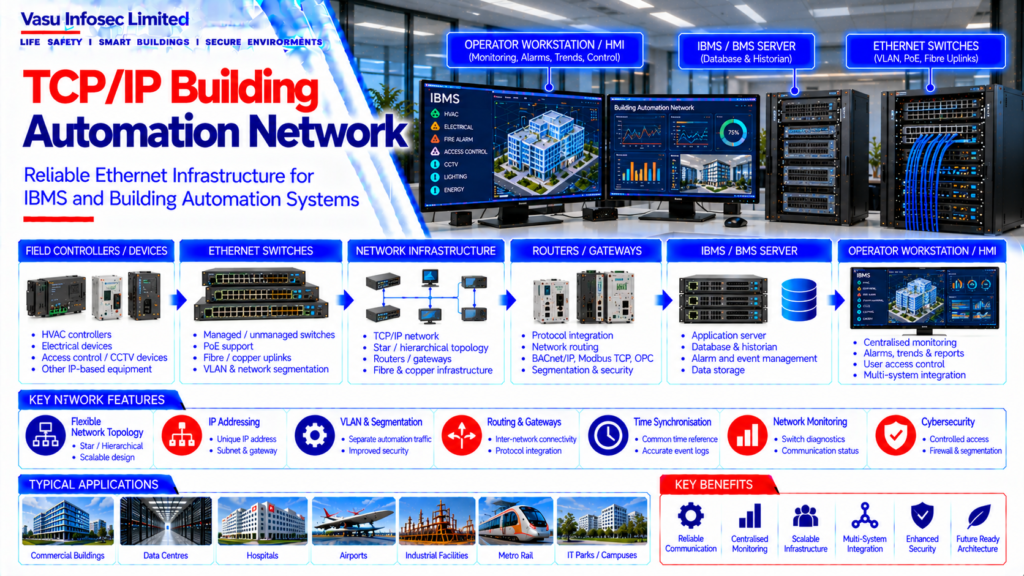
Field Controllers / Intelligent Devices → Ethernet Switches → Building Automation Network → Routers / Gateways → IBMS / BMS Servers → Database / Historian → Operator Workstations / HMI
3. Network Topology
The network topology should be based on the approved project architecture and may use star, hierarchical star, ring or other engineered arrangements. Network topology should provide adequate availability, scalability and maintainability.
4. Ethernet Switches
Managed or unmanaged switches may be used according to the approved design. Switch selection should consider port capacity, uplink requirements, PoE requirements, fibre interfaces, environmental conditions and network availability.
5. IP Addressing
Each IP-based device should be assigned an approved IP address, subnet mask and gateway where required. Addressing should be coordinated through the project network schedule to prevent duplicate addresses and communication conflicts.
6. VLAN & Network Segmentation
Where required, VLANs and network segmentation may be used to separate building automation traffic from enterprise IT, security systems and other network domains. Segmentation should follow the approved IT and cybersecurity architecture.
7. Routing & Gateway Architecture
Routers and gateways may be used to connect different IP networks or protocol environments. Routing rules should be controlled and documented to permit only the required communication paths.
8. Building Automation Protocols
TCP/IP networks may carry protocols such as BACnet/IP, Modbus TCP, OPC-based interfaces and other approved building automation protocols. Each protocol should be configured according to the connected equipment and approved integration requirements.
9. Server Connectivity
IBMS / BMS servers should connect to the building automation network through the approved network architecture. Server connectivity should support required communication, database, alarm, trend and supervisory functions.
10. Workstation Connectivity
Operator workstations should connect to the designated application or server network according to the approved architecture. User access should be controlled through appropriate authentication and role-based permissions.
11. Network Availability
Critical automation networks should be designed with appropriate availability measures where required. Redundant switches, uplinks, network paths or power supplies may be incorporated based on the approved project reliability requirements.
12. Fibre & Copper Infrastructure
Fibre optic and copper Ethernet cabling should be selected according to distance, bandwidth, environmental conditions and project requirements. Termination, patching, labelling and segregation should follow the approved structured cabling design.
13. PoE Integration
Where IP-based devices such as cameras, access devices or other approved equipment require Power over Ethernet, PoE switch capacity and power budgets should be verified against the connected device load.
14. Network Time Synchronisation
Connected systems may require a common time reference for alarms, events and historical records. Time synchronisation should be coordinated through the approved network architecture and applicable system requirements.
15. Network Monitoring
Network health may be monitored through switch diagnostics, communication status, gateway status and server monitoring. Critical communication failures should generate appropriate alarms or diagnostic indications.
16. Cybersecurity
The automation network should incorporate the approved cybersecurity controls, including network segmentation, controlled access, secure credentials, firewall rules, remote-access restrictions and configuration management as applicable.
17. Communication Performance
Network design should consider bandwidth, latency, traffic load, polling rates, broadcast traffic and the number of connected devices. Communication performance should be verified during commissioning.
18. Installation Requirements
Installation should verify:
- Correct network topology
- Correct switches
- Correct IP addressing
- Correct VLAN configuration, where applicable
- Correct routing
- Correct gateways
- Correct fibre / copper links
- Correct port configuration
- Correct labelling
- Correct power supply
- Proper service segregation
19. Testing & Commissioning
TCP/IP building automation network commissioning should verify:
- Physical connectivity
- IP addressing
- Network reachability
- Switch operation
- VLAN configuration
- Gateway communication
- Protocol communication
- Server connectivity
- Workstation connectivity
- Network redundancy, where applicable
- Communication failure alarms
20. Troubleshooting
Typical network issues may include duplicate IP addresses, incorrect subnet configuration, incorrect VLAN assignment, faulty switches, damaged cabling, incorrect routing, gateway configuration errors, excessive traffic and communication timeouts.
21. Maintenance
Maintenance should include switch health checks, network diagnostics, cable inspection, IP address verification, configuration backup, gateway checks and review of communication alarms. Network configuration changes should be documented.
22. Design Change Control
Changes to switches, IP addressing, VLANs, routing, gateways, cabling, network topology or connected devices should be reviewed against the approved building automation network architecture before implementation.
23. Documentation
Network documentation should include, as applicable:
- Network architecture
- Topology diagram
- IP address schedule
- VLAN schedule
- Switch schedule
- Port allocation schedule
- Fibre / copper link schedule
- Gateway details
- Protocol architecture
- Cybersecurity requirements
- Testing and commissioning records
- As-built drawings
- O&M manual
24. Engineering Objective
The engineering objective is:
Reliable Physical Network → Correct IP Addressing → Controlled Network Segmentation → Stable Protocol Communication → Secure Server & Gateway Connectivity → Accurate Building Automation Data → Verified Network Performance → Complete Commissioning → Maintainable TCP/IP Automation Infrastructure
Frequently Asked Questions
What is a TCP/IP building automation network?
It is an Ethernet/IP-based communication infrastructure connecting approved building automation devices, controllers, gateways, servers and workstations.
Which protocols can run over the network?
The source document lists BACnet/IP, Modbus TCP, OPC-based interfaces and other approved building automation protocols. Actual support depends on connected equipment and approved integration requirements.
Why are IP addressing and VLANs important?
An approved IP schedule helps prevent duplicate addresses and communication conflicts. Where required, VLANs and segmentation separate building automation traffic from other network domains in line with the approved IT and cybersecurity architecture.
Is network redundancy always required?
No universal redundancy requirement is specified in the source. Redundant switches, uplinks, network paths or power supplies may be incorporated where required by approved project reliability requirements.
What should be checked during commissioning?
The source lists physical connectivity, IP addressing, network reachability, switch operation, VLANs, gateway and protocol communication, server/workstation connectivity, applicable redundancy and communication-failure alarms.
What documents should be maintained?
As applicable: network architecture and topology, IP and VLAN schedules, switch and port allocation schedules, fibre/copper link schedules, gateway details, protocol architecture, cybersecurity requirements, commissioning records, as-built drawings and the O&M manual.
SEO & Website Publishing Details
SEO title: TCP/IP Building Automation Network: Architecture & Design
Meta description: Learn how TCP/IP building automation networks connect controllers, gateways, IBMS/BMS servers and workstations, including topology, IP addressing, segmentation, cybersecurity and commissioning.
Suggested URL slug: tcp-ip-building-automation-network
Primary keyword: TCP/IP building automation network
Secondary keywords: IBMS network architecture; building automation Ethernet network; BACnet/IP; Modbus TCP; network segmentation; building automation cybersecurity
Suggested image alt text: TCP/IP building automation network architecture connecting field controllers, Ethernet switches, gateways, IBMS servers and operator workstations.