
Article
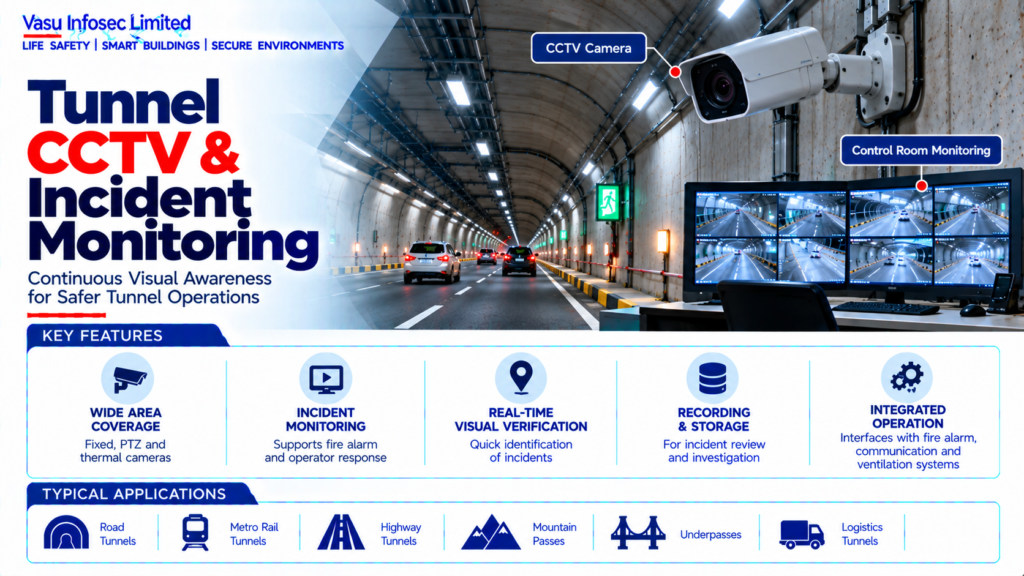
Tunnel CCTV & Incident Monitoring
Oct 2026
Direct Answer
Tunnel CCTV and incident monitoring provide visual awareness of tunnel conditions, traffic, fire events and emergency response, supporting incident verification, operator decisions and post-incident investigation.
1. Engineering Overview
Tunnel CCTV & Incident Monitoring provides continuous visual awareness of tunnel conditions, incidents, fire events, traffic conditions and emergency response activities. The system supports rapid incident verification, operator decision-making, emergency response coordination and post-incident investigation.
2. Complete CCTV & Incident Monitoring Architecture
Tunnel Environment → CCTV Cameras → Field Network → PoE / Fibre Network → Video Management System → Control Room Workstations / Video Wall
Incident Inputs → Fire Detection / Emergency Communication / Traffic Systems → VMS / Incident Management → Camera Selection / Alarm Display → Operator Response
Supporting Systems → NVR / Storage → Network Switches → UPS / Emergency Power → Cybersecurity → Monitoring & Maintenance
3. Monitoring Philosophy
The monitoring philosophy should define camera coverage, critical viewing zones, image quality, recording requirements, incident detection, alarm integration, control-room operation, storage, network resilience and emergency-power requirements.
4. CCTV Camera Selection
Camera selection should consider tunnel geometry, mounting height, viewing distance, lighting conditions, environmental exposure, vibration, temperature, dust, moisture and required identification capability.
5. Fixed Cameras
Fixed cameras provide continuous coverage of defined tunnel areas. They may be positioned to monitor roadways, entrances, exits, emergency equipment, junctions, cross-passages and other critical locations.
6. PTZ Cameras
PTZ cameras provide remotely controllable pan, tilt and zoom functions and may be used for incident verification and wider-area situational awareness. PTZ coverage should complement rather than replace required fixed-camera coverage.
7. Thermal Cameras
Thermal cameras may be considered for specific applications where visibility is impaired or heat signatures provide useful incident information. Their application should be based on the approved risk assessment and operational requirements.
8. Camera Coverage
Camera locations should provide overlapping or complementary coverage of critical areas where required. Blind spots, obstructions, lighting conditions and emergency equipment visibility should be assessed during design.
9. Tunnel Entrances & Exits
Entrances and exits should be monitored to support traffic observation, incident verification, access control and emergency response. Camera positioning should provide appropriate identification and situational awareness.
10. Emergency Equipment Monitoring
CCTV should provide suitable views of designated hydrants, emergency telephones, fire equipment, emergency exits, refuge areas where applicable and other critical life-safety infrastructure.
11. Incident Detection
Incident detection may use operator observation, video analytics, fire alarm events, traffic systems or other approved inputs. Automated analytics should be validated for the actual tunnel environment before being relied upon for safety-critical decisions.
12. Video Analytics
Video analytics may support detection of stopped vehicles, wrong-way movement, congestion, smoke-like conditions, intrusion or other defined events. Analytics configuration should account for lighting, traffic movement and environmental conditions.
13. Fire Alarm Interface
Fire detection events may automatically select relevant CCTV cameras, display alarm locations or provide incident information at the control room. The interface should be defined in the approved cause-and-effect matrix.
14. Fire Detection Location Mapping
Fire detection zones should be mapped to corresponding CCTV views where possible. This enables operators to rapidly verify the affected tunnel section and assess incident conditions.
15. Emergency Communication Interface
Emergency telephone or help-point activation may be associated with nearby CCTV camera selection to help operators identify the caller’s location and surrounding conditions.
16. Ventilation Interface
Ventilation fire-mode activation may be displayed alongside CCTV views to provide operators with combined information on smoke-control status and visual tunnel conditions.
17. Fire Suppression Interface
Where sprinkler, hydrant or water mist systems provide alarms or status information, these events may be correlated with relevant CCTV views for incident verification.
18. Control Room Architecture
The control room should provide operator workstations, video displays, incident alarms, camera controls, event information and appropriate communication interfaces. The arrangement should support rapid identification and coordinated response.
19. Video Management System
The VMS manages camera streams, live viewing, recording, user access, event handling, playback and system configuration. VMS capacity should accommodate the required camera count, resolution, frame rate and retention period.
20. Recording & Storage
Recording capacity should be calculated from camera count, resolution, frame rate, compression, recording mode and required retention period. Critical cameras may require continuous recording while other streams may use event-based recording.
21. Network Architecture
The CCTV network should provide sufficient bandwidth, redundancy where required, fibre backbone connectivity and appropriate segmentation. Network design should account for camera traffic, recording traffic, management traffic and future expansion.
22. Fibre Optic Backbone
Fibre-optic links are commonly used for long tunnel distances and high-bandwidth backbone connectivity. Fibre routing should be protected, appropriately supported and coordinated with other tunnel services.
23. PoE Infrastructure
PoE switches may provide both power and network connectivity to IP cameras. Switch capacity, PoE budget, uplink bandwidth, redundancy and environmental suitability should be verified.
24. Cybersecurity
CCTV and incident-monitoring networks should incorporate appropriate access control, user authentication, network segmentation, secure management, logging and controlled remote access. Cybersecurity requirements should align with the project’s approved ICT / OT security architecture.
25. Emergency Power
Critical CCTV cameras, network equipment, recording systems and control-room equipment should be connected to the approved emergency / standby power arrangement where required by the tunnel incident-management strategy.
26. Installation Requirements
Installation should verify:
- Complete camera coverage
- Correct camera type and resolution
- Correct mounting locations
- Correct viewing angles
- Adequate lighting / image performance
- Correct network bandwidth
- Correct PoE capacity
- Correct fibre backbone
- Correct VMS configuration
- Correct recording and storage capacity
- Correct alarm / fire-system interfaces
- Correct emergency power
- Proper identification and accessibility
27. Testing & Commissioning
CCTV commissioning should verify:
- Camera operation
- Image quality
- Field of view
- PTZ operation where provided
- Recording operation
- Playback
- Storage capacity
- Network communication
- PoE operation
- Fibre links
- VMS functions
- Alarm / fire detection interface
- Emergency communication interface
- Control-room display
- Emergency power operation
28. Incident Scenario Testing
Representative fire and tunnel incident scenarios should verify automatic or operator-assisted camera selection, alarm display, recording, control-room response and coordination with fire detection, emergency communication, ventilation and other systems.
29. Maintenance
Maintenance should include lens cleaning, camera inspection, focus / alignment checks, PTZ operation, network checks, storage health, VMS health, PoE status, fibre connectivity and review of incident / fault logs.
30. Failure & Recovery
The system should be assessed for camera failure, network failure, fibre interruption, storage failure, VMS failure, PoE failure and power loss. Redundancy and recovery procedures should prioritise critical tunnel monitoring areas.
31. Design Change Control
Changes to tunnel geometry, lighting, traffic arrangements, fire detection, emergency exits, ventilation, fire equipment or control-room architecture should trigger a review of CCTV coverage and incident-monitoring requirements.
32. Documentation
Tunnel CCTV and incident-monitoring documentation should include, as applicable:
- CCTV philosophy
- Camera layout
- Camera schedule
- Coverage assessment
- VMS architecture
- Recording / storage calculation
- Network architecture
- Fibre schedule
- PoE switch schedule
- IP / addressing schedule
- Video analytics configuration
- Cause-and-effect matrix
- Interface matrix
- Emergency-power calculation
- Testing and commissioning records
- Camera coverage test reports
- Maintenance schedule
- As-built drawings
- O&M manual
33. Engineering Objective
The engineering objective is:
Assess Tunnel Monitoring Requirements → Define Critical Viewing Areas → Select Camera Technologies → Establish Coverage & Image Performance → Design Fibre / IP / PoE Network → Size VMS & Storage → Integrate Fire Alarm, Emergency Communication, Ventilation & Incident Systems → Provide Emergency Power & Cybersecurity → Test Incident Scenarios → Maintain Continuous Tunnel Situational Awareness
Frequently Asked Questions
What is tunnel CCTV and incident monitoring?
The answer depends on the approved tunnel fire-safety strategy, project design basis and specific system configuration. Refer to the relevant technical sections; do not infer project-specific values where they are not stated.
How is CCTV recording capacity determined?
The answer depends on the approved tunnel fire-safety strategy, project design basis and specific system configuration. Refer to the relevant technical sections; do not infer project-specific values where they are not stated.
What should tunnel CCTV commissioning verify?
The answer depends on the approved tunnel fire-safety strategy, project design basis and specific system configuration. Refer to the relevant technical sections; do not infer project-specific values where they are not stated.
SEO & Publishing Details
| SEO title | Tunnel CCTV & Incident Monitoring | Vasu Infosec Limited |
| Meta description | Tunnel CCTV and incident monitoring provide visual awareness of tunnel conditions, traffic, fire events and emergency response, supporting incident verification, operator decisions and post-incident investigation. |
| Primary keyword | tunnel CCTV |
| Secondary keywords | tunnel incident monitoring, tunnel video management system, tunnel CCTV storage calculation, tunnel CCTV commissioning |
| Suggested URL slug | tunnel-cctv-incident-monitoring |
| Suggested image alt text | Technical architecture and process flow for tunnel cctv & incident monitoring. |