
Article
Tunnel Emergency Communication
Oct 2026
Direct Answer
A tunnel emergency communication system provides reliable communication to tunnel users, operators and emergency responders during fires, evacuations, equipment failures and other incidents.
1. Engineering Overview
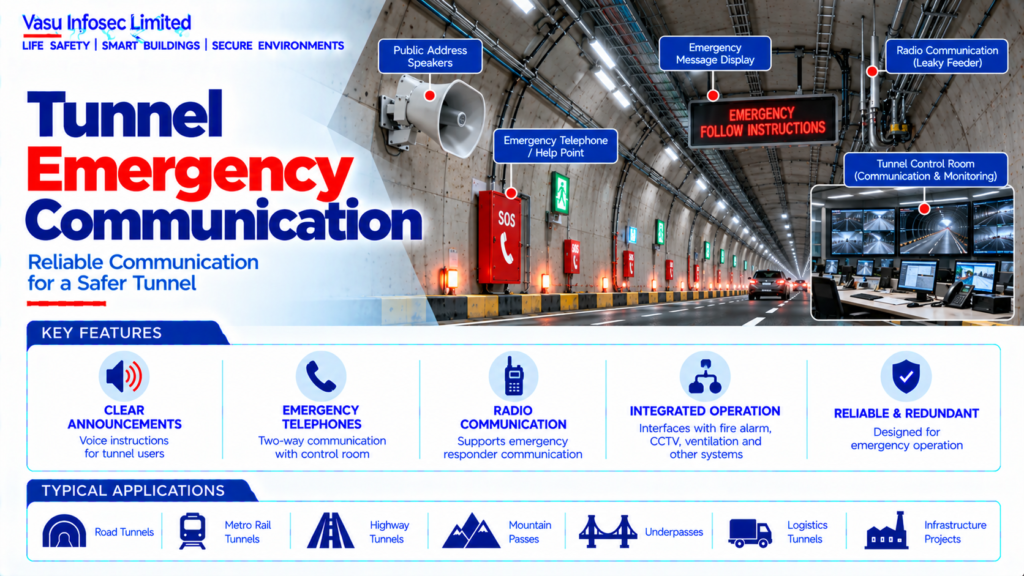
A Tunnel Emergency Communication System provides reliable communication to tunnel users, operators and emergency responders during fire, evacuation, equipment failure and other incidents. The architecture may include public-address systems, emergency telephones, help points, radio communication, control-room communication and interfaces with the tunnel incident-management system.
2. Complete Emergency Communication Architecture
Emergency Event → Fire Alarm / Incident Detection → Tunnel Control Room → Emergency Communication System → Users / Operators / Emergency Responders
Communication Systems → Public Address → Emergency Telephones / Help Points → Radio Communication → Control-Room Voice Communication → Visual / Message Displays where provided
Supporting Systems → Network → Power Supply → Emergency / Standby Power → Monitoring → CCTV → Event Logging
3. Communication Philosophy
The communication philosophy should define coverage, intelligibility, availability, priority of emergency messages, operator control, responder communication, network architecture, emergency power, redundancy and integration with the tunnel fire-safety strategy.
4. Public Address System
The public-address system provides voice instructions and emergency announcements to tunnel users. Speaker coverage, intelligibility, sound pressure level, zoning and emergency priority should be established from the approved communication design.
5. Emergency Voice Messages
Emergency messages should provide clear and actionable information appropriate to the incident. Message content, priority, activation method and language requirements should be established by the approved emergency operating procedures.
6. Speaker Zoning
Public-address speakers should be arranged in logical zones corresponding to tunnel sections, exits and other operational areas. Zoning should allow targeted announcements where required by the evacuation strategy.
7. Speech Intelligibility
Speech intelligibility is critical in noisy tunnel environments. Speaker selection, spacing, acoustic performance, ambient noise and system commissioning should be considered to achieve the required communication performance.
8. Emergency Telephones / Help Points
Emergency telephones or help points may provide two-way communication between tunnel users and the control room. Locations should be accessible, clearly identified and coordinated with emergency exits and firefighting equipment.
9. Control Room Communication
The control room should provide operators with communication interfaces for receiving emergency calls, making announcements, coordinating incidents and communicating with emergency responders.
10. Radio Communication
Where required, the tunnel should support emergency-service radio communication. Radio coverage, antenna / leaky-feeder arrangement, equipment rooms, repeaters and interface requirements should be established from the approved radio-communication design.
11. Radio Rebroadcast / Leaky Feeder
Long tunnels may require dedicated radio-distribution infrastructure to maintain reliable communication. The selected arrangement should be suitable for the tunnel geometry, frequency bands, emergency-service requirements and environmental conditions.
12. Communication Priority
Emergency communication systems should define priority levels so that life-safety announcements can override routine messages when required. The priority logic should be coordinated with tunnel control-room operating procedures.
13. Fire Alarm Interface
Fire alarm events may initiate predefined public-address messages, operator alerts or emergency communication actions. The exact sequence should be established in the approved cause-and-effect matrix.
14. CCTV Interface
Emergency communication events may be correlated with CCTV views to help operators verify the location and circumstances of an incident where integration is provided.
15. Evacuation Interface
Communication systems should support the evacuation strategy by providing instructions concerning exits, direction of movement, restricted areas, refuge locations where applicable and emergency procedures.
16. Emergency Lighting Coordination
Emergency communication and emergency lighting should operate as coordinated life-safety systems. Messages should be consistent with illuminated escape routes, signs and emergency exit locations.
17. Fire Suppression / Ventilation Coordination
Communication messages should reflect the operational status of ventilation, smoke control and fire suppression systems where relevant. Operators should have access to the information required to issue accurate instructions.
18. Control Network
Communication equipment may be connected through dedicated or shared communication networks. Network architecture should provide the required availability, segregation, fault monitoring and cybersecurity controls appropriate to the project.
19. Emergency Power
Critical communication equipment should be supplied from the approved emergency / standby power arrangement. Required autonomy should be established for control equipment, network equipment, public-address systems, help points and other safety-critical components.
20. Equipment Environmental Suitability
Communication equipment should be suitable for tunnel temperature, humidity, dust, vibration, moisture and other environmental conditions. Tunnel-mounted equipment should have appropriate enclosure protection.
21. Installation Requirements
Installation should verify:
- Complete communication coverage
- Correct speaker zoning
- Adequate speech intelligibility
- Correct emergency telephone / help-point locations
- Correct radio coverage where required
- Correct priority logic
- Correct fire alarm interface
- Correct CCTV interface where provided
- Correct evacuation messaging
- Correct emergency power
- Correct network connectivity
- Proper identification and accessibility
22. Testing & Commissioning
Emergency communication commissioning should verify:
- Public-address operation
- Speaker coverage
- Speech intelligibility
- Emergency message activation
- Zone selection
- Emergency telephone / help-point operation
- Control-room communication
- Radio coverage where provided
- Alarm / communication interfaces
- Network communication
- Emergency power operation
- Fault monitoring
23. Intelligibility & Coverage Testing
The communication system should be tested throughout designated tunnel zones to confirm audibility and speech intelligibility under representative operating noise conditions. Results should be recorded against the approved design criteria.
24. Integrated Emergency Scenario Testing
Representative fire and evacuation scenarios should verify communication from incident detection through control-room response, public-address announcements, emergency telephone operation, responder communication and coordination with evacuation, ventilation and other life-safety systems.
25. Maintenance
Maintenance should include inspection and functional testing of speakers, amplifiers, emergency telephones, help points, radio equipment, network equipment, control interfaces and emergency power. Communication performance and fault history should be reviewed periodically.
26. Failure & Recovery
The system should be assessed for amplifier failure, speaker circuit failure, communication-network loss, help-point failure, radio coverage loss, power failure and control-room interface faults. Redundancy and recovery procedures should be defined for critical communication functions.
27. Design Change Control
Changes to tunnel geometry, exits, traffic arrangements, fire detection, ventilation, emergency lighting, control-room architecture or radio requirements should trigger a review of emergency communication coverage and zoning.
28. Documentation
Tunnel emergency communication documentation should include, as applicable:
- Communication philosophy
- Public-address layout
- Speaker schedule
- Coverage / intelligibility assessment
- Emergency telephone / help-point layout
- Radio communication architecture
- Network architecture
- Equipment schedule
- Power / battery calculation
- Cause-and-effect matrix
- Interface matrix
- Emergency message schedule
- Testing and commissioning records
- Coverage / intelligibility test reports
- Maintenance schedule
- Emergency communication procedures
- As-built drawings
- O&M manual
29. Engineering Objective
The engineering objective is:
Assess Emergency Communication Requirements → Establish Coverage & Communication Zones → Select PA, Help Point & Radio Technologies → Provide Reliable Control-Room Communication → Integrate Fire Alarm, CCTV, Evacuation & Incident Management → Provide Emergency Power & Fault Monitoring → Verify Coverage & Intelligibility → Test Emergency Scenarios → Maintain Reliable Tunnel Emergency Communication
Frequently Asked Questions
What is a tunnel emergency communication system?
The answer depends on the approved tunnel fire-safety strategy, project design basis and specific system configuration. Refer to the relevant technical sections; do not infer project-specific values where they are not stated.
Which communication systems may be used in a tunnel?
The answer depends on the approved tunnel fire-safety strategy, project design basis and specific system configuration. Refer to the relevant technical sections; do not infer project-specific values where they are not stated.
What should emergency communication commissioning verify?
The answer depends on the approved tunnel fire-safety strategy, project design basis and specific system configuration. Refer to the relevant technical sections; do not infer project-specific values where they are not stated.
SEO & Publishing Details
| SEO title | Tunnel Emergency Communication | Vasu Infosec Limited |
| Meta description | A tunnel emergency communication system provides reliable communication to tunnel users, operators and emergency responders during fires, evacuations, equipment failures and other incidents. |
| Primary keyword | tunnel emergency communication |
| Secondary keywords | tunnel public address system, tunnel emergency telephone, tunnel radio communication, tunnel evacuation messaging |
| Suggested URL slug | tunnel-emergency-communication |
| Suggested image alt text | Technical architecture and process flow for tunnel emergency communication. |