
Article
Tunnel Emergency Lighting
Oct 2026
Direct Answer
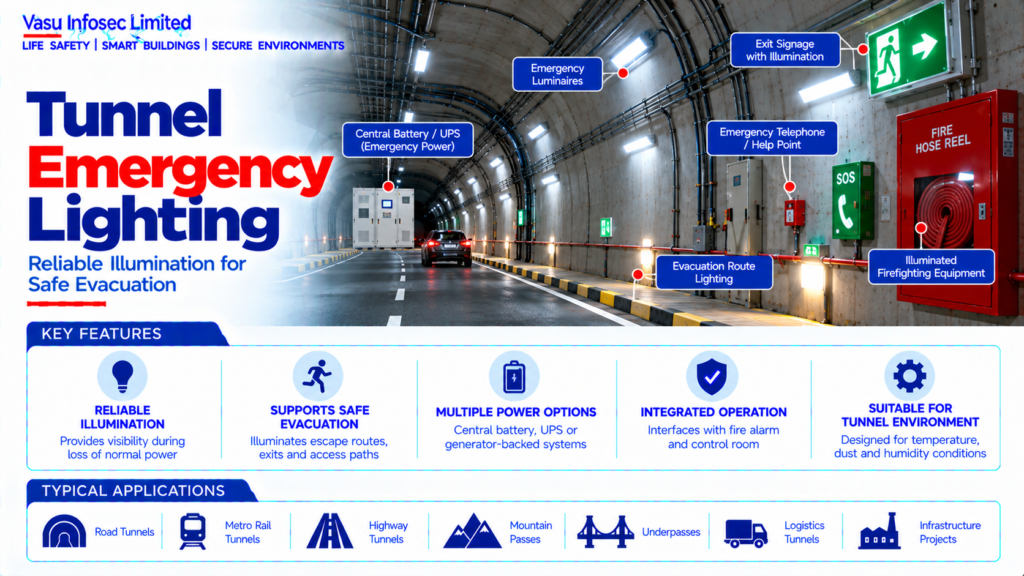
Tunnel emergency lighting provides illumination during loss of normal power and emergency conditions. It supports movement, evacuation, identification of emergency equipment and emergency responder access.
1. Engineering Overview
Tunnel Emergency Lighting is a life-safety system designed to provide illumination during loss of normal power and emergency conditions. It supports safe movement, evacuation, identification of emergency equipment and access by emergency responders within the tunnel.
2. Complete Emergency Lighting Architecture
Normal Power Supply → Tunnel Lighting Distribution → Normal Lighting
Emergency Condition → Emergency / Standby Power → Emergency Lighting Distribution → Emergency Luminaires → Evacuation / Emergency Areas
Supporting Systems → Central Battery / UPS where applicable → Emergency Lighting Control → Monitoring → Fire Alarm / Control Room → Testing & Maintenance
3. Emergency Lighting Philosophy
The emergency-lighting philosophy should define the areas requiring emergency illumination, minimum illumination performance, duration, power-source arrangement, luminaire type, spacing, monitoring, testing and relationship with the evacuation strategy.
4. Emergency Lighting Coverage
Emergency lighting should cover designated tunnel roadways, pedestrian escape routes, emergency exits, access paths, firefighting equipment locations, control areas and other critical locations identified by the approved fire-safety design.
5. Evacuation Route Lighting
Lighting along emergency escape routes should provide sufficient visibility for occupants to identify and follow the designated evacuation path during loss of normal lighting.
6. Emergency Exit Lighting
Emergency exits should be adequately illuminated and coordinated with exit signage so that occupants can identify available escape routes during an emergency.
7. Fire-Fighting Equipment Lighting
Hydrants, fire extinguishers, fire alarm devices, emergency telephones, fire-system control equipment and other designated firefighting facilities should have appropriate visibility under emergency conditions.
8. Luminaire Selection
Emergency luminaires should be selected for tunnel environmental conditions including temperature, humidity, dust, vibration, moisture and mechanical exposure. Optical performance should suit the installation location.
9. Lighting Levels
Required illumination levels should be established from the approved tunnel lighting and life-safety design. The design should account for tunnel geometry, mounting height, spacing, surface reflectance and emergency operating conditions.
10. Emergency Duration
The emergency lighting duration should be established from the approved evacuation and emergency-operating strategy and applicable project requirements. Battery capacity should support the required duration.
11. Emergency Power Sources
Emergency lighting may be supported by central battery systems, UPS systems, generator-backed distribution or self-contained emergency luminaires, depending on the approved architecture.
12. Central Battery System
A central battery arrangement supplies multiple emergency luminaires from a common battery and charging system. The system should provide appropriate monitoring, distribution, autonomy and fault indication.
13. Self-Contained Emergency Luminaires
Self-contained luminaires incorporate their own battery and charging equipment. Each unit should be monitored and tested according to the approved maintenance philosophy.
14. UPS / Standby Power Interface
Where emergency lighting is supplied from a UPS or standby source, the power system should provide the required transfer characteristics, autonomy and reliability for the emergency lighting load.
15. Generator Interface
Where generator-backed emergency lighting is used, the lighting distribution should be coordinated with automatic source transfer and generator start-up characteristics so that required emergency illumination is restored within the approved response time.
16. Lighting Distribution
Emergency lighting circuits should be distributed so that a single circuit or equipment fault does not unnecessarily compromise critical evacuation areas. Circuit segregation and redundancy should follow the approved design.
17. Emergency Lighting Control
Control arrangements may include automatic emergency operation, maintained / non-maintained modes, central monitoring, test functions and local controls where permitted. Emergency operation should not depend on routine manual intervention.
18. Fire Alarm Interface
Where required, the emergency lighting system may exchange status and fault information with the fire alarm system or tunnel control room. Safety-critical operation should follow the approved interface philosophy.
19. Control Room Monitoring
The tunnel control room should receive relevant emergency-lighting status, battery condition, circuit faults and system alarms where central monitoring is provided.
20. Evacuation Strategy Integration
Emergency lighting should be coordinated with evacuation routes, emergency exits, signage, emergency communication and smoke-control strategy. Lighting should support the intended direction of evacuation.
21. Smoke & Visibility Considerations
Emergency lighting design should consider reduced visibility caused by smoke. Luminaire placement and optical performance should support identification of routes and critical equipment under the expected emergency conditions.
22. Installation Environment
Tunnel-mounted emergency luminaires and associated equipment should be suitable for the expected environmental conditions and protected against mechanical damage, water ingress and other identified hazards.
23. Installation Requirements
Installation should verify:
- Correct emergency-lighting coverage
- Correct luminaire type
- Correct spacing and mounting
- Correct emergency illumination levels
- Correct emergency duration
- Correct power-source arrangement
- Correct circuit segregation
- Correct battery / UPS capacity
- Correct exit and evacuation-route coordination
- Correct fire alarm / control-room monitoring where provided
- Correct equipment environmental protection
- Proper identification and accessibility
24. Testing & Commissioning
Emergency-lighting commissioning should verify:
- Normal lighting operation
- Emergency-mode activation
- Source transfer
- Luminaire operation
- Emergency illumination levels
- Battery autonomy / capacity
- Charger operation
- Circuit monitoring
- Fault indication
- Control-room status
- Exit and evacuation-route visibility
- Emergency power operation
25. Illumination Performance Testing
Emergency lighting should be tested at representative points along designated evacuation routes and critical areas. Measurements should be compared with the approved design criteria and recorded for handover.
26. Integrated Emergency Scenario Testing
Representative loss-of-normal-power and tunnel fire scenarios should verify emergency lighting activation, emergency power response, evacuation-route illumination, exit identification and coordination with fire alarm, emergency communication and smoke-control systems.
27. Maintenance
Maintenance should include inspection and functional testing of luminaires, batteries, chargers, central monitoring, distribution circuits and emergency power sources. Battery condition and emergency-duration performance should be periodically assessed.
28. Failure & Recovery
The system should be assessed for luminaire failure, battery degradation, charger failure, circuit failure, central-battery faults, UPS failure and loss of emergency power. Faults should be clearly indicated and corrected through controlled maintenance.
29. Design Change Control
Changes to tunnel geometry, evacuation routes, emergency exits, fire equipment locations, normal lighting, electrical distribution or emergency power should trigger a review of emergency-lighting coverage and capacity.
30. Documentation
Tunnel emergency-lighting documentation should include, as applicable:
- Emergency-lighting philosophy
- Lighting layout
- Luminaire schedule
- Illumination calculations
- Emergency-duration calculation
- Battery / UPS calculation
- Emergency-power architecture
- Circuit schedule
- Monitoring architecture
- Interface matrix
- Testing and commissioning records
- Illumination test reports
- Battery test reports
- Maintenance schedule
- Emergency operating procedures
- As-built drawings
- O&M manual
31. Engineering Objective
The engineering objective is:
Assess Evacuation & Emergency Lighting Requirements → Define Critical Areas & Routes → Select Suitable Emergency Luminaires → Establish Illumination & Duration Criteria → Design Emergency Power & Distribution → Coordinate with Fire Alarm, Communication & Smoke Control → Verify Illumination & Autonomy → Test Emergency Scenarios → Maintain Reliable Tunnel Emergency Lighting
Frequently Asked Questions
What is tunnel emergency lighting?
The answer depends on the approved tunnel fire-safety strategy, project design basis and specific system configuration. Refer to the relevant technical sections; do not infer project-specific values where they are not stated.
How is emergency lighting duration established?
The answer depends on the approved tunnel fire-safety strategy, project design basis and specific system configuration. Refer to the relevant technical sections; do not infer project-specific values where they are not stated.
What should emergency lighting commissioning verify?
The answer depends on the approved tunnel fire-safety strategy, project design basis and specific system configuration. Refer to the relevant technical sections; do not infer project-specific values where they are not stated.
SEO & Publishing Details
| SEO title | Tunnel Emergency Lighting | Vasu Infosec Limited |
| Meta description | Tunnel emergency lighting provides illumination during loss of normal power and emergency conditions. It supports movement, evacuation, identification of emergency equipment and emergency responder access. |
| Primary keyword | tunnel emergency lighting |
| Secondary keywords | tunnel evacuation lighting, emergency lighting battery autonomy, tunnel exit lighting, emergency lighting commissioning |
| Suggested URL slug | tunnel-emergency-lighting |
| Suggested image alt text | Technical architecture and process flow for tunnel emergency lighting. |