
Article
Tunnel Fire Detection System
Oct 2026
Direct Answer
A tunnel fire detection system identifies fire or abnormal heat conditions and initiates required alarm and approved response actions. Technology, zoning and interfaces must suit the tunnel environment and fire strategy.
1. Engineering Overview
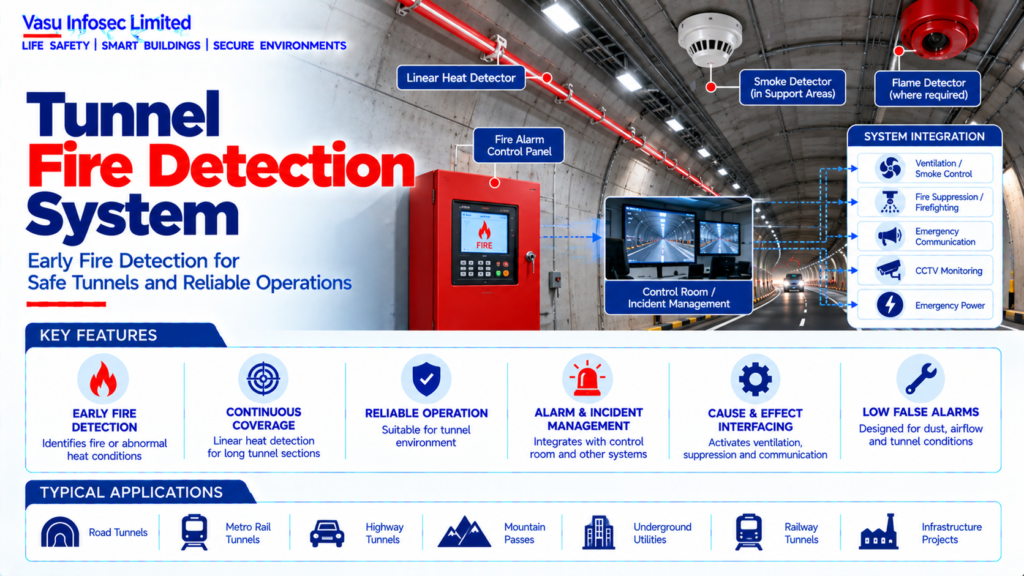
A Tunnel Fire Detection System is an engineered life-safety system intended to identify fire or abnormal heat conditions at the earliest practical stage and initiate the required alarm, incident-management and fire-response actions. Detection selection must account for tunnel length, geometry, airflow, temperature, dust, vibration, accessibility and the approved fire strategy.
2. Complete Tunnel Fire Detection Architecture
Tunnel Fire / Heat Condition → Detection Device → Detection Controller / Fire Alarm Panel → Alarm Processing → Cause & Effect → Fire Response Systems
Detection Inputs → Linear Heat Detection / Point Detection / Other Approved Detection → Fire Alarm Network → Control Room / Incident Management
Interfaces → Ventilation / Smoke Control → Fire Suppression → Emergency Communication → CCTV → Emergency Power → Monitoring
3. Detection Philosophy
The detection philosophy should define the required detection technology, zoning, alarm thresholds, response time, false-alarm management, redundancy, fault monitoring and interfaces with other tunnel life-safety systems.
4. Tunnel Detection Environment
Tunnel environments may expose detection equipment to dust, exhaust gases, vibration, moisture, temperature variation, airflow and electromagnetic interference. Equipment should be selected and installed for the actual tunnel environment.
5. Linear Heat Detection
Linear heat detection provides continuous or distributed thermal sensing along a defined route. It can be particularly suitable for long tunnel sections where continuous coverage is required. Detector type, sensing principle and alarm temperature should follow the approved design.
6. Point Fire Detection
Point detectors may be used in suitable tunnel areas where environmental and airflow conditions allow reliable detection. Their applicability, spacing and mounting height should be established by the approved fire detection design.
7. Flame Detection
Where specifically justified by the fire risk, flame detection may be considered for locations where rapid flame recognition is required and environmental conditions support reliable operation. The technology should be selected through the approved risk assessment and detection philosophy.
8. Smoke Detection
Smoke detection may be suitable in designated tunnel support areas, equipment rooms, control rooms or other locations where smoke movement and environmental conditions allow reliable detection. Tunnel-roadway application should follow the approved design rather than generic building practice.
9. Detection Zoning
The tunnel should be divided into logical detection zones based on tunnel geometry, fire strategy, operational sections and the required response. Zone boundaries should correspond with the fire alarm and cause-and-effect architecture.
10. Fire Alarm Control Panel
The fire alarm control equipment receives detection signals, identifies alarm / fault conditions, activates notification and issues approved control outputs. Panel capacity, networking, redundancy and environmental suitability should match the tunnel system requirements.
11. Alarm Processing
Detection inputs should be processed using defined alarm logic to distinguish fire, pre-alarm where provided, fault, communication failure and other system states. Alarm processing should minimise unwanted system responses while maintaining required fire sensitivity.
12. Alarm Verification
Where an alarm-verification or confirmation strategy is approved, the system may use defined logic such as multiple detection inputs, confirmation signals or operator verification. Safety-critical automatic actions should not be compromised by unnecessary delay.
13. False Alarm Management
The detection system should be designed to minimise false alarms caused by dust, exhaust, heat sources, airflow, maintenance activities and other tunnel-specific conditions. Environmental suitability and appropriate detection technology are key controls.
14. Detector Location
Detector mounting locations should be coordinated with tunnel geometry, ventilation, cable routes, structural elements, maintenance access and the expected fire characteristics. The approved shop drawings should define final locations.
15. Detection Coverage
Detection coverage should be demonstrated against the approved tunnel fire strategy. Blind spots, inaccessible areas, ventilation effects and potential fire locations should be assessed during design and commissioning.
16. Fire Alarm Network
Multiple fire alarm panels, remote modules or detection controllers may be networked to provide tunnel-wide monitoring. Network architecture should provide the required communication reliability, fault monitoring and segregation.
17. Control Room Interface
Fire detection alarms, zones, device status, faults and events should be displayed at the tunnel control room or incident-management centre where required. Operator displays should clearly identify the affected tunnel location.
18. CCTV Verification Interface
Where integrated, a fire detection event may trigger or assist CCTV camera selection / display for incident verification. The interface should be defined in the approved cause-and-effect and communication matrix.
19. Ventilation Interface
Fire detection may initiate or modify the approved emergency ventilation sequence. The exact response should be established in the tunnel fire cause-and-effect matrix and coordinated with the ventilation control philosophy.
20. Fire Suppression Interface
Where water mist, sprinkler or another suppression system is provided, detection signals may initiate or release the approved suppression sequence. Detection and suppression zoning should be coordinated.
21. Emergency Communication Interface
Fire alarm events may initiate or support emergency communication actions such as public-address messages, operator alerts or other defined emergency procedures. The sequence should follow the approved cause-and-effect matrix.
22. Emergency Power
Detection and alarm equipment should be connected to the approved emergency / standby power arrangement so that required operation is maintained during loss of normal power.
23. Fault Monitoring
The system should monitor relevant faults including detector faults, open / short circuits, power failure, communication failure, controller faults and other equipment-specific conditions.
24. Installation Requirements
Installation should verify:
- Correct detection technology
- Correct detector coverage
- Correct zoning
- Correct mounting locations
- Correct fire alarm panel configuration
- Correct network architecture
- Correct power supply
- Correct fault monitoring
- Correct CCTV interface where provided
- Correct ventilation interface
- Correct suppression interface
- Proper identification and accessibility
25. Testing & Commissioning
Tunnel fire detection commissioning should verify:
- Detector operation
- Linear heat detection operation where provided
- Alarm thresholds / response
- Zone identification
- Fire alarm panel operation
- Network communication
- Fault monitoring
- Control-room indication
- CCTV interface where provided
- Ventilation interface
- Suppression interface
- Emergency communication interface
- Emergency power operation
26. Integrated Fire Scenario Testing
Representative tunnel fire scenarios should be tested to confirm the complete sequence from detection through alarm, control-room notification and the approved cause-and-effect actions. Testing should verify that interfaces operate in the intended sequence.
27. Maintenance
Maintenance should include detector inspection, cleaning where applicable, functional testing, cable / loop inspection, panel health checks, battery checks, network monitoring and review of alarm / fault history. Maintenance frequency should follow the approved programme and manufacturer requirements.
28. Failure & Recovery
The system should be assessed for detector failure, communication loss, controller failure, power failure, cable faults and nuisance alarms. Fault response should maintain the required level of fire detection availability and provide clear fault indication.
29. Design Change Control
Changes to tunnel geometry, ventilation, fire suppression, cable routing, traffic arrangement, detector locations or control-room architecture should trigger a review of the fire detection coverage and cause-and-effect logic.
30. Documentation
Tunnel fire detection documentation should include, as applicable:
- Fire detection philosophy
- Detection layout
- Detector schedule
- Linear heat detection details
- Fire alarm zoning
- Panel schedule
- Network architecture
- Cause-and-effect matrix
- Interface matrix
- Power supply details
- Battery calculation
- Testing and commissioning records
- Alarm / fault history
- Maintenance schedule
- As-built drawings
- O&M manual
31. Engineering Objective
The engineering objective is:
Assess Tunnel Fire Risk → Select Suitable Detection Technology → Establish Detection Zones & Coverage → Provide Reliable Fire Alarm Processing → Integrate Control Room, CCTV, Ventilation & Suppression Interfaces → Verify Emergency Power & Fault Monitoring → Test Representative Fire Scenarios → Maintain Continuous & Reliable Tunnel Fire Detection
Frequently Asked Questions
What is a tunnel fire detection system?
The answer depends on the approved tunnel fire-safety strategy, project design basis and specific system configuration. Refer to the relevant technical sections above; do not infer a project-specific value or requirement where it is not stated.
Which detection technologies may be used in tunnels?
The answer depends on the approved tunnel fire-safety strategy, project design basis and specific system configuration. Refer to the relevant technical sections above; do not infer a project-specific value or requirement where it is not stated.
What should detection commissioning verify?
The answer depends on the approved tunnel fire-safety strategy, project design basis and specific system configuration. Refer to the relevant technical sections above; do not infer a project-specific value or requirement where it is not stated.
SEO & Publishing Details
| SEO title | Tunnel Fire Detection System | Vasu Infosec Limited |
| Meta description | A tunnel fire detection system identifies fire or abnormal heat conditions and initiates required alarm and approved response actions. Technology, zoning and interfaces must suit the tunnel environment and fire strategy. |
| Primary keyword | tunnel fire detection system |
| Secondary keywords | linear heat detection tunnel, tunnel fire alarm interface, tunnel detection zoning, tunnel fire safety |
| Suggested URL slug | tunnel-fire-detection-system |
| Suggested image alt text | Technical architecture and process flow for tunnel fire detection system. |