
Article
Tunnel Fire Safety Maintenance
Oct 2026
Direct Answer
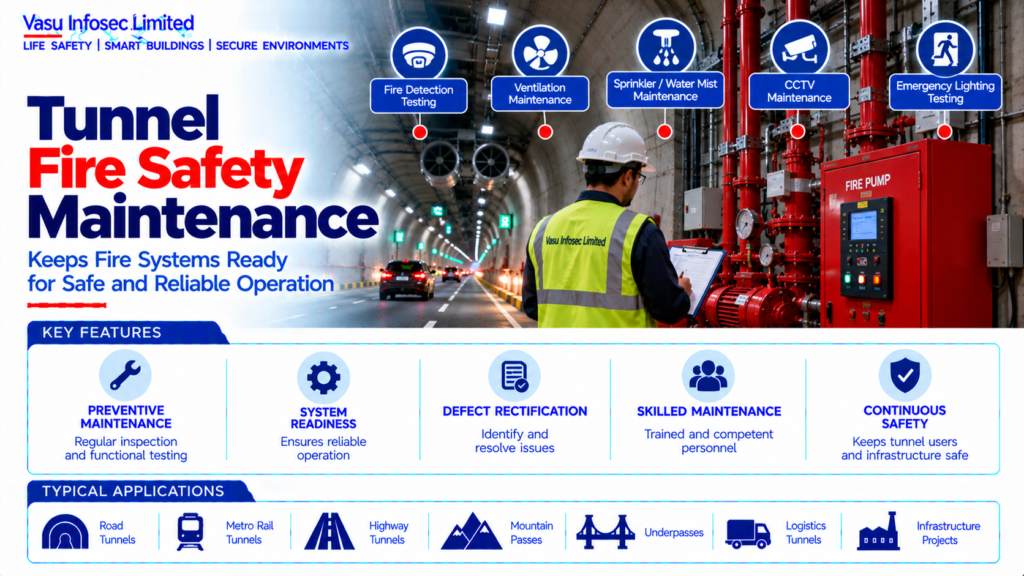
Tunnel fire-safety maintenance preserves the availability, reliability and performance of fire and life-safety systems through inspection, functional testing, corrective maintenance, records, competency and integrated verification.
1. Engineering Overview
Tunnel Fire Safety Maintenance is the structured programme for preserving the availability, reliability and performance of all tunnel fire and life-safety systems throughout their operational life. It covers preventive maintenance, inspection, functional testing, corrective maintenance, records, competency, spares and periodic integrated verification.
2. Complete Maintenance Architecture
Approved Maintenance Strategy → Asset Register → Preventive Maintenance Schedule → Routine Inspection → Functional Testing → Performance Verification → Defect Identification → Corrective Action → Retesting → Record Closure → Periodic Review
3. Maintenance Philosophy
The maintenance philosophy should define system criticality, inspection frequency, test requirements, responsible personnel, safety precautions, impairment controls, documentation, spare-parts requirements and escalation procedures.
4. Fire Safety Asset Register
A controlled asset register should identify fire detection, fire alarm, hydrant, sprinkler, water mist, fire pumps, smoke extraction, ventilation fire mode, emergency communication, emergency lighting, CCTV, fire doors, compartmentation and other safety-critical assets.
5. Asset Criticality
Assets should be classified according to their impact on life safety and emergency response. Critical equipment should receive appropriate inspection, testing, redundancy and corrective-maintenance priority.
6. Preventive Maintenance
Preventive maintenance should be planned to identify deterioration before failure. Activities should include inspection, cleaning, functional testing, calibration where applicable, lubrication, battery checks and performance verification.
7. Fire Detection Maintenance
Maintenance should include detector inspection, cleaning where appropriate, alarm testing, zone verification, panel checks, loop / circuit monitoring, fault review and confirmation of correct detector coverage.
8. Linear Heat Detection Maintenance
Where LHD is installed, maintenance should include controller inspection, cable / sensing element integrity, alarm simulation or approved testing, location identification and fault monitoring.
9. Fire Alarm Maintenance
Fire alarm panels, annunciators, sounders, visual indicators, manual call points, batteries, network interfaces and alarm transmission paths should be inspected and functionally tested.
10. Hydrant System Maintenance
Hydrant systems should be inspected for valve condition, accessibility, leakage, hose / equipment condition where provided, pressure and flow performance and integrity of the fire-water network.
11. Sprinkler System Maintenance
Sprinkler systems should be maintained through inspection of control valves, alarm valves, flow switches, sprinkler heads, pipework, test arrangements and associated fire-water supply equipment.
12. Water Mist System Maintenance
Water mist systems should be maintained in accordance with the approved system-specific requirements, including pumps, cylinders or water supply equipment where applicable, control valves, nozzles, detection interface and system monitoring.
13. Fire Pump Maintenance
Fire pumps should undergo routine inspection and scheduled performance testing. Maintenance should cover electric motors or diesel engines, controllers, batteries, chargers, fuel systems, valves, gauges, pressure and flow performance.
14. Smoke Extraction Maintenance
Smoke-extraction fans, motors, dampers, actuators, ducts, controls and monitoring equipment should be inspected and tested to confirm readiness for fire-mode operation.
15. Ventilation Fire-Mode Maintenance
Jet fans, ventilation fans, fire-mode controls, dampers, sensors, drives and associated control logic should be periodically tested to confirm correct emergency operation.
16. Emergency Communication Maintenance
Public-address systems, emergency telephones, help points, amplifiers, radio equipment, network equipment and control-room interfaces should be inspected and functionally tested.
17. Emergency Lighting Maintenance
Emergency luminaires, central batteries, self-contained batteries, chargers, UPS systems, distribution circuits and monitoring equipment should be inspected and tested for operation and required duration.
18. CCTV & Incident Monitoring Maintenance
CCTV cameras, PTZ mechanisms, network switches, fibre links, VMS servers, storage systems, displays and incident-monitoring interfaces should be maintained to ensure continuous operational visibility.
19. Fire Compartmentation Maintenance
Fire-rated barriers, fire doors, penetration seals, dampers, cross-passages and other compartmentation elements should be periodically inspected for damage, deterioration or unauthorised modification.
20. Fire Brigade Access Maintenance
Emergency access routes, gates, doors, barriers, cross-passages, responder equipment and hydrant access should remain unobstructed and operational. Access arrangements should be periodically verified.
21. Emergency Power Maintenance
Generators, UPS systems, central batteries, chargers, automatic transfer systems, emergency distribution boards and associated cabling should be maintained and tested according to their criticality and approved maintenance programme.
22. Cause & Effect Verification
The approved cause-and-effect logic should be periodically verified to ensure that fire detection and other initiating events produce the correct ventilation, suppression, communication, CCTV, lighting, traffic and control-room responses.
23. Integrated System Testing
Integrated fire-safety testing should verify interaction between fire alarm, smoke control, suppression, emergency communication, emergency lighting, CCTV, traffic management, access control and control-room systems.
24. Impairment Management
Any planned impairment of a safety-critical system should be formally controlled. The impairment process should identify affected systems, duration, compensatory measures, responsible persons, notifications and restoration requirements.
25. Corrective Maintenance
Defects should be recorded, prioritised according to risk and rectified within defined response periods. Critical defects affecting life-safety functionality should receive immediate escalation and appropriate compensatory measures.
26. Spare Parts Management
Critical spare parts should be identified based on equipment criticality, manufacturer availability, lead time and failure history. Storage conditions and stock levels should be periodically reviewed.
27. Maintenance Safety
Maintenance activities should follow approved safety procedures, isolation requirements, access controls and permit systems. Work on fire-safety systems should ensure that impairment and restoration status are clearly communicated.
28. Testing & Commissioning Baseline
Original commissioning records should be retained as the baseline for future maintenance. Subsequent test results should be compared with baseline performance to identify deterioration or abnormal trends.
29. Maintenance Records
Maintenance records should document asset identification, date, technician, activity, test method, measured result, defect, corrective action, retest result and closure status.
30. Competency & Training
Maintenance personnel should be suitably trained and competent for the equipment they service. Training should cover system operation, fire-mode response, testing procedures, fault diagnosis and safe maintenance practices.
31. Maintenance Requirements
Maintenance should verify:
- Asset register accuracy
- Preventive-maintenance compliance
- Fire detection operation
- Fire alarm operation
- Hydrant / sprinkler / water mist readiness
- Fire-pump performance
- Smoke-control operation
- Emergency communication
- Emergency lighting
- CCTV monitoring
- Fire compartmentation
- Fire brigade access
- Emergency power
- Cause-and-effect logic
- Integrated system performance
32. Periodic Performance Review
Maintenance data should be periodically reviewed to identify recurring failures, declining performance, overdue activities, spare-parts issues and systemic reliability concerns. Corrective or improvement actions should be documented.
33. Design Change Control
Changes to tunnel infrastructure, fire systems, ventilation, electrical systems, communication, evacuation arrangements or operating procedures should trigger an assessment of maintenance requirements and updates to the asset register and maintenance programme.
34. Documentation
Tunnel fire-safety maintenance documentation should include, as applicable:
- Maintenance philosophy
- Asset register
- Criticality classification
- Preventive-maintenance schedule
- Inspection checklists
- Testing procedures
- Fire detection test records
- Fire alarm test records
- Fire-water system test records
- Fire-pump performance records
- Smoke-control test records
- Communication test records
- Emergency-lighting test records
- CCTV maintenance records
- Compartmentation inspection records
- Emergency-power test records
- Cause-and-effect test records
- Integrated testing records
- Impairment records
- Defect / corrective-action register
- Spare-parts register
- Training records
- Maintenance reports
- As-built drawings
- O&M manual
35. Engineering Objective
The engineering objective is:
Establish Asset Register → Classify Safety Criticality → Plan Preventive Maintenance → Inspect & Test Individual Systems → Verify Performance → Control Impairments → Rectify Defects → Conduct Integrated Fire-System Testing → Review Reliability Trends → Maintain Competent Resources & Spares → Update Records → Sustain Continuous Tunnel Fire-Safety Readiness
Frequently Asked Questions
What is tunnel fire-safety maintenance?
The answer depends on the approved tunnel fire-safety strategy, project design basis and specific system configuration. Refer to the relevant technical sections; do not infer project-specific values where they are not stated.
Which systems should be included in the maintenance programme?
The answer depends on the approved tunnel fire-safety strategy, project design basis and specific system configuration. Refer to the relevant technical sections; do not infer project-specific values where they are not stated.
How should safety-critical system impairments be managed?
The answer depends on the approved tunnel fire-safety strategy, project design basis and specific system configuration. Refer to the relevant technical sections; do not infer project-specific values where they are not stated.
SEO & Publishing Details
| SEO title | Tunnel Fire Safety Maintenance | Vasu Infosec Limited |
| Meta description | Tunnel fire-safety maintenance preserves the availability, reliability and performance of fire and life-safety systems through inspection, functional testing, corrective maintenance, records, competency and integrated verification. |
| Primary keyword | tunnel fire safety maintenance |
| Secondary keywords | tunnel fire system preventive maintenance, tunnel fire pump maintenance, tunnel life safety system testing, tunnel maintenance asset register |
| Suggested URL slug | tunnel-fire-safety-maintenance |
| Suggested image alt text | Technical architecture and process flow for tunnel fire safety maintenance. |