
Article
Tunnel Fire Safety Risk Assessment
Oct 2026
Direct Answer
A tunnel fire-safety risk assessment identifies credible fire hazards, evaluates likelihood and consequences, reviews safeguards and establishes risk-reduction requirements to support the approved tunnel fire strategy.
1. Engineering Overview
A Tunnel Fire Safety Risk Assessment is a structured engineering process used to identify credible fire hazards, evaluate their likelihood and consequences, assess the effectiveness of existing and proposed fire-safety measures, and establish risk-reduction requirements. The assessment should support the overall tunnel fire strategy and be coordinated with detection, alarm, suppression, smoke control, evacuation, emergency communication and fire brigade access.
2. Complete Risk Assessment Architecture
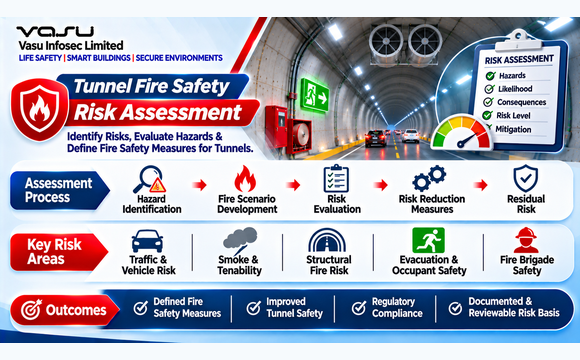
Tunnel Information → Hazard Identification → Fire Scenario Development → Frequency / Likelihood Assessment → Consequence Assessment → Existing Safeguards → Risk Evaluation → Risk Reduction Measures → Residual Risk → Approval / Acceptance → Verification & Review
3. Risk Assessment Philosophy
The risk assessment should be proportionate to the tunnel complexity and hazards and should provide a traceable basis for fire-safety decisions. Assumptions, data sources, modelling methods, acceptance criteria, safeguards and residual risks should be clearly documented.
4. Tunnel Characteristics
The assessment should consider tunnel length, number of bores, cross-section, gradients, curves, portals, cross-passages, emergency exits, traffic direction, ventilation arrangement, service areas and adjacent infrastructure.
5. Traffic & Vehicle Risk
Vehicle type, traffic volume, traffic composition, congestion, vehicle breakdown, collision and hazardous vehicle incidents should be considered when developing credible tunnel fire scenarios.
6. Fire Hazard Identification
Potential ignition sources and combustible loads should be identified. These may include vehicle fires, electrical equipment, cables, plant rooms, maintenance activities, fuel-related hazards and other tunnel-specific sources.
7. Fire Scenario Development
Representative fire scenarios should be developed from credible hazards and should consider fire location, fire size, growth, duration, smoke production, ventilation conditions, suppression response and occupant exposure.
8. Design Fire
Where quantitative analysis is required, an appropriate design-fire scenario should be established for the relevant tunnel application. The adopted assumptions should be documented and justified within the approved assessment.
9. Fire Frequency / Likelihood
Where a quantitative or semi-quantitative assessment is undertaken, the likelihood or frequency of relevant fire events should be established using suitable project data, historical information, recognised methodologies or documented engineering assumptions.
10. Consequence Assessment
Consequences may include fatalities, injury, smoke exposure, infrastructure damage, service interruption, traffic disruption, environmental effects and loss of critical tunnel functions. The assessment should identify the relevant consequence categories.
11. Occupant Risk
Occupant risk should consider the number and distribution of people, warning time, evacuation routes, travel distance, smoke conditions, vehicle entrapment and available emergency response.
12. Fire Brigade Risk
Emergency responder exposure should be considered in relation to access routes, heat, smoke, ventilation, structural conditions, firefighting water, communication and incident duration.
13. Smoke & Tenability Assessment
Where applicable, smoke movement, temperature, visibility and other tenability parameters should be assessed to determine the impact on evacuation and emergency response.
14. Structural Fire Risk
The assessment should consider the potential impact of fire on tunnel structural elements, linings, supports, services and other critical infrastructure. Required fire resistance should be linked to the identified fire scenarios and consequences.
15. Fire Detection Safeguards
Existing and proposed detection systems, including linear heat detection and other approved technologies, should be identified as risk-reduction measures. Their coverage, reliability and response should be considered in the assessment.
16. Fire Alarm Safeguards
Fire alarm systems should be assessed for their contribution to early warning, incident identification, operator notification and initiation of emergency actions.
17. Fire Suppression Safeguards
Hydrant, sprinkler, water mist or other suppression systems should be evaluated as risk-reduction measures where provided. The assessment should consider activation, water supply, coverage, reliability and effectiveness.
18. Smoke-Control Safeguards
Ventilation and smoke-extraction systems should be assessed for their ability to control smoke movement and support evacuation and emergency response under the relevant fire scenarios.
19. Evacuation Safeguards
Emergency exits, cross-passages, evacuation routes, signage, emergency lighting and communication systems should be assessed for their contribution to safe evacuation.
20. Emergency Communication Safeguards
Public-address, emergency telephones, help points, radio communication and control-room communication should be considered in relation to warning, coordination and emergency response.
21. CCTV & Incident Monitoring
CCTV and incident-monitoring systems should be assessed as supporting safeguards for rapid verification, operator awareness, incident location and emergency coordination.
22. Fire Brigade Access
Fire brigade entry points, emergency routes, cross-passages, hydrants and responder facilities should be assessed for accessibility and effectiveness during credible fire conditions.
23. Risk Evaluation
Identified risks should be evaluated against the project’s approved risk criteria. Where a risk is not acceptable, additional safeguards or design modifications should be identified and evaluated.
24. Risk Reduction Measures
Risk reduction may include improved detection, increased suppression capability, enhanced smoke control, additional emergency exits, improved communication, stronger compartmentation, improved fire brigade access, operational controls or changes to tunnel infrastructure.
25. ALARP / Residual Risk
Where an ALARP-based or equivalent risk framework is adopted by the project, residual risks should be demonstrated to be reduced to the approved level. The adopted acceptance methodology should be explicitly documented.
26. Reliability & Availability
Safety-critical systems should be assessed for failure modes, availability, redundancy and single points of failure. The risk assessment should consider credible failures of detection, power, communication, ventilation and suppression systems.
27. Emergency Power Risk
Loss of normal electrical power should be considered as a credible initiating or consequential event. Emergency-power arrangements for fire alarm, communication, lighting, ventilation and other critical systems should be assessed.
28. Interface Risk
Interfaces between fire detection, alarm, ventilation, suppression, CCTV, emergency communication, traffic management, access control and control-room systems should be assessed for potential failure or conflicting actions.
29. Operational Risk
Operational factors including maintenance activities, traffic management, tunnel closure procedures, emergency access, operator response and staff competency should be considered in the risk assessment.
30. Testing & Validation
Risk-control measures should be validated through inspection, testing, commissioning, integrated scenario testing, drills or other approved methods. Evidence should demonstrate that assumed safeguards are available and functional.
31. Installation Requirements
Risk-control implementation should verify:
- Complete hazard identification
- Credible fire scenarios
- Documented assumptions
- Defined risk criteria
- Detection coverage
- Alarm functionality
- Suppression capability
- Smoke-control performance
- Evacuation arrangements
- Emergency communication
- CCTV / incident monitoring
- Fire brigade access
- Emergency power
- System interfaces
- Residual-risk controls
32. Risk Assessment & Review
The assessment should be reviewed whenever significant changes occur to tunnel geometry, traffic conditions, fire loads, ventilation, detection, suppression, evacuation routes, emergency communication or operating procedures.
33. Documentation
Tunnel fire-safety risk assessment documentation should include, as applicable:
- Risk assessment methodology
- Tunnel description
- Hazard register
- Fire scenario register
- Design-fire assumptions
- Frequency / likelihood assessment
- Consequence assessment
- Smoke / tenability assessment
- Evacuation assessment
- Fire brigade response assessment
- Existing safeguards
- Risk matrix / acceptance criteria
- Risk-reduction measures
- Residual-risk register
- Interface assessment
- Emergency-power assessment
- Testing / validation records
- Review and approval records
34. Engineering Objective
The engineering objective is:
Understand Tunnel Characteristics → Identify Fire Hazards → Develop Credible Fire Scenarios → Assess Likelihood & Consequences → Evaluate Detection, Alarm, Suppression, Smoke Control & Evacuation Safeguards → Identify Risk Gaps → Implement Proportionate Risk-Reduction Measures → Evaluate Residual Risk → Validate Safeguards → Maintain a Controlled & Reviewable Tunnel Fire Safety Risk Profile
Frequently Asked Questions
What is a tunnel fire-safety risk assessment?
The answer depends on the approved tunnel fire-safety strategy, project design basis and specific system configuration. Refer to the relevant technical sections; do not infer project-specific values where they are not stated.
Which hazards and safeguards should be considered?
The answer depends on the approved tunnel fire-safety strategy, project design basis and specific system configuration. Refer to the relevant technical sections; do not infer project-specific values where they are not stated.
How should residual risk be documented?
The answer depends on the approved tunnel fire-safety strategy, project design basis and specific system configuration. Refer to the relevant technical sections; do not infer project-specific values where they are not stated.
SEO & Publishing Details
| SEO title | Tunnel Fire Safety Risk Assessment | Vasu Infosec Limited |
| Meta description | A tunnel fire-safety risk assessment identifies credible fire hazards, evaluates likelihood and consequences, reviews safeguards and establishes risk-reduction requirements to support the approved tunnel fire strategy. |
| Primary keyword | tunnel fire safety risk assessment |
| Secondary keywords | tunnel fire hazard identification, tunnel fire scenarios, tunnel smoke tenability assessment, tunnel fire risk reduction |
| Suggested URL slug | tunnel-fire-safety-risk-assessment |
| Suggested image alt text | Technical architecture and process flow for tunnel fire safety risk assessment. |