
Article
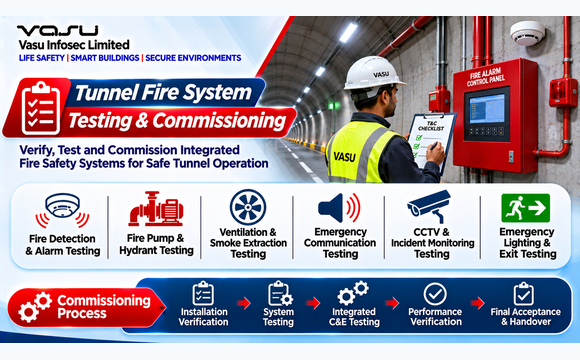
Tunnel Fire System Testing & Commissioning
Oct 2026
Direct Answer
Tunnel fire-system testing and commissioning verifies that installed systems perform in accordance with approved designs, specifications, cause-and-effect logic and project requirements, including interfaces and integrated emergency scenarios.
1. Engineering Overview
Tunnel Fire System Testing & Commissioning is the structured process of verifying that installed fire-safety systems perform in accordance with the approved design, specifications, cause-and-effect logic and project requirements. Testing should cover individual equipment, complete systems and integrated emergency scenarios.
2. Complete Testing & Commissioning Architecture
Approved Design → Installation Verification → Equipment Pre-Commissioning → Individual System Testing → Functional Testing → Interface Testing → Integrated Fire Scenario Testing → Performance Verification → Defect Rectification → Final Acceptance → Handover
3. Commissioning Philosophy
The commissioning philosophy should establish inspection stages, test responsibilities, prerequisites, test methods, acceptance criteria, documentation, witnessing requirements, integrated testing and final handover requirements.
4. Testing Documentation
Testing should be based on approved drawings, equipment schedules, calculations, specifications, cause-and-effect matrices, interface schedules, manufacturer’s requirements and approved method statements.
5. Pre-Commissioning Inspection
Before functional testing, the installation should be inspected for correct equipment, location, identification, wiring, pipework, valves, supports, power supply, communication links and accessibility.
6. Fire Detection Testing
Fire detection systems should be tested for detector operation, alarm initiation, zone identification, circuit integrity, controller operation, fault monitoring and communication with the fire alarm system.
7. Linear Heat Detection Testing
Where LHD is provided, testing should verify sensing-cable / fibre continuity, alarm response, zone identification, location information where applicable, controller operation and fault monitoring.
8. Fire Alarm Testing
Fire alarm testing should verify alarm inputs, panel operation, zone indication, audible / visual notification, network communication, event logging, fault indication and reset functions.
9. Hydrant System Testing
Hydrant testing should verify pipework integrity, valve operation, fire-pump operation, flow, pressure, hydrant accessibility and performance at the governing test condition.
10. Sprinkler System Testing
Sprinkler testing should verify control valves, flow switches, alarm transmission, pipework integrity, pump operation, pressure, flow and test-drain arrangements. Full discharge testing should follow the approved test methodology.
11. Water Mist System Testing
Water mist testing should verify detection / release logic, control valves, pumps, pressure, flow, nozzle arrangement, alarm interfaces and system faults. Discharge testing should follow the approved system-specific procedure.
12. Fire-Fighting Pump Testing
Fire-pump testing should verify automatic and manual start, main and standby pump operation, jockey-pump operation, pressure, flow, controller status, alarms and emergency power.
13. Smoke Extraction Testing
Smoke-extraction testing should verify fan operation, airflow, pressure, damper operation, status feedback, fire-mode activation and interface with fire alarm and control systems.
14. Ventilation Fire-Mode Testing
Fire-mode ventilation testing should verify jet-fan operation, smoke-extraction sequence, fan direction, damper positions, control priorities, manual override and emergency-power operation.
15. Emergency Communication Testing
Emergency communication testing should verify public-address operation, speaker zoning, speech intelligibility, emergency messages, emergency telephones / help points, radio communication where provided and control-room communication.
16. Emergency Lighting Testing
Emergency-lighting testing should verify normal-to-emergency transfer, luminaire operation, illumination, battery / UPS performance, emergency duration, circuit monitoring and control-room fault indication where provided.
17. CCTV & Incident Monitoring Testing
CCTV testing should verify camera operation, field of view, image quality, recording, playback, PTZ operation where provided, network connectivity, storage, alarm pop-up and integration with fire detection.
18. Fire Brigade Access Verification
Fire brigade access testing should verify entry points, emergency routes, cross-passages, doors, gates, barriers, hydrant access, emergency communication, lighting and access-control emergency override where provided.
19. Fire Compartmentation Inspection
Compartmentation verification should inspect fire-rated barriers, doors, cross-passages, penetration seals, fire / smoke dampers and service penetrations against approved drawings and specified requirements.
20. Cause & Effect Testing
Every approved cause-and-effect sequence should be tested from initiating input through the required output and status feedback. Testing should verify priority, time delay, reset logic and operator indication.
21. Interface Testing
Interfaces between fire detection, fire alarm, ventilation, smoke extraction, suppression, fire pumps, CCTV, emergency communication, emergency lighting, traffic management, access control and control-room systems should be tested as integrated functions.
22. Emergency Power Testing
Emergency-power testing should verify automatic transfer, standby source availability, battery / UPS autonomy where applicable, emergency lighting, communication, fire alarm, ventilation controls and other designated safety-critical loads.
23. Integrated Fire Scenario Testing
Representative tunnel fire scenarios should be simulated to verify the complete sequence from detection through alarm, ventilation, smoke control, suppression, emergency communication, CCTV, emergency lighting, traffic management, evacuation support and control-room response.
24. Performance Verification
Performance testing should compare measured results against approved design requirements, calculations and equipment data. Deviations should be documented and resolved before final acceptance.
25. Defect Management
All defects identified during testing should be recorded with reference number, description, responsibility, corrective action and closure status. Retesting should be performed after corrective action.
26. Witnessing & Acceptance
Required tests should be witnessed by designated project stakeholders, consultants, authorities or client representatives as applicable. Acceptance should be based on approved test procedures and documented results.
27. Installation Requirements
Testing and commissioning should verify:
- Correct equipment installation
- Correct identification and labelling
- Correct power supply
- Correct wiring / network connectivity
- Correct fire detection operation
- Correct fire alarm operation
- Correct hydrant / sprinkler / water mist operation
- Correct fire-pump operation
- Correct smoke-control operation
- Correct emergency communication
- Correct emergency lighting
- Correct CCTV monitoring
- Correct cause-and-effect logic
- Correct emergency-power operation
28. Final Testing & Handover
Final acceptance should confirm completion of functional testing, integrated scenario testing, defect closure, documentation, training, approved as-built drawings, test certificates, commissioning records and operation / maintenance information.
29. Training
Operators and maintenance personnel should receive appropriate training covering system operation, alarm response, fire-mode controls, emergency communication, ventilation, suppression, CCTV, emergency lighting, fault response and reset procedures.
30. Maintenance Baseline
Commissioning results should establish a baseline for future preventive maintenance and performance verification. Initial measured values, test results and equipment status should be retained for comparison during future inspections.
31. Documentation
Testing and commissioning documentation should include, as applicable:
- Approved commissioning plan
- Method statements
- Inspection checklists
- Equipment test certificates
- Fire detection test records
- Fire alarm test records
- Hydrant flow / pressure test reports
- Sprinkler test reports
- Water mist test reports
- Fire-pump performance reports
- Smoke-control test reports
- Emergency communication test reports
- Emergency lighting test reports
- CCTV test reports
- Cause-and-effect test sheets
- Interface test records
- Emergency-power test records
- Integrated fire scenario reports
- Defect / punch-list records
- Training records
- Final acceptance certificates
- As-built drawings
- O&M manual
32. Engineering Objective
The engineering objective is:
Verify Approved Design → Inspect Installation → Pre-Commission Equipment → Test Individual Fire Systems → Test Interfaces → Validate Cause & Effect → Conduct Integrated Fire Scenarios → Verify Performance & Emergency Power → Close Defects → Complete Training & Documentation → Obtain Final Acceptance → Establish Reliable Tunnel Fire-Safety Operation
Frequently Asked Questions
What is tunnel fire-system testing and commissioning?
The answer depends on the approved tunnel fire-safety strategy, project design basis and specific system configuration. Refer to the relevant technical sections; do not infer project-specific values where they are not stated.
Which systems and interfaces should be tested?
The answer depends on the approved tunnel fire-safety strategy, project design basis and specific system configuration. Refer to the relevant technical sections; do not infer project-specific values where they are not stated.
What records support final acceptance and handover?
The answer depends on the approved tunnel fire-safety strategy, project design basis and specific system configuration. Refer to the relevant technical sections; do not infer project-specific values where they are not stated.
SEO & Publishing Details
| SEO title | Tunnel Fire System Testing & Commissioning | Vasu Infosec Limited |
| Meta description | Tunnel fire-system testing and commissioning verifies that installed systems perform in accordance with approved designs, specifications, cause-and-effect logic and project requirements, including interfaces and integrated emergency scenarios. |
| Primary keyword | tunnel fire system testing |
| Secondary keywords | tunnel fire commissioning, integrated fire scenario testing, tunnel cause and effect testing, fire system handover documentation |
| Suggested URL slug | tunnel-fire-system-testing-commissioning |
| Suggested image alt text | Technical architecture and process flow for tunnel fire system testing & commissioning. |