
Article
Tunnel Water Mist System
Oct 2026
Direct Answer
A tunnel water mist system uses finely divided water droplets for fire-control and cooling functions. Technology, nozzles, pressure, water supply and release logic must follow the approved hazard and validated system design.
1. Engineering Overview
A Tunnel Water Mist System is a fixed fire-suppression system that uses finely divided water droplets to control fire development, cool the fire zone and reduce heat transfer. In tunnels, the system is engineered around the specific fire scenario, tunnel geometry, ventilation conditions, detection strategy, nozzle arrangement, water supply and required discharge performance.
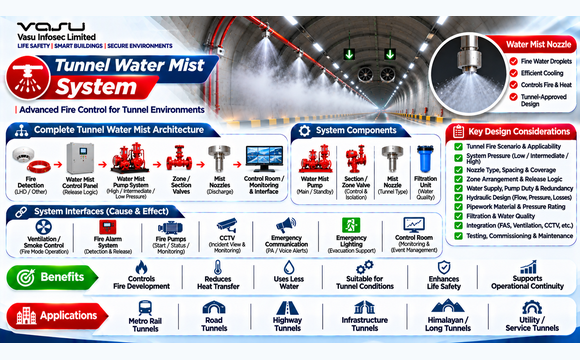
2. Complete Tunnel Water Mist Architecture
Fire Detection → Water Mist Control / Release Logic → Water Mist Pump / Pressure System → Water Supply → Distribution Pipework → Section / Zone Valves → Mist Nozzles → Fire Suppression
Supporting Systems → Control Panel → Pressure Monitoring → Flow Monitoring → Fire Alarm → Ventilation / Smoke Control → CCTV → Control Room → Emergency Power
3. Water Mist Fire Suppression Principle
Water mist systems discharge small water droplets through specially designed nozzles. The droplets absorb heat and can contribute to cooling and fire-control mechanisms appropriate to the selected system design.
4. Tunnel Application
Water mist may be used for specific tunnel fire scenarios where the approved fire strategy identifies it as an appropriate suppression or fire-control technology. The design should consider vehicle fire characteristics, tunnel dimensions, ventilation airflow and the required fire performance.
5. System Technology Selection
Water mist systems may be designed using different pressure levels, nozzle technologies, pump arrangements and control philosophies. The selected technology should be based on the approved hazard analysis, tested / validated system performance and project requirements.
6. Low, Intermediate & High Pressure Concepts
Water mist systems are commonly categorised by operating pressure. Pressure selection affects droplet characteristics, nozzle design, pipework, pump arrangement and system performance. The final pressure class should follow the selected manufacturer’s approved system design.
7. Water Mist Nozzles
Nozzles convert pressurised water into the required mist pattern. Nozzle type, orifice, spray angle, discharge coefficient and installation orientation should be selected according to the system design and validated performance.
8. Nozzle Spacing & Coverage
Nozzle spacing should provide the required discharge density and coverage for the protected tunnel zone. Spacing must consider tunnel cross-section, obstructions, mounting height, airflow and the manufacturer’s approved design limitations.
9. Zone Arrangement
The tunnel should be divided into water-mist protection zones based on fire risk, tunnel geometry and operational requirements. Each zone should have clearly defined boundaries, valves, nozzles, detection inputs and control outputs.
10. Detection & Release
The water mist system may be activated by dedicated detection, tunnel fire alarm signals or an approved combination of detection and release logic. The release sequence should be defined in the cause-and-effect matrix.
11. Pre-Action / Controlled Release
Where the approved design uses controlled or pre-action release, detection confirmation and valve-control logic should be coordinated to minimise unintended discharge while ensuring the required fire response.
12. Water Supply
The water supply should provide the required flow, pressure and duration for the governing water-mist zone. Storage and supply arrangements should be established from the approved hydraulic and system-performance design.
13. Water Mist Pump System
The pump system may include high-pressure or other specified pumps, standby arrangements, controllers, pressure regulation and monitoring. Pump duty should satisfy the required flow and pressure at the hydraulically governing condition.
14. Pump Redundancy
Critical tunnel water-mist systems should adopt the required pump redundancy and availability philosophy. Main, standby and other supporting equipment should be coordinated with the project fire-safety requirements.
15. Hydraulic Design
Hydraulic calculations should determine pipe sizes, flow rates, pressure losses, nozzle discharge, pump duty and the governing zone. The calculation should reflect the actual nozzle arrangement and manufacturer-specific system characteristics.
16. Pipework System
Water mist pipework should be suitable for the system pressure, water quality, corrosion environment and installation arrangement. Pipe material, joining method and pressure rating should be compatible with the selected system.
17. Section / Zone Valves
Zone valves provide controlled water supply to designated mist sections. Valves should be accessible, monitored and suitable for the system operating pressure.
18. Filtration & Water Quality
Where required by the selected water-mist technology, filtration should protect small nozzle orifices from blockage. Water quality and filtration requirements should follow the approved manufacturer’s system design.
19. Fire Alarm Interface
Water mist activation, valve status, pump status, fault and other designated signals should interface with the tunnel fire alarm system or control room as defined in the approved interface matrix.
20. Ventilation Interface
Water mist operation should be coordinated with the tunnel ventilation and smoke-control strategy. The cause-and-effect matrix should define the relationship between mist discharge and ventilation operation.
21. CCTV Interface
Water mist activation may trigger relevant CCTV camera selection or incident display at the control room where integrated. The interface should support rapid verification and incident management.
22. Emergency Power
Water mist control, detection, monitoring and other required safety-critical equipment should be connected to the approved emergency / standby power arrangement. Pump power requirements should be assessed separately within the fire-water resilience strategy.
23. Installation Requirements
Installation should verify:
- Correct water mist technology
- Correct pressure class
- Correct nozzle type
- Correct nozzle spacing and orientation
- Correct protection zoning
- Correct pipework rating
- Correct pump capacity and redundancy
- Correct zone valves
- Correct filtration where required
- Correct detection / release logic
- Correct fire alarm and control-room interface
- Correct ventilation interface
- Proper identification and accessibility
24. Testing & Commissioning
Water mist commissioning should verify:
- Visual installation inspection
- Pipework integrity / pressure testing
- Nozzle condition and orientation
- Valve operation
- Pump automatic and manual operation
- Pressure and flow performance
- Detection / release sequence
- Fire alarm interface
- Ventilation interface
- CCTV / control-room interface
- Alarm and fault monitoring
- Emergency power operation
25. Discharge Testing
Where full discharge testing is permitted and required, testing should verify the intended nozzle operation, flow distribution and system response without compromising the installed equipment. Otherwise, approved functional and simulated discharge tests should be used according to the system design.
26. Integrated Fire Scenario Testing
Representative tunnel fire scenarios should verify the sequence from detection through water-mist release, pump operation, alarm annunciation, ventilation response and control-room monitoring. Testing should follow the approved cause-and-effect matrix.
27. Maintenance
Maintenance should include inspection and testing of nozzles, pipework, pumps, valves, filters, pressure instruments, control panels, detection interfaces and monitoring systems. Nozzle blockage, corrosion and mechanical damage should be specifically checked.
28. Failure & Recovery
The system should be assessed for pump failure, valve failure, blocked nozzles, pipe leakage, pressure loss, controller failure, detection failure and loss of power. The approved standby and emergency response philosophy should provide appropriate recovery measures.
29. Design Change Control
Changes to tunnel geometry, ventilation, nozzle locations, ceiling / lining arrangement, fire detection, pipe routing, water supply or other suppression systems should trigger a water-mist coverage and hydraulic review.
30. Documentation
Tunnel water-mist documentation should include, as applicable:
- Water mist design philosophy
- Hazard / fire scenario assessment
- System architecture
- Nozzle layout
- Nozzle schedule
- Hydraulic calculation
- Pipe sizing schedule
- Pump schedule
- Water-storage calculation
- Zone-valve arrangement
- Detection / release philosophy
- Cause-and-effect matrix
- Interface matrix
- Testing and commissioning records
- Pressure / flow test reports
- Maintenance schedule
- As-built drawings
- O&M manual
31. Engineering Objective
The engineering objective is:
Assess Tunnel Fire Scenario → Establish Water Mist Applicability → Select Validated System Technology → Define Protection Zones → Design Nozzles, Pipework & Hydraulic Supply → Size Pumps & Storage → Integrate Detection, Alarm & Ventilation → Verify Flow, Pressure & Release Logic → Test Integrated Fire Scenarios → Maintain Reliable Tunnel Fire Suppression Capability
Frequently Asked Questions
What is a tunnel water mist system?
The answer depends on the approved tunnel fire-safety strategy, project design basis and specific system configuration. Refer to the relevant technical sections above; do not infer a project-specific value or requirement where it is not stated.
What determines nozzle spacing?
The answer depends on the approved tunnel fire-safety strategy, project design basis and specific system configuration. Refer to the relevant technical sections above; do not infer a project-specific value or requirement where it is not stated.
What should water mist commissioning verify?
The answer depends on the approved tunnel fire-safety strategy, project design basis and specific system configuration. Refer to the relevant technical sections above; do not infer a project-specific value or requirement where it is not stated.
SEO & Publishing Details
| SEO title | Tunnel Water Mist System | Vasu Infosec Limited |
| Meta description | A tunnel water mist system uses finely divided water droplets for fire-control and cooling functions. Technology, nozzles, pressure, water supply and release logic must follow the approved hazard and validated system design. |
| Primary keyword | tunnel water mist system |
| Secondary keywords | high pressure water mist tunnel, water mist nozzle layout, water mist hydraulic calculation, tunnel fire suppression |
| Suggested URL slug | tunnel-water-mist-system |
| Suggested image alt text | Technical architecture and process flow for tunnel water mist system. |