
Article
Turnstile Access Control
Oct 2026
Direct Answer
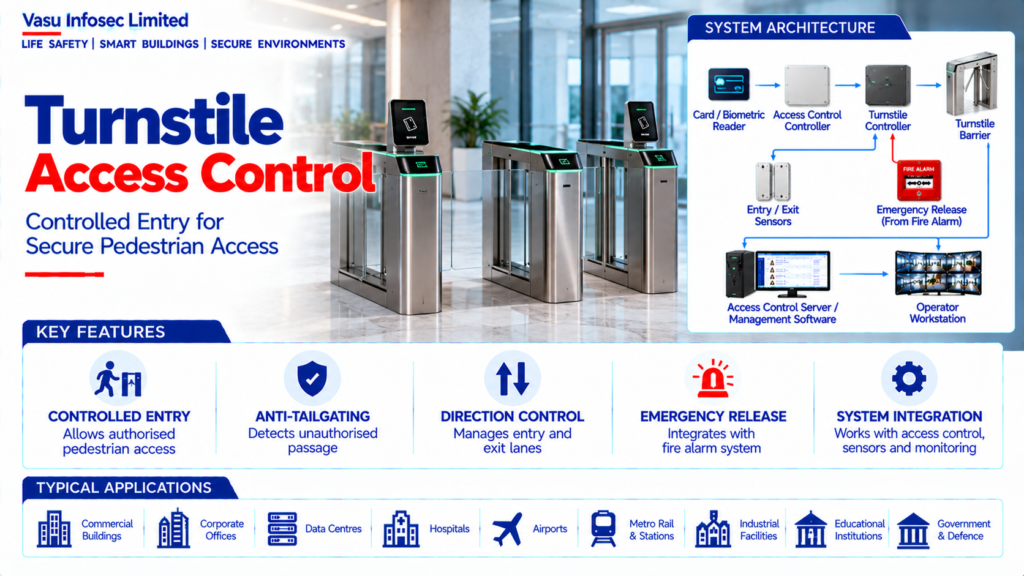
Turnstile Access Control is a controlled pedestrian-entry solution that regulates movement through defined lanes using authorised credentials and a physical barrier mechanism. It integrates readers, turnstile controllers, locking / barrier mechanisms, safety sensors, access control software and event monitoring.
1. Engineering Overview
Turnstile Access Control is a controlled pedestrian-entry solution that regulates movement through defined lanes using authorised credentials and a physical barrier mechanism. It integrates readers, turnstile controllers, locking / barrier mechanisms, safety sensors, access control software and event monitoring.
2. Complete Turnstile Architecture
Credential → Card / Biometric / QR / Approved Reader → Access Control Controller → Turnstile Controller → Turnstile Barrier
Entry / Exit Sensors → Turnstile Controller
Emergency Release / Fire Alarm → Approved Release Interface → Turnstile
Access Control Network → ACS Server / Management Software → Operator Workstation
Supporting Infrastructure → Power Supply / UPS → Controller → Turnstile
3. Working Principle
The user presents an authorised credential at the designated reader. The access control system validates the credential and, when access is granted, sends a release command to the turnstile. The turnstile permits passage through the authorised lane and then returns to its secured condition.
4. Turnstile Types
Common turnstile arrangements include tripod turnstiles, full-height turnstiles, flap barriers, swing gates and optical / speed gates. Selection should be based on security level, throughput, architectural requirements, accessibility and emergency-egress requirements.
5. Entry Lane Architecture
Each controlled entry lane should have the required reader, turnstile mechanism, lane sensors, access-control interface and status monitoring. Lane configuration should be coordinated with pedestrian flow and architectural layout.
6. Exit Lane Architecture
Exit lanes may use a reader, request-to-exit arrangement or free-exit configuration depending on the security strategy. Exit operation should be coordinated with emergency egress and the approved access-control philosophy.
7. Access Granted Sequence
Credential Presented → Credential Authenticated → Access Granted → Turnstile Unlocked / Enabled → User Passes → Passage Sensors Confirm Movement → Lane Returns to Secured State → Event Recorded.
8. Access Denied Sequence
Credential Presented → Credential Authentication → Access Denied → Turnstile Remains Secured → Denied Event Recorded → Operator Alarm / Notification, where configured.
9. Passage Detection
Turnstiles may use optical, infrared, mechanical or other approved sensors to detect passage through the lane. Sensor configuration should prevent unauthorised passage and identify abnormal movement conditions.
10. Tailgating Detection
Where required, the turnstile can support anti-tailgating functions using lane sensors and access-event correlation. The selected equipment should provide the required detection capability for the intended application.
11. Direction Control
The system may control permitted travel direction for each lane. Directional logic should be coordinated with entry / exit readers, occupancy requirements and the approved security strategy.
12. Anti-Passback Integration
Turnstiles can support anti-passback by correlating entry and exit transactions. The anti-passback logic should be configured in the central access-control platform according to the approved zone architecture.
13. Emergency Release
During an emergency, designated turnstiles should achieve the approved safe-release condition. Emergency release arrangements must be coordinated with the fire alarm system, evacuation strategy and applicable life-safety requirements.
14. Fire Alarm Integration
Where required, the fire alarm system should provide an approved signal to release designated turnstiles or place them into the defined emergency mode. The cause-and-effect and restoration sequence should be documented.
15. Emergency Manual Release
Where required, manual emergency-release devices should be provided and clearly identified. Their location and operation should support rapid evacuation and comply with the approved life-safety design.
16. Accessibility
Turnstile selection and lane arrangement should consider accessibility requirements, including suitable lane width, operating characteristics, user interface and provision of an appropriate accessible route where required.
17. Throughput & Capacity
Turnstile capacity should be evaluated based on expected peak pedestrian flow, authentication time, lane width and operating cycle. The number of lanes should be determined from the required throughput and site circulation.
18. Controller Integration
The turnstile should interface with the access control controller using the approved electrical and communication interface. Access granted, denied, lane status, alarms and emergency conditions should be appropriately mapped.
19. Power Supply & UPS
Turnstiles require suitable power for motors, controllers, readers, sensors and auxiliary equipment. Critical systems may require UPS support. Power capacity should include operating load and appropriate design margin.
20. Network Communication
Network-connected turnstile controllers should communicate with the access control server through the approved network. IP addressing, VLANs, communication protocols and cybersecurity controls should be defined.
21. Safety Features
Turnstiles should incorporate the safety features appropriate to the selected equipment, such as obstacle detection, anti-pinch protection, controlled movement and emergency release. Safety functions should be tested during commissioning.
22. Installation Requirements
Installation should verify:
- Correct turnstile type
- Correct lane configuration
- Correct reader interface
- Correct controller interface
- Correct passage sensors
- Correct emergency-release arrangement
- Correct fire alarm interface
- Correct power supply
- Correct network connectivity
- Correct accessibility provisions
- Correct mechanical alignment
- Proper cable routing and protection
23. Testing & Commissioning
Testing should verify:
- Valid credential access
- Invalid credential rejection
- Turnstile release
- Passage detection
- Direction control
- Tailgating detection, where applicable
- Anti-passback, where applicable
- Emergency release
- Fire alarm release
- Safety sensors
- Network communication
- Event logging
24. Failure & Recovery
Controlled tests should verify turnstile behaviour during power failure, controller communication loss, emergency release and sensor fault conditions. Recovery to the approved normal operating state should be confirmed.
25. Maintenance
Maintenance should include mechanical inspection, cleaning, sensor checks, reader checks, controller health checks, power-supply inspection, emergency-release testing, safety-function verification and review of system events.
26. Design Change Control
Changes to lane quantity, turnstile type, reader technology, access-control logic, fire alarm interface, emergency release or network architecture should be reviewed for security, safety and capacity impact.
27. Documentation
Turnstile documentation should include, as applicable:
- Turnstile schedule
- Lane layout
- Reader schedule
- Controller allocation
- Passage sensor details
- Emergency-release arrangement
- Fire alarm interface / cause-and-effect
- Power / UPS calculation
- Network / IP details
- Testing and commissioning records
- As-built drawings
- O&M manual
28. Engineering Objective
The engineering objective is:
Define Pedestrian Security Requirement → Establish Entry / Exit Lane Capacity → Select Turnstile Type → Integrate Readers & Controllers → Provide Passage & Safety Detection → Coordinate Fire Alarm & Emergency Release → Verify Accessibility & Throughput → Complete Testing → Establish Secure, Safe & Reliable Pedestrian Access Control
Frequently Asked Questions
What is turnstile access control?
Turnstile Access Control is a controlled pedestrian-entry solution that regulates movement through defined lanes using authorised credentials and a physical barrier mechanism. It integrates readers, turnstile controllers, locking / barrier mechanisms, safety sensors, access control software and event monitoring.
What should be checked before installation?
Confirm equipment compatibility, approved interfaces, power and network requirements, installation details, emergency or fault behaviour where applicable, and manufacturer instructions.
What should be tested during commissioning?
Test functions and scenarios identified in the source content and approved project procedures, including normal operation, alarms, integrations, power or communication failures where applicable, and restoration.
What documentation should be retained?
Retain applicable schedules, wiring and interface details, configuration records, test and commissioning records, as-built drawings and O&M documentation as required by the project.
SEO & Publishing Details
| SEO Title | Turnstile Access Control | Technical Guide | Vasu Infosec Limited |
| Meta Description | Turnstile Access Control is a controlled pedestrian-entry solution that regulates movement through defined lanes using authorised credentials and a |
| Primary Keyword | Turnstile Access Control |
| Secondary Keywords | Turnstile Access Control; access control system; electronic security; system architecture; installation and commissioning |
| Suggested URL Slug | turnstile-access-control |
| Suggested Image Alt Text | Technical architecture and key components of turnstile access control |