
Article
Vehicle Barrier Integration
Oct 2026
Direct Answer
Vehicle Barrier Integration is a security-control arrangement used to regulate vehicular entry and exit at controlled premises. The barrier system integrates vehicle identification, access-control logic, barrier operators, safety sensors, traffic signals, intercom / surveillance systems and central monitoring.
1. Engineering Overview
Vehicle Barrier Integration is a security-control arrangement used to regulate vehicular entry and exit at controlled premises. The barrier system integrates vehicle identification, access-control logic, barrier operators, safety sensors, traffic signals, intercom / surveillance systems and central monitoring.
2. Complete Vehicle Barrier Architecture
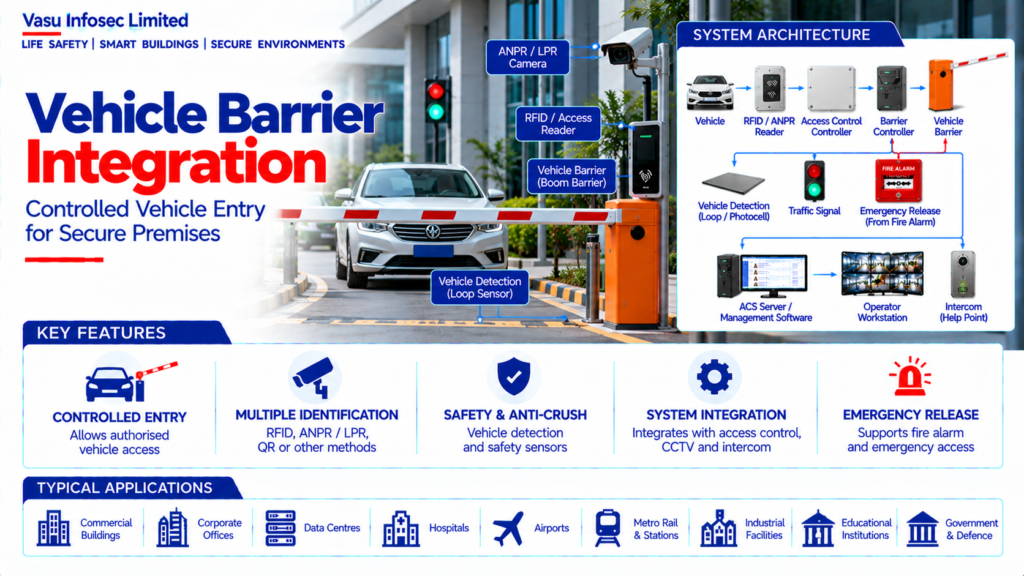
Vehicle → Credential / Vehicle Identification → Reader / Access Device → Access Control Controller → Barrier Controller → Vehicle Barrier
Safety Loop / Photocell / Vehicle Detection → Barrier Controller
Emergency Release / Fire Alarm → Approved Interface → Barrier Controller
Access Control Network → ACS Server / Management Software → Operator Workstation
CCTV / ANPR / Intercom → Security Control Room
Power Supply / UPS → Barrier Controller & Access Devices
3. Working Principle
A vehicle approaches the controlled lane and presents an authorised credential or is identified through the approved vehicle-identification system. The access-control system validates the access request and, when authorised, sends a command to the barrier controller to open the barrier.
4. Vehicle Identification Methods
Vehicle access may use RFID tags, proximity credentials, long-range readers, ANPR / LPR, QR credentials or other approved technologies. Selection should consider security level, vehicle flow, environmental conditions and project requirements.
5. Barrier Types
Common vehicle barriers include boom barriers, rising-arm barriers, sliding gates, swing gates and other approved vehicle-control mechanisms. Selection should consider lane width, vehicle type, operating frequency, security level and site layout.
6. Entry Lane Architecture
A controlled entry lane may include a vehicle identification device, access reader, barrier, safety loops, photocells, traffic lights, CCTV camera, intercom and access-control interface. Equipment should be coordinated to prevent unsafe or unauthorised vehicle movement.
7. Exit Lane Architecture
Exit lanes may use credential readers, ANPR, free-exit sensors or other approved methods. Exit logic should be coordinated with anti-passback, vehicle detection, emergency egress and site security requirements.
8. Access Granted Sequence
Vehicle Detected → Vehicle / Credential Identified → Access Authorised → Barrier Open Command → Barrier Raises → Vehicle Passes → Safety / Presence Detection → Barrier Closes → Event Recorded.
9. Access Denied Sequence
Vehicle / Credential Presented → Authentication → Access Denied → Barrier Remains Closed → Denied Event Recorded → Operator Notification, where configured.
10. Vehicle Detection
Inductive loops, radar, photocells, infrared sensors or other approved vehicle-detection devices may be used to identify vehicle presence and protect against premature barrier closure.
11. Safety & Anti-Crush Function
The barrier system should incorporate appropriate safety detection to prevent the barrier from closing onto vehicles or persons. Safety inputs and barrier movement logic should be verified during commissioning.
12. Barrier Controller
The barrier controller manages motor operation, opening / closing limits, safety inputs, access-control commands, emergency operation and status feedback. Controller capacity and interface compatibility should be verified.
13. Access Control Integration
The vehicle barrier should interface with the access-control system through approved dry-contact, relay, network or other compatible interfaces. Access granted, denied, barrier status and alarms should be mapped according to the approved architecture.
14. ANPR / LPR Integration
Where automatic number-plate recognition is provided, vehicle number plates may be matched against an authorised vehicle database. Camera positioning, lighting, plate visibility, lane geometry and recognition performance should be considered.
15. CCTV Integration
CCTV cameras may provide overview, identification and incident-recording coverage for vehicle lanes. Access events can be correlated with camera views through the approved CCTV / access-control integration.
16. Intercom Integration
An intercom or help-point system may be provided for visitor assistance or operator-controlled vehicle access. The communication system should be integrated with the security control room where required.
17. Anti-Passback Integration
Where vehicle anti-passback is required, entry and exit transactions should be correlated so that an authorised vehicle credential cannot be reused for an inconsistent movement sequence.
18. Fire Alarm & Emergency Release
Where required, vehicle barriers serving emergency access routes should respond to approved emergency conditions. Fire alarm integration and emergency opening requirements should be defined in the approved cause-and-effect matrix.
19. Manual Emergency Operation
Manual release or override arrangements should be provided where required. Emergency operation should be clearly identified, controlled and coordinated with the site’s security and life-safety strategy.
20. Power Supply & UPS
Barrier motors, controllers, readers, safety sensors and associated equipment require suitable power. UPS or backup power may be required for critical access lanes. Motor starting current and auxiliary loads should be considered.
21. Network Communication
Network-connected vehicle access equipment should communicate through the approved security network. IP addressing, VLANs, bandwidth, communication protocols and cybersecurity controls should be defined.
22. Installation Requirements
Installation should verify:
- Correct barrier type and lane width
- Correct reader / vehicle identification system
- Correct barrier controller
- Correct safety loops / sensors
- Correct photocell / obstacle detection
- Correct traffic signals
- Correct emergency release arrangement
- Correct fire alarm interface
- Correct power supply
- Correct network connectivity
- Correct CCTV / ANPR alignment
- Proper cable routing and protection
23. Testing & Commissioning
Testing should verify:
- Valid vehicle / credential access
- Invalid access rejection
- Barrier opening and closing
- Vehicle detection
- Safety / anti-crush function
- Loop / photocell operation
- Barrier status feedback
- ANPR / LPR operation, where applicable
- CCTV event correlation
- Emergency release
- Fire alarm interface
- Power interruption behaviour
- Event logging
24. Failure & Recovery
Controlled tests should verify barrier behaviour during power failure, controller communication loss, sensor failure and emergency release. The system should return to the approved normal operating condition after recovery.
25. Maintenance
Maintenance should include barrier mechanical inspection, motor and gearbox checks, boom / gate alignment, safety-sensor testing, reader checks, controller health, power-supply inspection, emergency release testing and event-log review.
26. Design Change Control
Changes to lane layout, barrier type, vehicle identification, safety sensors, access-control logic, fire alarm interface or network architecture should be reviewed for security, safety and capacity impact.
27. Documentation
Vehicle barrier documentation should include, as applicable:
- Barrier schedule
- Lane layout
- Vehicle identification schedule
- Controller allocation
- Safety sensor details
- Traffic signal details
- CCTV / ANPR details
- Emergency-release arrangement
- Fire alarm interface / cause-and-effect
- Power / UPS calculation
- Network / IP details
- Testing and commissioning records
- As-built drawings
- O&M manual
28. Engineering Objective
The engineering objective is:
Define Vehicle Security Requirement → Establish Entry / Exit Lane Architecture → Select Barrier & Vehicle Identification → Integrate Safety Detection → Integrate Access Control, CCTV / ANPR & Intercom → Coordinate Emergency Release → Verify Power & Network → Test Normal & Emergency Operations → Establish Secure, Safe & Reliable Vehicle Access Control
Frequently Asked Questions
What is vehicle barrier integration?
Vehicle Barrier Integration is a security-control arrangement used to regulate vehicular entry and exit at controlled premises. The barrier system integrates vehicle identification, access-control logic, barrier operators, safety sensors, traffic signals, intercom / surveillance systems and central monitoring.
What should be checked before installation?
Confirm equipment compatibility, approved interfaces, power and network requirements, installation details, emergency or fault behaviour where applicable, and manufacturer instructions.
What should be tested during commissioning?
Test functions and scenarios identified in the source content and approved project procedures, including normal operation, alarms, integrations, power or communication failures where applicable, and restoration.
What documentation should be retained?
Retain applicable schedules, wiring and interface details, configuration records, test and commissioning records, as-built drawings and O&M documentation as required by the project.
SEO & Publishing Details
| SEO Title | Vehicle Barrier Integration | Technical Guide | Vasu Infosec Limited |
| Meta Description | Vehicle Barrier Integration is a security-control arrangement used to regulate vehicular entry and exit at controlled premises. The barrier system |
| Primary Keyword | Vehicle Barrier Integration |
| Secondary Keywords | Vehicle Barrier Integration; access control system; electronic security; system architecture; installation and commissioning |
| Suggested URL Slug | vehicle-barrier-integration |
| Suggested Image Alt Text | Technical architecture and key components of vehicle barrier integration |