
Article
Visitor Management System
Oct 2026
Direct Answer
A Visitor Management System (VMS) is an electronic security and administration platform used to manage visitor registration, identification, host notification, access authorisation, badge issuance, movement tracking and visitor records. It can integrate with access control, CCTV, intercom, identity verification and other approved security systems.
1. Engineering Overview
A Visitor Management System (VMS) is an electronic security and administration platform used to manage visitor registration, identification, host notification, access authorisation, badge issuance, movement tracking and visitor records. It can integrate with access control, CCTV, intercom, identity verification and other approved security systems.
2. Complete Visitor Management Architecture
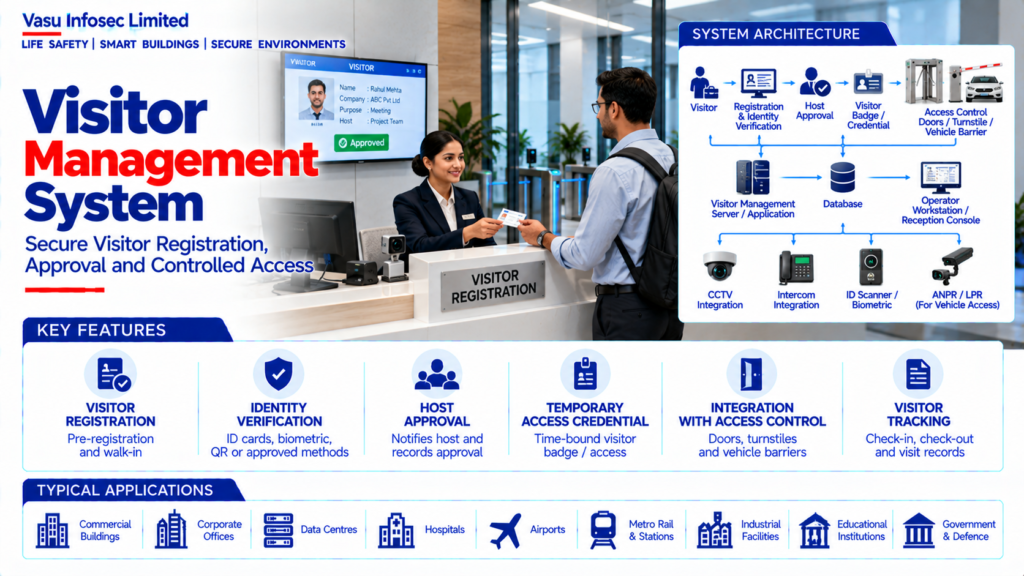
Visitor → Registration / Reception → Identity Verification → Host / Visit Approval → Visitor Credential / Badge → Access Control → Controlled Door / Turnstile / Barrier
Visitor Management Server / Application → Database → Operator Workstation / Reception Console
Access Control ↔ Visitor Management
CCTV / Intercom / ID Scanner ↔ Visitor Management
Supporting Infrastructure → Network → Power / UPS → Cybersecurity
3. Visitor Registration
Visitor information should be captured through the approved registration process. Information collected should be limited to the requirements of the organisation, security policy and applicable data-handling requirements.
4. Pre-Registration
Where supported, hosts may create visitor invitations in advance. The system can assign the visit date, time, location, host and approved access requirements before the visitor arrives.
5. Walk-In Registration
For walk-in visitors, reception or security personnel can create the visit record after obtaining the required identification and host information. Approval should follow the site’s visitor-management policy.
6. Identity Verification
Identity verification may use government-approved identification, organisation-approved credentials, QR codes, biometric verification or other approved methods. The verification method should be selected according to the site’s security requirements.
7. Host Notification
The system may notify the host through approved communication methods when a visitor arrives. The host response can be recorded as approved, rejected or otherwise handled according to the configured workflow.
8. Visitor Approval Workflow
Typical sequence:
Visitor Registration → Identity Verification → Host / Security Approval → Visit Authorised → Visitor Badge Issued → Access Granted → Visit Monitoring → Check-Out → Visitor Record Closed.
9. Visitor Badge Architecture
Visitor badges may include printed identification, QR codes, barcodes, proximity credentials or other approved temporary credentials. Badge permissions should be limited to the authorised visit period and access areas.
10. Temporary Access Credential
Where integrated with access control, the visitor credential can be assigned temporary access rights. Access should automatically expire at the approved end of the visit or be revoked when the visitor checks out.
11. Access Control Integration
The visitor management system may interface with the access control platform to create or activate temporary visitor credentials and assign approved doors, zones and time schedules.
12. Turnstile Integration
Visitor credentials may be used at turnstiles to control pedestrian entry and exit. The visitor-management platform should exchange the required credential and visit-status information with the access control system.
13. Vehicle Visitor Management
Where vehicle access is included, the system may capture vehicle registration details and integrate with vehicle barriers, ANPR / LPR and parking-control systems according to the approved architecture.
14. CCTV Integration
CCTV may be used to verify visitor activity, reception events and controlled-area movement. Visitor events can be correlated with camera views where the approved VMS / CCTV integration supports it.
15. Intercom Integration
Intercom systems may support visitor-host communication and remote approval. The integration should be configured according to the approved security and communication workflow.
16. Access Zones & Time Schedules
Visitor permissions should be limited to approved zones and time periods. Restricted areas should not be included unless specifically authorised.
17. Escort Management
For high-security or restricted areas, the system may record the assigned escort and require the visitor to remain accompanied. Escort requirements should be defined in the approved visitor policy.
18. Visitor Check-In
At arrival, the system should verify the approved visit, complete the required identity checks and issue the authorised visitor credential / badge before granting access.
19. Visitor Check-Out
At departure, the visitor should be checked out and any temporary credential or badge should be deactivated or returned as applicable. The visit record should be closed with the appropriate timestamp.
20. Overstay & Expired Visits
The system may identify visitors whose authorised visit period has expired or who have not completed check-out. Security personnel should be able to review and manage these events.
21. Visitor Database
Visitor records should be stored in the approved database with appropriate access restrictions, retention settings and audit controls. Data retention should follow organisational policy and applicable requirements.
22. Data Protection & Privacy
Visitor information, identification details, photographs and other collected data should be protected against unauthorised access, disclosure or modification. Collection and retention should follow applicable organisational, contractual and legal requirements.
23. Cybersecurity
The visitor management platform should use secure authentication, role-based permissions, protected network communication, controlled administrative access, configuration backup and appropriate system-hardening measures.
24. Server & Application Architecture
The visitor management application may operate on a dedicated or virtualised server depending on the approved solution. Server capacity should consider visitor volume, concurrent transactions, database size, integrations and retention requirements.
25. Network Architecture
Visitor management workstations, kiosks, badge printers, scanners and integrated access-control systems should communicate through the approved network. IP addressing, VLANs, firewall rules and required ports should be documented.
26. Power & UPS
Reception workstations, visitor kiosks, servers, network equipment and critical access-control interfaces should have suitable power. UPS support should be provided where required for continuity of visitor processing and security operations.
27. Installation Requirements
Installation should verify:
- Correct visitor management platform
- Correct registration workstation / kiosk
- Correct ID scanner / reader
- Correct badge printer
- Correct access-control interface
- Correct visitor credential configuration
- Correct host notification workflow
- Correct network connectivity
- Correct server / database configuration
- Correct CCTV / intercom integration, where applicable
- Correct power / UPS arrangement
- Proper cable routing and identification
28. Testing & Commissioning
Testing should verify:
- Visitor registration
- Identity verification
- Pre-registration
- Host notification
- Visitor approval / rejection
- Badge issuance
- Temporary credential activation
- Access-control integration
- Visitor check-in
- Visitor check-out
- Credential expiry
- Overstay / expired visit alert
- Reporting and event logging
- Data access permissions
29. Maintenance
Maintenance should include application health checks, database verification, workstation and kiosk checks, badge-printer inspection, scanner checks, access-control interface verification, backup verification, user-access review and cybersecurity checks.
30. Design Change Control
Changes to visitor workflows, access-control integration, credential types, visitor zones, retention requirements, identity-verification methods or system architecture should be reviewed before implementation.
31. Documentation
Visitor management documentation should include, as applicable:
- Visitor management architecture
- Workflow diagram
- Visitor registration procedure
- User / role matrix
- Visitor credential schedule
- Access zone matrix
- Access-control interface details
- CCTV / intercom integration details
- Data retention requirements
- Network / IP details
- Testing and commissioning records
- Backup / recovery procedure
- As-built documentation
- O&M manual
32. Engineering Objective
The engineering objective is:
Define Visitor Security Requirement → Establish Registration & Approval Workflow → Select Visitor Management Platform → Integrate Identity Verification & Temporary Credentials → Integrate Access Control / Turnstile / Barrier → Provide CCTV & Intercom Integration → Establish Data Protection → Test Check-In, Access & Check-Out → Establish Secure, Controlled & Auditable Visitor Management
Frequently Asked Questions
What is visitor management system?
A Visitor Management System (VMS) is an electronic security and administration platform used to manage visitor registration, identification, host notification, access authorisation, badge issuance, movement tracking and visitor records. It can integrate with access control, CCTV, intercom, identity verification and other approved security systems.
What should be checked before installation?
Confirm equipment compatibility, approved interfaces, power and network requirements, installation details, emergency or fault behaviour where applicable, and manufacturer instructions.
What should be tested during commissioning?
Test functions and scenarios identified in the source content and approved project procedures, including normal operation, alarms, integrations, power or communication failures where applicable, and restoration.
What documentation should be retained?
Retain applicable schedules, wiring and interface details, configuration records, test and commissioning records, as-built drawings and O&M documentation as required by the project.
SEO & Publishing Details
| SEO Title | Visitor Management System | Technical Guide | Vasu Infosec Limited |
| Meta Description | A Visitor Management System (VMS) is an electronic security and administration platform used to manage visitor registration, identification, host |
| Primary Keyword | Visitor Management System |
| Secondary Keywords | Visitor Management System; access control system; electronic security; system architecture; installation and commissioning |
| Suggested URL Slug | visitor-management-system |
| Suggested Image Alt Text | Technical architecture and key components of visitor management system |