
Article
Water Mist Accumulator / Pressure Vessel
Oct 2026
Direct Answer
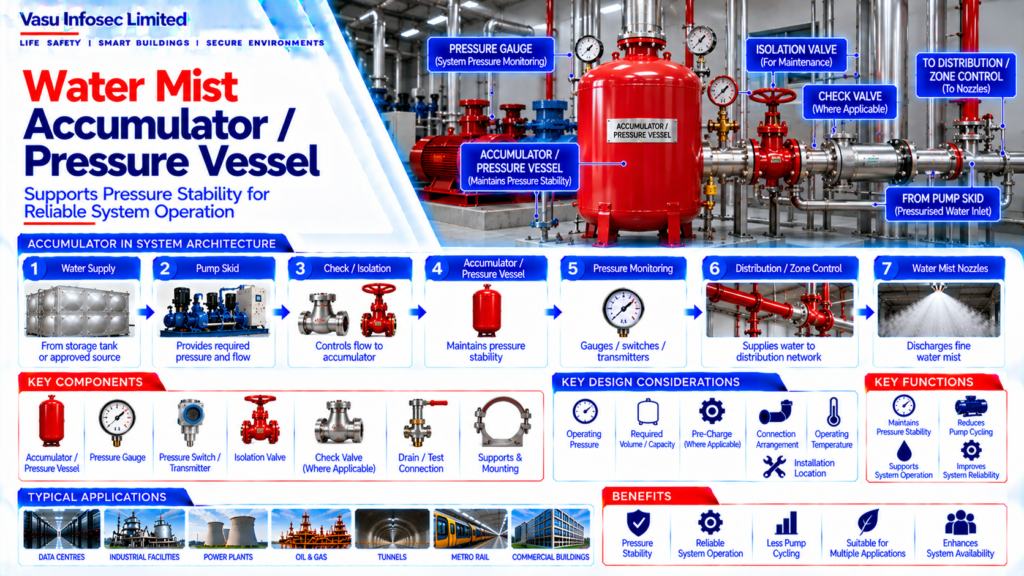
A water mist accumulator or pressure vessel is used in selected systems to support pressure stability, provide stored hydraulic energy, reduce pump cycling or support the approved operating sequence. Its use is system-specific: capacity, pressure rating, configuration and any pre-charge requirements must follow the approved manufacturer design rather than be assumed for every water mist system.
1. Engineering Overview
A water mist accumulator or pressure vessel is an engineered component used in selected water mist systems to support pressure stability, provide stored hydraulic energy, reduce pump cycling or support the approved system operating sequence. Its application, capacity, pressure rating and configuration should follow the approved manufacturer design.
2. Accumulator / Pressure Vessel Architecture
Water Source → Pump / Pressure Source → Check / Isolation Arrangement → Accumulator / Pressure Vessel → Pressure Monitoring → Distribution / Zone Control → Water Mist Nozzles
3. Purpose of the Accumulator
Depending on the approved system, an accumulator may support pressure maintenance, short-duration water demand, pump operation stability or other manufacturer-defined functions. It should not be treated as a generic component unless specifically required by the system design.
4. Vessel Selection Inputs
Selection should consider:
- System type
- Required operating pressure
- Design flow
- Required stored volume
- Pre-charge requirement, where applicable
- Maximum allowable working pressure
- Operating temperature
- Connection size
- Installation location
- Manufacturer requirements
5. Pressure Rating
The pressure vessel should have a pressure rating suitable for the maximum operating and test conditions of the water mist system. All associated valves, fittings, gauges and connections should be compatible with the vessel pressure rating.
6. Capacity Selection
Accumulator capacity should be established from the approved system design and manufacturer calculation. The required volume may depend on the pressure maintenance philosophy, pump characteristics and intended hydraulic function.
7. Pre-Charge Arrangement
Where a bladder or gas-charged accumulator is used, the specified pre-charge condition should be established by the manufacturer and approved design. Pre-charge verification should be carried out using the appropriate maintenance procedure.
8. Vessel Material & Construction
The vessel construction and internal arrangement should be suitable for the intended water service, operating pressure and environmental conditions. Material selection should follow the approved manufacturer specification.
9. Connection Arrangement
The vessel connection should be coordinated with the pump skid and distribution system. Isolation, check, drain and pressure monitoring components should be arranged as required by the approved design.
10. Pressure Monitoring
Pressure gauges, switches or transmitters may be provided to monitor vessel and system pressure. Monitoring points should be positioned and configured according to the approved control philosophy.
11. Pump Coordination
The accumulator should be coordinated with the pump operation. Where the vessel supports pressure maintenance, pump start / stop settings and pressure thresholds should be compatible with the approved system sequence.
12. Zone Control Coordination
Where the accumulator forms part of a zoned system, its operation should be coordinated with the zone control arrangement and the required pressure response during system activation.
13. Installation Location
The vessel should be installed in an accessible location suitable for inspection and maintenance. The installation should provide adequate clearance, secure support and protection from physical damage.
14. Supports & Restraints
The pressure vessel and associated piping should be securely supported. Mounting arrangements should account for the vessel mass, operating condition and applicable mechanical loads.
15. Safety & Protection
The vessel should be protected from conditions that could exceed its approved operating limits. Relief and protective devices, where required, should be selected and installed in accordance with the approved design and manufacturer requirements.
16. Inspection & Maintenance
Inspection may include:
- Vessel condition
- Pressure rating identification
- Leakage inspection
- Connection condition
- Pressure gauge condition
- Pre-charge verification, where applicable
- Valve condition
- Corrosion / physical damage
- Support condition
17. Testing & Commissioning
Commissioning should verify:
- Correct vessel installation
- Pressure condition
- Pump coordination
- Pressure monitoring
- Valve operation
- Leakage condition
- System response
- Zone operation
- Alarm / interface signals
18. Design Change Control
Any change to accumulator capacity, vessel rating, connection arrangement, pump configuration or system operating pressure should be reviewed against the approved hydraulic design and manufacturer requirements.
19. Documentation
Accumulator / pressure vessel documentation should include, as applicable:
- Vessel datasheet
- Capacity details
- Pressure rating
- Manufacturer certificate
- Pre-charge information
- GA / installation drawing
- Valve and instrument details
- Hydraulic calculation
- Inspection records
- Testing / commissioning records
- O&M documentation
20. Engineering Objective
The engineering objective is:
Correct System Assessment → Appropriate Vessel Capacity → Verified Pressure Rating → Suitable Pre-Charge → Coordinated Pump & Valve Arrangement → Reliable Pressure Stability → Complete Inspection & Testing → Safe and Reliable Water Mist System Operation
Frequently Asked Questions
Is an accumulator required in every water mist system?
No. Its use and function depend on the approved system design and manufacturer requirements.
How is accumulator capacity selected?
Capacity should be established from the approved system design and manufacturer calculation, considering the intended hydraulic function and pressure-maintenance philosophy.
What pressure rating should the vessel have?
The vessel must be suitable for the system’s maximum operating and test conditions. Final ratings should be verified against approved design documents and manufacturer data.
Does every accumulator require a pre-charge?
Pre-charge requirements apply where a bladder or gas-charged accumulator is used. The specified condition and verification method should follow the approved design and manufacturer procedure.
What should be checked during inspection and commissioning?
As applicable, verify installation, pressure condition, pump coordination, monitoring, valve operation, leakage, system response, zone operation and alarm/interface signals.
SEO and Website Publishing Details
SEO title: Water Mist Accumulator and Pressure Vessel: Selection & Integration
Meta description: Understand water mist accumulator and pressure vessel functions, capacity selection, pressure ratings, pre-charge, pump coordination, inspection and commissioning.
Suggested URL slug: /engineering/water-mist-accumulator-pressure-vessel/
Primary keyword: water mist accumulator pressure vessel
Related keywords: water mist accumulator capacity, pressure vessel rating, water mist pump pressure stability, accumulator pre-charge, water mist pressure monitoring
Suggested internal links: Water Mist Pump Selection; Water Mist Pump Skid Architecture; Water Mist Pressure & Flow Calculation; Water Mist Zone Control Arrangement; Water Mist Piping Network Design.