
Article
Water Mist Coverage & Nozzle Spacing
Oct 2026
Direct Answer
Water mist coverage and nozzle spacing define the engineered arrangement of nozzles needed to provide the intended fire protection performance throughout the approved protected area. Coverage and spacing are application-specific and depend on nozzle technology, operating pressure, hazard geometry and validated manufacturer design criteria. Generic spacing values should not be applied without confirming compatibility with the selected nozzle and hazard.
1. Engineering Overview
Water Mist Coverage & Nozzle Spacing establishes the engineered arrangement of water mist nozzles required to provide the intended fire protection performance throughout the approved protected area. Coverage and spacing are application-specific and depend on nozzle technology, operating pressure, hazard geometry and validated manufacturer design criteria.
2. Coverage & Spacing Architecture
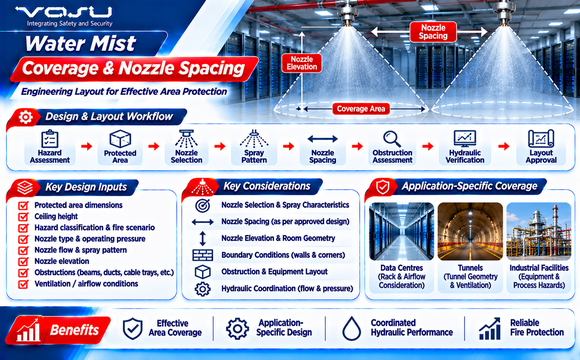
Hazard Assessment → Protected Area Definition → Nozzle Selection → Spray Pattern → Coverage Requirement → Nozzle Spacing → Obstruction Assessment → Hydraulic Verification → Layout Approval → Installation Inspection
3. Design Inputs
Typical design inputs include:
- Protected area dimensions
- Ceiling height
- Hazard classification
- Fire scenario
- Nozzle type
- Nozzle operating pressure
- Nozzle flow
- Spray pattern
- Nozzle elevation
- Obstructions
- Ventilation / airflow conditions
- Approved application criteria
4. Protected Area Definition
The protected area should be clearly identified from the approved fire protection strategy. Room boundaries, equipment locations, ceiling construction and other physical characteristics should be reflected in the nozzle layout.
5. Nozzle Selection
Nozzle selection should precede spacing development. The selected nozzle’s approved spray characteristics, pressure range, flow, discharge angle and application suitability should be considered when establishing the coverage arrangement.
6. Spray Pattern
The nozzle spray pattern determines the effective distribution of water mist. Spray angle, discharge direction and droplet characteristics should be coordinated with the protected geometry and the approved manufacturer’s design criteria.
7. Nozzle Spacing
Nozzle spacing should be established from the approved system design and application-specific testing / listing. Generic spacing values should not be applied without confirming compatibility with the selected nozzle and hazard.
8. Nozzle Elevation
Nozzle elevation affects the distribution of water mist and the effective coverage area. Ceiling height, mounting height and vertical separation from the protected hazard should be incorporated into the approved design.
9. Horizontal Coverage
Horizontal nozzle arrangement should provide the required distribution across the protected area. Spacing should account for room dimensions, spray pattern, boundary conditions and the approved coverage criteria.
10. Boundary Conditions
Nozzles near walls, corners and other boundaries may require different positioning from interior nozzles. The final arrangement should follow the approved manufacturer design to maintain the required coverage.
11. Obstruction Assessment
Obstructions that may interfere with water mist distribution should be identified during design.
Examples include:
- Beams
- Ducts
- Cable trays
- Large equipment
- Lighting fixtures
- Structural members
- Suspended ceilings
- Other services
12. Equipment Layout Coordination
Nozzle locations should be coordinated with the final equipment and service layout. Changes to equipment dimensions or locations may affect the approved water mist coverage and should be reviewed before implementation.
13. Ceiling-Mounted Arrangement
For ceiling-mounted systems, nozzle spacing should be coordinated with ceiling height, construction, beams, ducts and other overhead obstructions. The final layout should match the approved application-specific design.
14. Local / Equipment Protection
Where the water mist system provides local application protection, nozzle location should be established relative to the protected equipment or hazard. The spray pattern should cover the intended fire source in accordance with the approved design.
15. Tunnel Coverage
Tunnel applications require dedicated engineering based on tunnel geometry, fire scenario, ventilation, nozzle arrangement, zone length and application-specific testing. Spacing should follow the approved tunnel water mist design rather than generic room-based criteria.
16. Data Centre Coverage
For data centre applications, nozzle coverage should consider rack arrangement, ceiling configuration, cable spaces, airflow and sensitive equipment. The final spacing should be based on the approved water mist application and manufacturer criteria.
17. Hydraulic Coordination
Nozzle spacing directly affects the number of operating nozzles and hydraulic demand. The layout should therefore be coordinated with the hydraulic calculation to verify pressure and flow at the design nozzles.
18. Installation Requirements
Installation should verify:
- Correct nozzle type
- Correct nozzle location
- Correct spacing
- Correct elevation
- Correct orientation
- Clear discharge path
- Secure mounting
- Correct pipe connection
- No unauthorised obstruction
19. Testing & Commissioning
Coverage-related commissioning should verify the installed nozzle arrangement against approved drawings and calculations.
Checks may include:
- Nozzle quantity
- Nozzle spacing
- Nozzle elevation
- Nozzle orientation
- Obstruction clearance
- Hydraulic calculation conformity
- Zone operation
20. Design Change Control
Any change to room geometry, ceiling height, equipment arrangement, nozzle location, spacing or obstruction condition should be reviewed against the approved water mist design and hydraulic calculation before implementation.
21. Documentation
Coverage and spacing documentation should include, as applicable:
- Approved nozzle layout
- Nozzle schedule
- Nozzle datasheets
- Coverage criteria
- Hydraulic calculation
- Protected area drawings
- Obstruction coordination drawings
- Inspection records
- Testing / commissioning records
- As-built drawings
22. Engineering Objective
The engineering objective is:
Correct Hazard Assessment → Appropriate Nozzle Selection → Validated Spray Pattern → Optimised Nozzle Spacing → Obstruction-Free Distribution → Hydraulic Verification → Accurate Installation → Complete Inspection → Reliable Water Mist Coverage
Frequently Asked Questions
How is water mist nozzle spacing determined?
Spacing should follow the approved system design, selected manufacturer’s criteria and application-specific testing/listing. It depends on the nozzle, hazard geometry and operating conditions.
Why does nozzle selection come before spacing?
The nozzle’s approved spray characteristics, pressure range, flow, discharge angle and application suitability inform the coverage arrangement.
Which obstructions should be reviewed?
Review beams, ducts, cable trays, large equipment, lighting fixtures, structural members, suspended ceilings and other services that may interfere with water mist distribution.
Does tunnel spacing follow ordinary room criteria?
No. Tunnel applications require dedicated engineering based on tunnel geometry, fire scenario, ventilation, zone length, nozzle arrangement and application-specific testing.
How does spacing affect hydraulic design?
Spacing affects the number of operating nozzles and hydraulic demand. The layout must be coordinated with calculations to verify pressure and flow at design nozzles.
SEO and Website Publishing Details
| SEO title | Water Mist Coverage and Nozzle Spacing: Engineering Guide |
| Meta description | Learn how water mist nozzle coverage and spacing are developed using nozzle selection, spray patterns, obstructions, hazard geometry, hydraulic calculations and application-specific criteria. |
| Suggested URL slug | /engineering/water-mist-coverage-nozzle-spacing/ |
| Primary keyword | water mist coverage and nozzle spacing |
| Related keywords | water mist nozzle spacing; water mist nozzle coverage; water mist spray pattern; water mist hydraulic calculation; tunnel water mist coverage; data centre water mist design |
| Suggested internal links | Open vs Closed Water Mist Nozzles; Water Mist Nozzle Types and Applications; Water Mist Piping Network Design; Water Mist Pressure and Flow Calculation; Water Mist Deluge Arrangement. |