
Article
Water Mist Deluge Arrangement
Oct 2026
Direct Answer
A Water Mist Deluge Arrangement is an engineered open-nozzle system in which an approved detection and releasing sequence activates a zone control or deluge valve. Pressurised water then flows to the designated open water mist nozzles within the protected zone. The arrangement, hydraulic duty and operating sequence must follow the approved system design, hydraulic calculation and manufacturer requirements.
1. Engineering Overview
A Water Mist Deluge Arrangement is an engineered open-nozzle system in which a detection and releasing sequence activates a zone control or deluge valve, allowing pressurised water to flow simultaneously to the designated open water mist nozzles within the protected zone. The complete arrangement should follow the approved system design and manufacturer requirements.
2. Deluge System Architecture
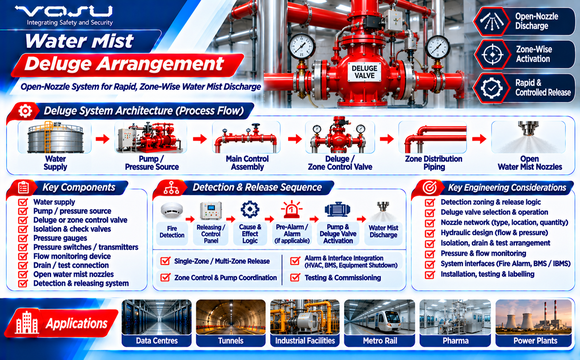
Water Supply → Pump / Pressure Source → Main Control Assembly → Deluge / Zone Control Valve → Zone Distribution Piping → Open Water Mist Nozzles
Detection System → Releasing / Control Panel → Deluge Valve Activation → Pump Start / Water Flow → Nozzle Discharge → Alarm & Interface Actions
3. Purpose of Deluge Arrangement
The deluge arrangement provides rapid water mist discharge over a defined protected zone following confirmed detection and release initiation. It is suitable where simultaneous discharge from multiple open nozzles is required by the approved fire protection strategy.
4. Major Components
A typical arrangement may include:
- Water supply
- Pump / pressure source
- Deluge or zone control valve
- Isolation valves
- Check valves, where applicable
- Pressure gauges
- Pressure switches / transmitters
- Flow monitoring device
- Drain / test connection
- Open water mist nozzles
- Detection and releasing system
5. Detection & Release Initiation
The detection system identifies the fire condition and sends the approved release signal to the releasing / control panel. The panel processes the Cause and Effect logic and initiates the appropriate deluge valve and pump sequence.
6. Deluge Valve Function
The deluge valve controls the water supply to the protected zone. When the approved release condition occurs, the valve opens and allows water to enter the zone distribution piping connected to the open water mist nozzles.
7. Zone Control Arrangement
Each deluge zone should be clearly defined and associated with its designated nozzle network. The zone control assembly should provide the required isolation, supervision, pressure monitoring and testing facilities.
8. Pump Activation
Pump activation should be coordinated with the deluge release sequence. The pump should provide the pressure and flow required by the hydraulic calculation for the operating zone.
9. Open Nozzle Network
Open nozzles remain available for immediate discharge when the zone valve opens. The nozzle quantity, type, location, orientation and operating pressure should correspond with the approved design and hydraulic calculation.
10. Hydraulic Design
The hydraulic calculation should verify the pressure and flow available at the design nozzles. The calculation should account for pipe sizes, lengths, fittings, valves, elevation differences and nozzle characteristics.
11. Deluge Zone Flow
The total design flow is based on the approved number of operating nozzles and their calculated flow characteristics. The pump and distribution network should be capable of satisfying the hydraulically most demanding deluge zone.
12. Alarm & Flow Monitoring
Flow or pressure monitoring devices may provide confirmation of water flow and system activation. Signals should be integrated with the fire alarm / releasing system as defined by the approved Cause and Effect Matrix.
13. Drain & Test Arrangement
The deluge assembly should include appropriate test and drain provisions where required by the approved design. These facilities should allow controlled testing and drainage without compromising normal system operation.
14. Isolation Arrangement
Isolation valves should be arranged to permit maintenance and testing of the deluge assembly. Any isolation or impairment should be controlled through the approved fire protection impairment procedure.
15. Pressure & Flow Monitoring
Pressure gauges, switches and transmitters should be installed where required to monitor the condition of the deluge system. Monitoring points should be accessible and coordinated with the control philosophy.
16. Installation Requirements
Installation should verify:
- Correct deluge / zone valve
- Correct valve orientation
- Correct piping connection
- Correct pressure instruments
- Correct drain / test arrangement
- Correct open nozzle locations
- Secure supports
- Correct detection wiring
- Correct identification / labelling
17. Testing & Commissioning
Deluge testing should verify:
- Detection activation
- Releasing logic
- Deluge valve operation
- Pump start
- Water flow
- Pressure response
- Alarm indication
- Flow monitoring
- Interface actions
- Drain / test operation
18. Design Change Control
Any change to the protected zone, nozzle quantity, piping route, valve arrangement, pump duty point or detection logic should be reviewed against the approved hydraulic calculation and Cause and Effect Matrix before implementation.
19. Documentation
Deluge documentation should include, as applicable:
- Deluge / zone control schematic
- Valve datasheet
- Valve schedule
- Hydraulic calculation
- Nozzle schedule
- Detection layout
- Cause and Effect Matrix
- Test and drain details
- Testing records
- Commissioning report
- As-built drawings
- O&M manual
20. Engineering Objective
The engineering objective is:
Reliable Detection → Correct Release Logic → Rapid Deluge Valve Operation → Adequate Pump Response → Controlled Zone Flow → Correct Open Nozzle Distribution → Verified Pressure & Flow → Complete Testing → Reliable Water Mist Deluge Protection
Frequently Asked Questions
What is a water mist deluge arrangement?
It is an open-nozzle arrangement in which the approved release sequence opens a zone/deluge valve and allows pressurised water to discharge through the designated nozzles in the protected zone.
How is the deluge zone flow determined?
It is based on the approved number of operating nozzles and their calculated flow characteristics. The hydraulic calculation should verify pressure and flow at the design nozzles.
What initiates the deluge valve?
The detection system sends a release signal to the releasing/control panel, which processes the approved Cause and Effect logic and initiates the valve and pump sequence.
What should be verified during commissioning?
As applicable, verify detection, releasing logic, valve operation, pump start, water flow, pressure response, alarms, flow monitoring, interface actions and drain/test operation.
What documents should be retained?
As applicable, retain the deluge/zone schematic, valve datasheet and schedule, hydraulic calculation, nozzle schedule, detection layout, Cause and Effect Matrix, test/drain details, testing records, commissioning report, as-built drawings and O&M manual.
SEO and Website Publishing Details
| SEO title | Water Mist Deluge Arrangement: Components, Operation & Design |
| Meta description | Learn how a water mist deluge arrangement operates, including detection, deluge valves, open nozzles, hydraulic flow, pump coordination, monitoring and commissioning. |
| Suggested URL slug | /engineering/water-mist-deluge-arrangement/ |
| Primary keyword | water mist deluge arrangement |
| Related keywords | water mist deluge valve; open nozzle water mist system; water mist zone control; water mist hydraulic calculation; deluge system commissioning |
| Suggested internal links | Water Mist System Complete Architecture; Water Mist Zone Control Arrangement; Water Mist Piping Network Design; Water Mist Pressure and Flow Calculation; Water Mist Pump Selection. |