
Article
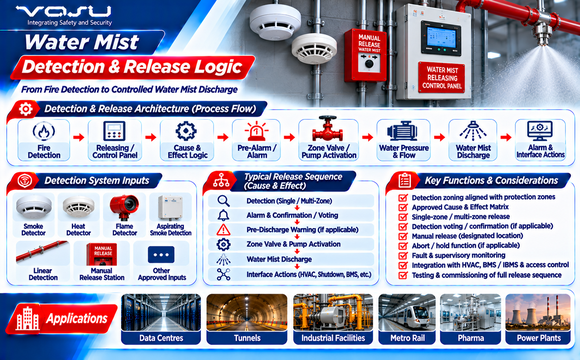
Water Mist Detection & Release Logic
Oct 2026
Direct Answer
Water mist detection and release logic defines how a fire condition is detected, evaluated and translated into controlled activation of the water mist system. Detection devices, releasing/control panels, zone control valves, pumps, alarms and building interfaces are coordinated through the approved Cause and Effect Matrix. The specific sequence, voting requirements, delays and interface actions must follow the approved system design.
1. Engineering Overview
Water Mist Detection & Release Logic defines how a fire condition is detected, evaluated and translated into the controlled activation of the water mist system. The logic coordinates detection devices, releasing / control panels, zone control valves, pumps, alarms and associated building interfaces in accordance with the approved Cause and Effect Matrix.
2. Detection & Release Architecture
Fire Detection → Detection Signal → Releasing / Control Panel → Cause & Effect Logic → Pre-Alarm / Alarm → Zone Activation → Valve / Pump Operation → Water Mist Discharge → Alarm & Interface Actions
3. Detection System Inputs
The detection system may use approved detection technologies appropriate to the protected hazard.
Typical inputs may include:
- Smoke detectors
- Heat detectors
- Flame detectors
- Linear detection
- Aspirating smoke detection
- Manual release station
- Other approved fire detection inputs
4. Detection Philosophy
Detection philosophy should be established from the hazard assessment and approved fire protection strategy. Detection arrangement, spacing, zoning and voting logic should be coordinated with the protected area and the water mist release philosophy.
5. Detection Zoning
Detection zones should correspond with the water mist protection zones where required. The zoning arrangement should clearly identify the protected area and provide reliable initiation of the appropriate water mist release sequence.
6. Releasing / Control Panel
The releasing / control panel receives detection inputs, processes the approved Cause and Effect logic and operates the required water mist system outputs. It may also provide alarm, fault, supervisory and interface indications.
7. Cause & Effect Logic
The Cause and Effect Matrix should define the response to each relevant input.
Typical sequence may include:
Detection → Alarm → Confirmation / Voting, where applicable → Pre-Discharge Warning → Zone Valve / Pump Activation → Water Mist Discharge → Interface Actions
8. Single-Zone Release
For a single-zone arrangement, the approved detection input may initiate the associated water mist release sequence. The system should ensure that the correct zone control equipment operates and that unintended discharge to other zones is prevented.
9. Multi-Zone Release
In multi-zone systems, detection inputs should be logically associated with the correct protected zone. The release logic should activate only the required zone unless the approved fire strategy specifies another operating sequence.
10. Detection Voting / Confirmation
Where the approved design uses confirmation or voting logic, the releasing panel should process the designated detection inputs before initiating water mist discharge. The exact voting arrangement should follow the approved Cause and Effect Matrix.
11. Manual Release
A manual release facility may be provided to initiate the water mist system from a designated location. The manual release arrangement should be clearly identified and integrated with the approved releasing sequence.
12. Abort / Hold Function
Where an abort or hold function is part of the approved system design, its operation should be coordinated with the release delay and Cause and Effect logic. The function should not be assumed unless specifically included in the approved system.
13. Pre-Discharge Warning
Where applicable, the release sequence may provide a pre-discharge warning through audible / visual notification before water mist activation. The warning sequence and delay should follow the approved Cause and Effect Matrix.
14. Pump Activation
Following the approved release command, the pump or pressure source should operate as required to establish the water pressure and flow necessary for the selected zone. Pump start logic should be coordinated with zone valve operation.
15. Zone Valve Activation
The zone control valve or deluge arrangement should operate in response to the approved release signal. Valve operation should establish the required water path to the protected zone.
16. Alarm & Interface Actions
Water mist activation may initiate:
- Fire alarm indication
- Audible / visual alarms
- HVAC shutdown / control
- Equipment shutdown
- BMS / IBMS status
- Access control actions
- Remote monitoring
17. Fault & Supervisory Logic
The system should monitor relevant fault and supervisory conditions.
Examples may include:
- Power supply fault
- Battery fault
- Detection circuit fault
- Releasing circuit fault
- Valve supervisory fault
- Pump fault
- Pressure fault
- Communication fault
18. Testing & Commissioning
Detection and release logic should be functionally tested without unintended water discharge where the approved test procedure permits simulation.
Testing may include:
- Detector activation
- Manual release
- Voting logic
- Pre-discharge warning
- Zone valve operation
- Pump start
- Alarm indication
- Interface signals
- Fault / supervisory signals
19. Design Change Control
Any change to detection devices, zoning, Cause and Effect logic, valve arrangement, pump sequence or building interfaces should be reviewed against the approved system design before implementation.
20. Documentation
Detection and release documentation should include, as applicable:
- Detection layout
- Releasing panel datasheet
- Cause and Effect Matrix
- Zone control schematic
- Detection zoning schedule
- Interface schedule
- Sequence of operation
- Testing records
- Commissioning report
- As-built drawings
- O&M manual
21. Engineering Objective
The engineering objective is:
Reliable Fire Detection → Correct Zone Identification → Controlled Cause & Effect Logic → Verified Release Decision → Correct Valve & Pump Activation → Effective Water Mist Discharge → Complete Alarm & Interface Response → Tested & Documented System Performance
Frequently Asked Questions
What determines the water mist release sequence?
The approved Cause and Effect Matrix, supported by the hazard assessment and approved fire protection strategy, determines the sequence.
Does every water mist system use detector voting?
No. Voting or confirmation logic should be used where it is included in the approved design; the exact arrangement must follow the approved Cause and Effect Matrix.
Are abort/hold and pre-discharge warning functions always required?
They should not be assumed. Include them only where they form part of the approved system design and Cause and Effect logic.
What should be checked during functional testing?
As applicable, detector activation, manual release, voting logic, pre-discharge warning, valve operation, pump start, alarms, interfaces and fault/supervisory signals.
What documents support commissioning and handover?
As applicable, detection layouts, panel datasheets, Cause and Effect Matrix, zone-control schematic, zoning and interface schedules, sequence of operation, testing records, commissioning report, as-built drawings and O&M manual.
SEO and Website Publishing Details
| SEO title | Water Mist Detection and Release Logic: System Sequence & Control |
| Meta description | Understand water mist detection inputs, releasing-panel logic, zone activation, pump and valve sequencing, alarms, interfaces, testing and documentation. |
| Suggested URL slug | /engineering/water-mist-detection-release-logic/ |
| Primary keyword | water mist detection and release logic |
| Related keywords | water mist release sequence; water mist cause and effect matrix; water mist zone control; releasing panel; water mist commissioning |
| Suggested internal links | Water Mist System Complete Architecture; High-Pressure Water Mist Working Principle; Water Mist Zone Control Arrangement; Water Mist Pump Skid Architecture; Water Mist Pressure and Flow Calculation. |