
Article
Water Mist for Data Centres
Oct 2026
Direct Answer
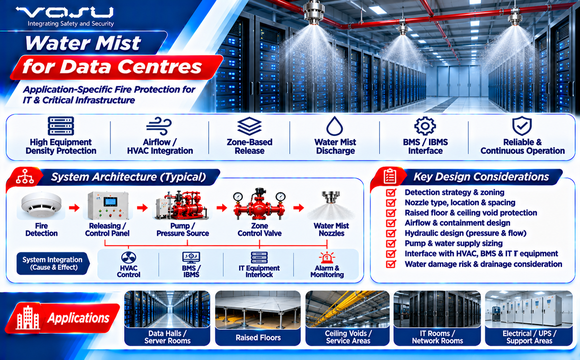
Water mist protection for data centres requires application-specific engineering because data halls contain high-value electronic equipment, dense cable infrastructure, controlled environmental conditions, and critical continuity requirements. The system should be selected and designed only where the approved water mist technology has demonstrated suitability for the intended data centre hazard.
1. Engineering Overview
Water mist protection for data centres requires application-specific engineering because data halls contain high-value electronic equipment, dense cable infrastructure, controlled environmental conditions and critical continuity requirements. The system should be selected and designed only where the approved water mist technology has demonstrated suitability for the intended data centre hazard.
2. Data Centre Water Mist Architecture
Fire Detection → Releasing / Control Logic → Water Mist Zone Activation → Pump / Pressure Source → Distribution Piping → Water Mist Nozzles → Fire Control / Suppression
Supporting Systems → BMS / IBMS → HVAC Interfaces → Equipment Shutdown / Interlocks → Alarm & Monitoring
3. Data Centre Hazard Characteristics
Typical engineering considerations include:
- High equipment density
- IT racks and servers
- Cable trays and underfloor cabling
- Raised floors
- Ceiling voids
- High-value electronic equipment
- Continuous operation requirements
- Airflow management
- Critical infrastructure redundancy
4. Fire Detection Strategy
Detection should be designed to provide reliable and timely identification of fire conditions. Depending on the approved fire strategy, systems may incorporate smoke detection, aspirating smoke detection, heat detection or other approved technologies.
5. Detection Zoning
Detection zones should be coordinated with the water mist protection zones and data centre fire strategy. The zoning should clearly identify the affected area and initiate the correct sequence of alarms, equipment interfaces and water mist release.
6. Water Mist System Selection
The selected water mist technology should be specifically suitable for the data centre hazard and supported by applicable manufacturer design criteria and fire performance evidence. System selection should consider equipment sensitivity, room geometry, airflow and required fire protection performance.
7. Nozzle Arrangement
Nozzle type, location, spacing, elevation and orientation should be established from the approved water mist design. Rack arrangement, ceiling height, cable trays, containment systems and other obstructions should be considered.
8. Raised Floor Protection
Where raised floors form part of the protected hazard, the fire strategy should determine whether dedicated detection and/or water mist protection is required. Any underfloor nozzle arrangement should be based on the approved application-specific design.
9. Ceiling & Void Protection
Ceiling voids, service spaces and other concealed areas should be assessed as part of the fire protection strategy. Where protection is required, nozzle arrangement and detection should be designed for the actual geometry and fire scenario.
10. Airflow Considerations
Data centres typically have significant mechanical airflow. Air movement, hot / cold aisle arrangements, containment systems and HVAC operation can influence smoke movement and water mist distribution. These conditions should be considered in the approved design.
11. Hydraulic Design
The hydraulic calculation should verify the required pressure and flow for the design operating condition. Pipe sizes, lengths, fittings, elevations, nozzle characteristics and the hydraulically most demanding zone should be included.
12. Pump & Water Supply
The pump / pressure source and water supply should be sized for the approved design condition. The system should provide the required flow and pressure while maintaining the intended availability and reliability of the data centre fire protection system.
13. Zone Control Arrangement
Data centre areas may be divided into zones based on room configuration, fire compartments, equipment areas and hydraulic requirements. Zone control valves and associated monitoring should be coordinated with the detection and release logic.
14. Interface with HVAC
The water mist system may interface with HVAC systems to control airflow during a fire event where required by the approved Cause and Effect Matrix. The sequence should be coordinated to avoid unintended effects on fire detection and suppression performance.
15. Interface with IT Equipment
Any equipment shutdown or interlock should be based on the approved fire strategy and Cause and Effect Matrix. Critical IT systems should not be shut down solely through assumptions; the final sequence should be approved by the relevant project stakeholders.
16. Water Damage Risk Consideration
Water mist uses significantly divided water droplets, but it remains a water-based fire protection system. Equipment sensitivity, drainage, containment and recovery considerations should be assessed during project design.
17. Installation Requirements
Installation should verify:
- Correct nozzle type and location
- Correct spacing and orientation
- Correct piping pressure rating
- Secure pipe supports
- Correct zone control valves
- Correct detection devices
- Correct pump skid installation
- Clear discharge paths
- Protection of sensitive equipment during installation
18. Testing & Commissioning
Commissioning should verify the complete data centre water mist system without causing unintended water discharge to operational IT equipment.
Testing may include:
- Detection testing
- Cause and Effect testing
- Zone valve operation
- Pump start
- Pressure / flow verification
- Alarm testing
- HVAC interface testing
- BMS / IBMS interface testing
- Fault / supervisory testing
19. Operational Readiness
Before final handover, the system should be verified for operational readiness. Approved procedures should define inspection, impairment management, emergency response, maintenance and restoration following system operation.
20. Documentation
Documentation should include, as applicable:
- Data centre fire protection design basis
- Water mist system schematic
- Hydraulic calculation
- Pump datasheets
- Nozzle schedule
- Zone control drawings
- Detection layout
- Cause and Effect Matrix
- Interface schedule
- Testing and commissioning records
- As-built drawings
- O&M manual
21. Engineering Objective
The engineering objective is:
Accurate Data Centre Hazard Assessment → Application-Suitable Water Mist Technology → Reliable Detection → Correct Zone Release → Engineered Nozzle Coverage → Verified Hydraulic Performance → Coordinated HVAC / BMS Interfaces → Controlled Fire Event → Protected Critical Infrastructure → Reliable System Availability
Frequently Asked Questions
Is water mist automatically suitable for every data centre?
No. The selected technology should be demonstrated as suitable for the intended hazard and supported by applicable manufacturer design criteria and fire-performance evidence.
Does water mist eliminate water-damage risk to IT equipment?
No. Water mist is still a water-based fire protection system. Equipment sensitivity, drainage, containment and recovery should be assessed during project design.
Should raised floors and ceiling voids be protected?
The approved fire strategy should determine whether dedicated detection and/or water mist protection is required for raised floors, ceiling voids and other concealed spaces.
Can the water mist system shut down IT equipment or HVAC automatically?
Any shutdown or interlock sequence should follow the approved fire strategy and Cause and Effect Matrix and be approved by relevant project stakeholders.
What should be checked during commissioning?
As applicable, verify detection, Cause and Effect, zone valves, pump start, pressure/flow, alarms, HVAC and BMS/IBMS interfaces, and fault/supervisory functions. Avoid unintended water discharge to operational IT equipment.
Which documents should be available for handover?
As applicable, the design basis, schematic, hydraulic calculation, pump datasheets, nozzle schedule, zone-control drawings, detection layout, Cause and Effect Matrix, interface schedule, commissioning records, as-built drawings and O&M manual.
SEO and Website Publishing Details
| Publishing field | Recommended content |
| SEO title | Water Mist for Data Centres: Engineering Design Considerations |
| Meta description | Explore engineering considerations for water mist protection in data centres, including detection, zoning, nozzle layout, hydraulics, HVAC interfaces, commissioning and water-damage risk. |
| Suggested URL slug | /water-mist-for-data-centres/ |
| Primary keyword | water mist for data centres |
| Secondary keywords | data centre fire protection; water mist system design; water mist detection and zoning; raised floor fire protection; water mist commissioning; data centre HVAC interface |
| Suggested internal links | Water Mist System Design; Water Mist Detection and Release Logic; Water Mist Coverage and Nozzle Spacing; Water Mist Deluge Arrangement; Data Centre Fire Protection |
| Content type | Engineering knowledge article |