
Article
Water Mist for Tunnels
Oct 2026
Direct Answer
Water mist protection for tunnels requires application-specific engineering because tunnels present long, enclosed geometries, restricted access, ventilation effects, vehicle or equipment fire scenarios and demanding maintenance conditions. The system should be designed specifically for the tunnel configuration, fire scenario and approved fire protection strategy.
1. Engineering Overview
Water mist protection for tunnels requires application-specific engineering because tunnels present long, enclosed geometries, restricted access, ventilation effects, vehicle or equipment fire scenarios and demanding maintenance conditions. The water mist system should be designed specifically for the tunnel configuration, fire scenario and approved fire protection strategy.
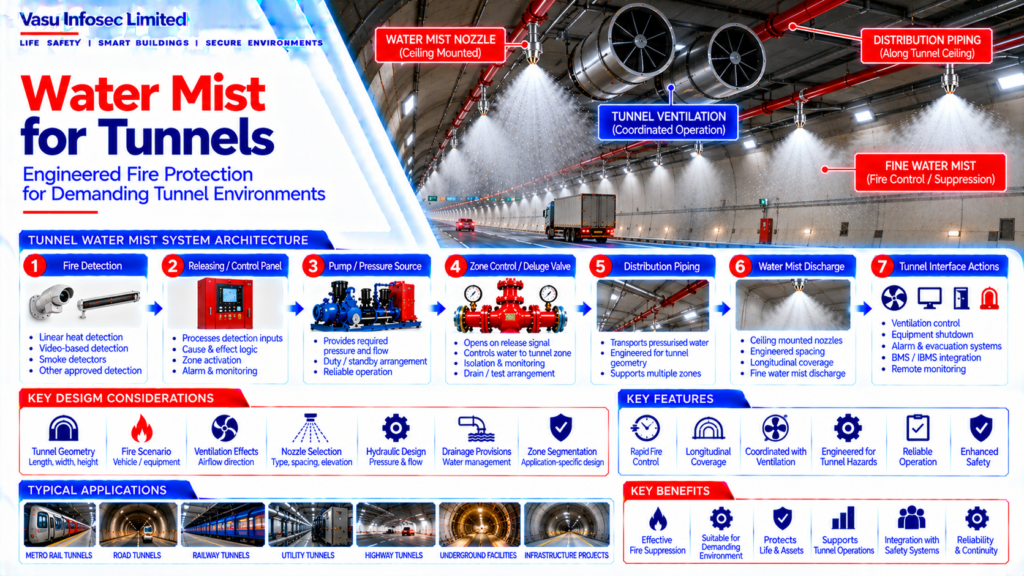
2. Tunnel Water Mist Architecture
Water Supply → Pump / Pressure Source → Main Distribution → Zone Control / Deluge Arrangement → Tunnel Distribution Piping → Water Mist Nozzles
Fire Detection → Releasing / Control Panel → Zone Activation → Pump / Valve Operation → Water Mist Discharge → Alarm & Tunnel Interface Actions
3. Tunnel Hazard Characteristics
Key engineering considerations may include:
- Tunnel length
- Tunnel cross-section
- Tunnel height and width
- Fire load
- Vehicle / equipment type
- Traffic arrangement
- Ventilation system
- Emergency access
- Drainage provisions
- Fire detection arrangement
- Zone segmentation
4. Fire Scenario Assessment
The design should establish the credible fire scenarios for the tunnel and determine the required water mist performance. Vehicle fires, equipment fires and other identified hazards should be evaluated according to the approved fire protection strategy and applicable project criteria.
5. Tunnel Zoning
The tunnel should be divided into water mist protection zones based on the approved design. Zone length, nozzle arrangement, hydraulic limitations, detection coverage and tunnel operational requirements should be coordinated.
6. Detection Strategy
Detection should provide timely identification of fire within the tunnel. Depending on the approved design, detection may include linear heat detection, video-based detection, smoke detection or other suitable technologies.
7. Detection & Release Logic
The approved Cause and Effect Matrix should define the sequence from fire detection to water mist activation.
Typical sequence:
Fire Detection → Alarm → Zone Identification → Release Command → Zone Valve / Deluge Activation → Pump Start → Water Mist Discharge → Tunnel Interface Actions
8. Tunnel Nozzle Arrangement
Nozzle type, spacing, elevation, orientation and zone distribution should be established from the approved tunnel water mist design. Tunnel geometry, ventilation, equipment and fire scenario should be considered.
9. Longitudinal Coverage
Water mist distribution in tunnels should be engineered for the tunnel’s longitudinal geometry. The final nozzle spacing and zone length should be based on the selected system’s approved design criteria and application-specific fire testing.
10. Tunnel Cross-Section
Nozzle arrangement should account for tunnel width, height, lining profile, services and equipment. The final arrangement should provide the required distribution without unacceptable obstruction.
11. Ventilation Effects
Tunnel ventilation can influence smoke movement, flame behaviour and water mist distribution. Ventilation mode, airflow direction, velocity and emergency operating sequence should be coordinated with the fire protection design.
12. Hydraulic Design
The hydraulic calculation should verify the required pressure and flow for the design tunnel zone. Pipe sizes, lengths, fittings, valves, elevations, nozzle characteristics and the hydraulically most demanding condition should be included.
13. Pump & Water Supply
The pump / pressure source and water storage should be sized for the approved tunnel design condition. The system should provide the required flow and pressure for the designated operating zone.
14. Zone Control / Deluge Arrangement
Where open nozzles are used, zone control or deluge valves should provide controlled water release to the designated tunnel section. Valve operation should be coordinated with detection, pump start and alarm logic.
15. Tunnel Drainage
Water mist discharge should be considered in conjunction with tunnel drainage arrangements. Drainage capacity, collection points and water management should be coordinated with the overall tunnel design where required.
16. Installation Requirements
Installation should verify:
- Correct pipe routing
- Correct pipe pressure rating
- Secure supports
- Correct valve arrangement
- Correct nozzle location and orientation
- Correct detection installation
- Adequate access for maintenance
- Protection from tunnel operational conditions
17. Testing & Commissioning
Testing should verify the complete tunnel water mist system.
Activities may include:
- Detection testing
- Zone release testing
- Pump operation
- Valve operation
- Pressure / flow verification
- Alarm testing
- Ventilation interface testing
- BMS / SCADA interface testing
- Cause and Effect testing
18. Operational & Maintenance Considerations
Tunnel systems require planned inspection and maintenance because access may be restricted and system impairment can affect operational safety. Maintenance procedures should address nozzle condition, piping, valves, pump equipment, detection, control panels and zone isolation.
19. Design Change Control
Any change to tunnel geometry, lining, services, ventilation, nozzle arrangement, piping route, zone boundaries or detection system should be reviewed for its effect on the approved water mist design and hydraulic calculation.
20. Documentation
Tunnel water mist documentation should include, as applicable:
- Tunnel fire protection design basis
- Tunnel zoning drawings
- Hydraulic calculation
- Pump datasheets
- Nozzle schedule
- Piping layouts / isometrics
- Detection layout
- Cause and Effect Matrix
- Interface schedule
- Testing and commissioning records
- As-built drawings
- O&M manual
21. Engineering Objective
The engineering objective is:
Tunnel Hazard Assessment → Application-Suitable Water Mist Technology → Reliable Detection → Correct Zone Identification → Engineered Nozzle Coverage → Verified Hydraulic Performance → Coordinated Ventilation & Interfaces → Effective Fire Control → Complete Testing → Reliable Tunnel Fire Protection
Frequently Asked Questions
What determines the design of a tunnel water mist system?
The approved tunnel configuration, credible fire scenarios, selected system design criteria, ventilation, zoning, detection and project requirements determine the design.
Can one nozzle spacing be used for every tunnel?
No universal spacing value is provided in this article. Final spacing and zone length should follow the selected system’s approved design criteria and application-specific fire testing.
Why must ventilation be coordinated with water mist?
Ventilation can affect smoke movement, flame behaviour and water mist distribution, so its operating modes and emergency sequence need to be coordinated with the fire protection design.
What should be checked during commissioning?
The article identifies detection, zone release, pump and valve operation, pressure/flow, alarms, ventilation and BMS/SCADA interfaces, and Cause and Effect testing as possible activities.
What happens if the tunnel design changes?
Changes to geometry, lining, services, ventilation, nozzle arrangement, piping, zones or detection should be reviewed for their effect on the approved design and hydraulic calculation.
SEO & Website Publishing Details
SEO title: Water Mist Systems for Tunnels: Design and Engineering Considerations
Meta description: Explore tunnel water mist engineering considerations, including hazard assessment, zoning, detection, nozzle coverage, ventilation, hydraulics, commissioning and maintenance.
Suggested URL slug: /engineering/water-mist-for-tunnels/
Primary keyword: water mist system for tunnels
Secondary keywords: tunnel fire protection; tunnel water mist design; water mist nozzle coverage; tunnel fire detection; water mist hydraulic calculation; tunnel ventilation interface
Suggested internal links: Water Mist Systems; Water Mist Detection and Release Logic; Water Mist Coverage and Nozzle Spacing; Water Mist Deluge Arrangement