
Article
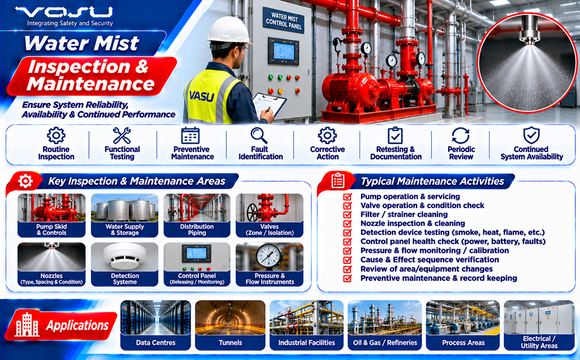
Water Mist Inspection & Maintenance
Oct 2026
Direct Answer
Water mist inspection and maintenance helps keep an installed system operational and available throughout its service life. Activities should follow the approved system design, manufacturer requirements, project maintenance philosophy and applicable requirements, including routine inspection, functional testing, preventive and corrective maintenance, retesting and documented restoration after impairment.
1. Engineering Overview
Water Mist Inspection & Maintenance ensures that the installed water mist system remains operational, available and capable of performing its intended fire protection function throughout its service life. Inspection and maintenance should follow the approved system design, manufacturer requirements, project maintenance philosophy and applicable requirements.
2. Inspection & Maintenance Cycle
Routine Inspection → Functional Testing → Preventive Maintenance → Fault Identification → Corrective Action → Retesting → Documentation → Periodic Review → Continued System Availability
3. Routine System Inspection
Routine inspection should identify physical damage, abnormal conditions, leakage, corrosion, contamination, faults or unauthorised modifications that may affect system performance.
4. Pump Skid Inspection
Inspection may include:
- Pump condition
- Pump control panel
- Motor / driver
- Suction arrangement
- Discharge arrangement
- Pressure gauges
- Pressure switches / transmitters
- Filters / strainers
- Valves
- Electrical connections
- Leakage / abnormal condition
5. Water Supply Inspection
Water storage and supply arrangements should be inspected for:
- Available water level
- Tank condition
- Valves
- Connections
- Leakage
- Contamination
- Accessibility
- Identification
6. Piping Inspection
The distribution network should be inspected for:
- Pipe damage
- Corrosion / deterioration
- Leakage
- Loose or damaged supports
- Incorrect routing
- Unauthorised modifications
- Physical obstruction
7. Valve Inspection
Zone control valves, isolation valves, deluge valves, check valves and associated components should be inspected for correct position, accessibility, physical condition and supervisory status.
8. Nozzle Inspection
Water mist nozzles should be inspected for:
- Correct type
- Physical damage
- Contamination
- Corrosion
- Displacement
- Incorrect orientation
- Obstruction
- Secure mounting
9. Detection System Maintenance
Detection devices associated with the water mist system should be inspected and functionally tested according to the approved maintenance procedure.
Activities may include:
- Smoke detection
- Heat detection
- Flame detection
- Linear detection
- Aspirating detection
- Manual release
10. Control Panel Maintenance
The releasing / control panel should be inspected for:
- Power supply status
- Battery condition
- Fault indications
- Alarm indications
- Releasing circuit condition
- Detection circuit condition
- Supervisory signals
- Communication status
11. Pressure & Flow Monitoring
Pressure gauges, switches, transmitters and flow monitoring devices should be checked for correct condition and indication. Where required, instruments should be calibrated or replaced according to the approved maintenance requirements.
12. Filter & Strainer Maintenance
Filters and strainers should be inspected and cleaned or serviced as specified by the manufacturer. Maintenance should prevent blockage that could restrict water flow to the nozzles.
13. Water Quality & Cleanliness
Where water quality requirements apply, the water supply and system condition should be monitored for contamination or conditions that may affect pump, valve or nozzle performance.
14. Functional Testing
Periodic functional testing should verify:
- Pump operation
- Zone valve operation
- Detection operation
- Alarm indication
- Releasing logic
- Pressure response
- Flow response
- Supervisory functions
- Interface signals
15. Cause & Effect Verification
The approved Cause and Effect Matrix should be reviewed and, where required, functionally tested to confirm that detection, alarm, valve, pump and interface actions remain consistent with the approved system design.
16. Enclosure & Area Changes
Protected areas should be reviewed for changes that may affect water mist performance.
Examples include:
- New equipment
- Ceiling modifications
- New partitions
- HVAC changes
- Cable trays
- Structural changes
- New obstructions
- Changes in hazard configuration
17. Preventive Maintenance
Preventive maintenance should identify and address potential failures before they affect system performance.
Activities may include:
- Pump servicing
- Valve servicing
- Filter cleaning
- Instrument checks
- Battery maintenance
- Detection maintenance
- Nozzle inspection
- Support inspection
18. Corrective Maintenance
Defects identified during inspection or testing should be documented, assessed and rectified through the approved maintenance process. Affected system functions should be retested following corrective action.
19. System Impairment
If any portion of the water mist system is taken out of service, the approved impairment procedure should be followed. Required notifications, temporary controls and restoration activities should be coordinated before returning the system to service.
20. Maintenance Records
Maintenance records should provide traceability of system condition and completed activities.
Records may include:
- Inspection checklists
- Test reports
- Pump maintenance records
- Valve inspection records
- Nozzle inspection records
- Detection test records
- Instrument records
- Fault reports
- Corrective action records
- Retest records
21. Documentation
Inspection and maintenance documentation should include, as applicable:
- Approved maintenance schedule
- Inspection checklists
- Testing procedures
- Equipment schedules
- Pump datasheets
- Nozzle schedule
- Cause and Effect Matrix
- Test records
- Service reports
- Corrective action reports
- As-built drawings
- O&M manual
22. Engineering Objective
The engineering objective is:
Routine Inspection → Reliable Functional Testing → Preventive Maintenance → Early Fault Detection → Corrective Action → Retesting → Complete Documentation → Continuous System Availability → Reliable Water Mist Fire Protection
Frequently Asked Questions
What is the purpose of water mist inspection and maintenance?
To help keep the installed system operational, available and capable of performing its intended fire protection function over its service life.
Which components should be inspected?
The source covers pump skid, water supply, piping, valves, nozzles, detection devices, control panel, pressure/flow instruments, filters and strainers.
Why are nozzles inspected?
Checks include nozzle type, physical damage, contamination, corrosion, displacement, orientation, obstruction and secure mounting.
What should periodic functional testing verify?
Applicable checks include pump and zone valve operation, detection, alarms, releasing logic, pressure/flow response, supervisory functions and interface signals.
What should happen if part of the system is taken out of service?
The source says to follow the approved impairment procedure, coordinate required notifications and temporary controls, and coordinate restoration before returning the system to service.
What records should be retained?
The source lists inspection checklists, test reports, pump and valve records, nozzle and detection records, instrument records, fault reports, corrective actions, retests, service reports, as-built drawings and the O&M manual.
SEO and Website Publishing Details
| SEO title | Water Mist Inspection and Maintenance | Vasu Infosec Limited |
| Meta description | Learn the key inspection and maintenance considerations for water mist systems, including pumps, water supply, piping, valves, nozzles, detection, testing, impairment control and records. |
| Suggested URL slug | /water-mist-inspection-maintenance/ |
| Primary keyword | water mist inspection and maintenance |
| Secondary keywords | water mist maintenance checklist; water mist system inspection; water mist pump maintenance; water mist nozzle inspection; water mist system impairment |
| Suggested internal links | Water Mist Installation Methodology; Water Mist Testing and Commissioning; Water Mist Detection and Release Logic; Water Mist Hydraulic Design |