
Article
Water Mist Installation Methodology
Oct 2026
Direct Answer
Water mist installation methodology is the controlled sequence of verifying approved design documents and materials, installing pumps and water supply, piping, valves, nozzles, detection and control equipment, and completing inspection, testing, commissioning and handover in accordance with the approved project design and manufacturer instructions.
1. Engineering Overview
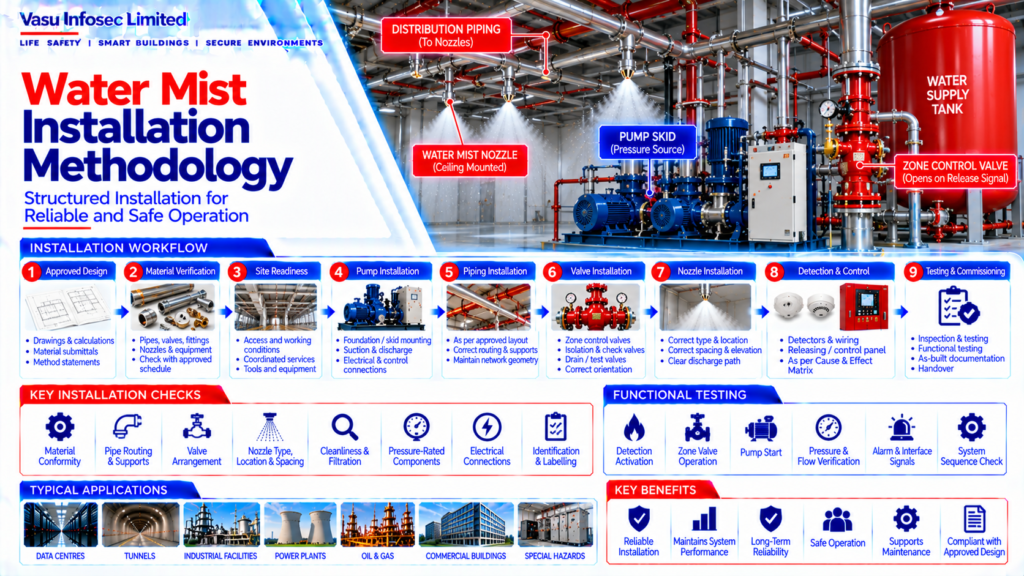
Water Mist Installation Methodology defines the controlled sequence for installation of the water mist system in accordance with approved drawings, manufacturer requirements, project specifications and the engineered design. Installation activities should maintain the integrity of the hydraulic, detection, control and nozzle arrangement.
2. Installation Workflow
Approved Design → Material Verification → Site Readiness → Pump / Equipment Installation → Piping Installation → Valve Installation → Nozzle Installation → Detection & Control Installation → Inspection → Testing → Commissioning → As-Built Documentation
3. Pre-Installation Requirements
Before commencing installation, verify:
- Approved drawings and calculations
Approved material submittals
• Manufacturer installation instructions
• Site readiness
• Access and working conditions
• Coordinated services layout
• Required equipment and tools
• Approved method statements / permits
4. Material Verification
Materials should be checked against the approved material schedule before installation.
Verification may include:
- Pipe material and size
Valves
• Fittings
• Nozzles
• Pump equipment
• Filters / strainers
• Pressure instruments
• Control equipment
• Detection devices
5. Pump Skid Installation
The pump skid or pressure source should be installed on a suitable prepared foundation or support. Installation should verify equipment orientation, alignment, access, suction and discharge connections, electrical connections and associated control interfaces.
6. Water Supply Installation
Water storage and supply connections should be installed in accordance with the approved design. Tank connections, isolation arrangements, suction piping and associated accessories should be coordinated with the pump manufacturer’s requirements.
7. Piping Installation
Piping should be installed in accordance with approved layouts and hydraulic calculations. Pipe routing should maintain the approved network geometry and coordinate with structural, architectural, HVAC, electrical and other services.
8. Pipe Supports
Pipe supports and restraints should be installed to maintain the required alignment and mechanical stability. Support arrangements should follow approved installation details and project requirements.
9. Valve Installation
Zone control valves, isolation valves, check valves, drain / test valves and other components should be installed in the correct location, orientation and configuration. Valves should remain accessible for operation, testing and maintenance.
10. Nozzle Installation
Water mist nozzles should be installed strictly as per the approved nozzle schedule and layout.
Verify:
- Nozzle type
Location
• Elevation
• Orientation
• Spacing
• Connection
• Clear discharge path
11. Detection & Control Installation
Detection devices, releasing / control panels, monitoring devices and associated wiring should be installed according to approved drawings and the Cause and Effect Matrix. Device identification and circuit segregation should be maintained as required by the approved design.
12. Filtration & Cleanliness
Piping and nozzle connections should be protected against contamination during installation. Filters / strainers should be installed as specified, and the piping system should be suitably cleaned or flushed in accordance with the approved procedure before final system readiness.
13. Pressure-Rated Installation
All piping, valves, fittings, connections and equipment should be suitable for the applicable system operating and test pressures. For high-pressure water mist systems, only approved pressure-rated components should be used.
14. Inspection During Installation
Installation inspection should verify:
- Material conformity
Pipe size and routing
• Supports
• Valve arrangement
• Nozzle locations
• Equipment installation
• Detection devices
• Wiring / termination
• Identification and labelling
15. Testing Before Commissioning
Pre-commissioning activities may include:
- Visual inspection
Piping inspection
• Leakage / pressure testing as applicable
• Valve operation checks
• Pump checks
• Detection circuit checks
• Control panel checks
• Nozzle verification
16. Functional Testing
Functional testing should verify the approved system sequence.
Testing may include:
- Detection activation
Cause and Effect logic
• Zone valve operation
• Pump start
• Pressure / flow response
• Alarm indication
• Interface signals
• Fault / supervisory functions
17. Installation Safety & Coordination
Installation activities should be coordinated with site safety requirements, permits, access arrangements and other construction activities. Special controls should be applied during pressure testing, lifting, electrical work and work at height.
18. Design Change Control
Any deviation from approved piping routes, nozzle locations, equipment arrangement, valve configuration or detection layout should be reviewed and approved before implementation. Changes affecting hydraulic performance should be evaluated against the approved calculation.
19. Handover Documentation
Installation handover documentation should include, as applicable:
- Approved installation drawings
Material inspection records
• Pressure / leakage test records
• Valve inspection records
• Nozzle inspection records
• Detection test records
• Commissioning report
• As-built drawings
• O&M manual
20. Engineering Objective
The engineering objective is:
Approved Design → Verified Materials → Controlled Installation → Correct Piping & Equipment → Accurate Nozzle Arrangement → Integrated Detection & Control → Complete Inspection → Functional Testing → Commissioning → Reliable Water Mist System
Frequently Asked Questions
What is the purpose of a water mist installation methodology?
It defines a controlled installation sequence based on approved drawings, manufacturer requirements, project specifications and the engineered design.
What should be checked before installation?
The source lists approved drawings and calculations, material submittals, manufacturer instructions, site readiness, access, coordinated services, tools, method statements and permits.
What should be verified during nozzle installation?
Nozzle type, location, elevation, orientation, spacing, connection and clear discharge path should match the approved nozzle schedule and layout.
What may be included in pre-commissioning?
The source lists visual and piping inspections, applicable leakage/pressure tests, valve operation checks, pump checks, detection/control checks and nozzle verification.
How should deviations from the approved design be handled?
Deviations should be reviewed and approved before implementation. Changes affecting hydraulic performance should be evaluated against the approved calculation.
What documents may be included in handover?
Applicable records include installation drawings, material inspection records, pressure/leakage test records, valve/nozzle inspection records, detection test records, commissioning report, as-built drawings and O&M manual.
SEO and Website Publishing Details
| SEO title | Water Mist Installation Methodology | Vasu Infosec Limited |
| Meta description | Explore water mist system installation stages, from material verification and piping to nozzle placement, inspection, testing, commissioning and handover. |
| Suggested URL slug | /water-mist-installation-methodology/ |
| Primary keyword | water mist installation methodology |
| Secondary keywords | water mist system installation; water mist piping installation; water mist nozzle installation; water mist testing and commissioning |
| Suggested internal links | Water Mist System Design; Water Mist Hydraulic Design; Water Mist Testing and Commissioning; Water Mist Maintenance |