
Article
Water Mist Piping Network Design
Oct 2026
Direct Answer
A water mist piping network carries pressurised water from the pump or pressure source to the designated nozzles. Its design must provide the pressure, flow, coverage and discharge performance required for the approved hazard and system configuration. Pipe sizing, material, routing, fittings, elevation and nozzle connections must be verified against the approved hydraulic calculation and selected manufacturer’s requirements.
1. Engineering Overview
The water mist piping network transports pressurised water from the pump or pressure source to the designated water mist nozzles. The network should be engineered to provide the required pressure, flow, coverage and discharge performance for the approved hazard and system configuration.
2. Piping Network Architecture
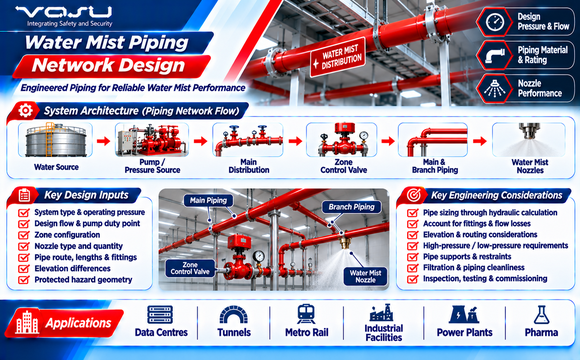
Water Source → Pump / Pressure Source → Main Distribution → Zone Control Valve → Main Piping → Branch Piping → Nozzle Connections → Water Mist Nozzles
3. Design Inputs
Piping design should be based on verified inputs including:
- Water mist system type
- Operating pressure
- Design flow
- Pump duty point
- Zone configuration
- Nozzle type and quantity
- Nozzle pressure requirement
- Pipe route
- Pipe lengths
- Fittings
- Elevation differences
- Protected hazard geometry
4. Pipe Material Selection
Pipe material and pressure rating should be selected from the approved system design and manufacturer requirements. The piping system must be suitable for the operating pressure, water quality, environmental conditions and installation arrangement.
5. Pipe Sizing
Pipe sizes should be established through the approved hydraulic calculation. Main and branch pipe diameters should provide the required flow while maintaining the pressure necessary at the hydraulically demanding nozzle or design zone.
6. Piping Layout
The piping layout should connect the zone control arrangement to all designated nozzles while maintaining the approved hydraulic design. Routing should be coordinated with structural, architectural, electrical, HVAC and other services.
7. Main & Branch Piping
The main piping distributes water towards individual zones and branch piping supplies the designated nozzles. The final arrangement should correspond with the approved hydraulic calculation and nozzle schedule.
8. Fittings & Flow Losses
Elbows, tees, reducers, valves, couplings and other fittings contribute to system pressure losses. Relevant fittings and equivalent lengths should be incorporated into the approved hydraulic calculation.
9. Elevation Considerations
Elevation changes influence pressure conditions within the piping network. Actual pipe elevations and vertical sections should be reflected in the approved calculation where required by the selected system methodology.
10. High-Pressure Piping
Where a high-pressure water mist system is used, piping, fittings, valves and connections must be rated for the applicable operating and test pressures. Specialised high-pressure components should be used where required by the approved manufacturer design.
11. Low-Pressure Piping
For low-pressure systems, piping and components should be selected according to the approved pressure regime and manufacturer requirements. The piping arrangement should still be hydraulically verified for the required nozzle performance.
12. Nozzle Connection
Each nozzle connection should correspond with the approved nozzle schedule. Connections should provide correct orientation, secure fixing and compatibility with the selected nozzle and piping system.
13. Pipe Supports & Restraints
Piping should be adequately supported and restrained to maintain alignment and mechanical stability. Support spacing, fixing methods and restraint arrangements should comply with approved installation details and project requirements.
14. Filtration & Cleanliness
Where filtration is provided, the piping arrangement should support the required protection of small nozzle passages and system components. Piping should be protected against debris and contamination during storage, fabrication and installation.
15. Hydraulic Calculation
The hydraulic calculation should verify the required flow and pressure throughout the network. It should consider pipe sizes, lengths, fittings, elevation, valves, nozzle characteristics and the selected design condition.
16. Hydraulically Most Demanding Condition
The design should identify the hydraulically most demanding zone or nozzle arrangement and confirm that the pump / pressure source can provide the required pressure and flow under that condition.
17. Installation Requirements
Installation should verify:
- Correct pipe material
- Correct pipe size
- Correct routing
- Correct fittings
- Correct jointing method
- Secure supports
- Correct elevation
- Correct valve connections
- Correct nozzle connections
- Protection from physical damage
18. Inspection & Testing
Piping inspection should verify conformity with approved drawings and calculations.
Checks may include:
- Material verification
- Pipe size verification
- Routing inspection
- Support inspection
- Joint inspection
- Valve inspection
- Nozzle connection inspection
- Pressure / leakage testing as applicable
19. Design Change Control
Any change to pipe size, route, fitting, elevation, valve arrangement or nozzle location should be reviewed against the approved hydraulic calculation. Changes affecting system performance should be incorporated into revised approved documentation before implementation.
20. Documentation
Piping documentation should include, as applicable:
- Piping layout drawings
- Isometric drawings
- Pipe and fitting schedule
- Hydraulic calculation
- Nozzle schedule
- Zone control drawings
- Support details
- Pressure / test records
- Installation inspection records
- As-built drawings
21. Engineering Objective
The engineering objective is:
Correct Design Inputs → Suitable Pipe Material & Rating → Accurate Pipe Sizing → Optimised Routing → Verified Fittings & Elevations → Secure Installation → Correct Nozzle Integration → Hydraulic Validation → Complete Testing → Reliable Water Mist Distribution
Frequently Asked Questions
What determines water mist pipe sizing?
Pipe sizes should be established through the approved hydraulic calculation to provide the required flow and pressure at the hydraulically demanding nozzle or design zone.
Why do fittings and elevation matter?
Fittings contribute to pressure losses, while elevation changes affect pressure conditions. These factors should be reflected in the approved hydraulic calculation using the selected system methodology.
Can the same piping components be used for high-pressure and low-pressure systems?
Component selection depends on the approved pressure regime, operating and test pressures, manufacturer requirements and system design. Compatibility must be verified rather than assumed.
What should be checked before installation is accepted?
Checks may include material and pipe size, routing, fittings, jointing, supports, elevation, valve and nozzle connections, and applicable pressure or leakage testing.
What happens if the piping route or nozzle location changes?
Changes should be reviewed against the approved hydraulic calculation. Changes affecting system performance should be reflected in revised approved documentation before implementation.