
Article
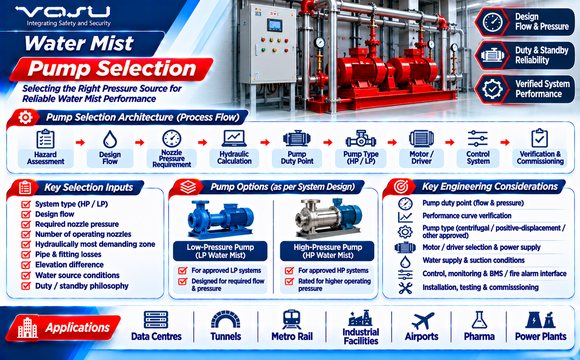
Water Mist Pump Selection
Oct 2026
Direct Answer
Water mist pump selection identifies the pressure source needed to deliver the design flow at the pressure required by the approved system. Selection should be based on the hydraulic calculation, nozzle requirements, water supply and suction conditions, system pressure regime, and manufacturer-approved equipment data. The pump must be checked against the hydraulically most demanding design condition rather than selected from protected area alone.
1. Engineering Overview
Water Mist Pump Selection determines the appropriate pressure source required to deliver the design flow at the pressure necessary for the approved water mist system. Pump selection should be based on the hydraulic calculation, nozzle requirements, water supply conditions, system pressure regime and manufacturer-approved equipment.
2. Pump Selection Architecture
Hazard Assessment → Design Flow → Required Nozzle Pressure → Hydraulic Calculation → Pump Duty Point → Pump Type → Motor / Driver → Control System → Verification & Commissioning
3. Selection Inputs
Typical inputs include:
- Water mist system type
- Design flow
- Required nozzle pressure
- Number of operating nozzles
- Hydraulically most demanding zone
- Pipe friction losses
- Fitting and valve losses
- Elevation difference
- Water source conditions
- Operating temperature
- Duty / standby philosophy
4. Pump Duty Point
The pump duty point is established from the required flow and pressure at the design condition. The selected pump should provide sufficient performance to overcome the total system pressure losses and still deliver the required pressure at the design nozzles.
5. Flow Requirement
The required pump flow should be based on the approved water mist hydraulic calculation and the applicable operating zone or design condition. The pump should not be selected only from the nominal protected area.
6. Pressure Requirement
Required pump pressure should account for nozzle operating pressure together with losses through piping, fittings, valves, filters, elevation and other system components. The approved calculation should establish the required discharge pressure.
7. Pump Type
Pump type should be selected according to the water mist technology and approved manufacturer system. Depending on the design, the pressure source may use an appropriate centrifugal, positive-displacement or other approved pump technology.
8. High-Pressure Pump Selection
High-pressure water mist systems require pumps and associated components specifically rated for the applicable operating pressure. Selection should consider the required flow, pressure, motor power, control arrangement and manufacturer’s performance data.
9. Low-Pressure Pump Selection
For low-pressure systems, the pump should be selected for the approved pressure regime and design flow. Pump performance should be verified against the hydraulic calculation and system nozzle requirements.
10. Duty & Standby Arrangement
Where redundancy is required, the duty and standby arrangement should be selected to maintain system availability. Automatic changeover, fault monitoring and pump sequencing should follow the approved control philosophy.
11. Pump Performance Curve
The pump performance curve should be reviewed against the calculated duty point. The selected pump should provide the required pressure and flow without operating outside the manufacturer’s permitted operating range.
12. Motor / Driver Selection
The motor or other driver should be suitable for the selected pump duty and operating environment. Motor rating, starting arrangement, power supply and control equipment should be coordinated with the approved electrical design.
13. Water Supply Coordination
Pump selection should consider the available water source, suction conditions, tank arrangement, available pressure and required flow. The water supply should be adequate for the selected pump under the design condition.
14. Suction Conditions
The pump suction arrangement should provide appropriate inlet conditions. Suction pipe size, available water level, strainers, valves and fittings should be coordinated with the pump manufacturer’s requirements.
15. Control & Monitoring
The pump control arrangement may include:
- Automatic start
- Local / remote operation
- Pump running indication
- Fault indication
- Pressure monitoring
- Power supply monitoring
- Duty / standby changeover
- BMS / fire alarm interface
16. Hydraulic Verification
The selected pump should be verified against the approved hydraulic calculation. The calculation should demonstrate that the pump can satisfy the required flow and pressure at the hydraulically most demanding condition.
17. Installation Requirements
Installation should verify:
- Correct pump model
- Correct orientation
- Secure foundation / skid mounting
- Correct suction connection
- Correct discharge connection
- Correct valves and fittings
- Correct electrical connections
- Adequate maintenance access
- Correct identification
18. Testing & Commissioning
Pump commissioning should include, as applicable:
- Manual start / stop
- Automatic start
- Pressure verification
- Flow verification
- Pump running indication
- Fault indication
- Duty / standby changeover
- Zone demand response
- Control panel testing
- Interface testing
19. Documentation
Pump selection documentation should include, as applicable:
- Pump datasheet
- Pump performance curve
- Duty point calculation
- Hydraulic calculation
- Motor / driver datasheet
- Pump skid GA drawing
- Control panel details
- Water supply details
- FAT / SAT records
- Commissioning report
- O&M manual
20. Engineering Objective
The engineering objective is:
Accurate Design Flow → Correct Nozzle Pressure → Complete Hydraulic Assessment → Suitable Pump Duty Point → Verified Performance Curve → Correct Motor / Driver → Reliable Water Supply → Complete Testing → Reliable Water Mist System Pressure & Flow
Frequently Asked Questions
What determines water mist pump selection?
The approved hydraulic calculation, design flow, required nozzle pressure, water supply and suction conditions, system pressure regime and manufacturer-approved equipment data.
Why is the hydraulically most demanding condition important?
The pump must provide sufficient flow and pressure at the relevant design zone or nozzles after accounting for system pressure losses.
Can the pump be selected only by protected area?
No. The required pump flow should be based on the approved hydraulic calculation and applicable operating zone or design condition, not nominal protected area alone.
How should the pump performance curve be checked?
Review it against the calculated duty point and confirm the selected pump can provide the required pressure and flow within the manufacturer’s permitted operating range.
Are duty and standby pumps always required?
Not universally. Redundancy, automatic changeover and sequencing should follow the approved system requirements and control philosophy.
SEO and Website Publishing Details
SEO title: Water Mist Pump Selection: Duty Point, Flow & Pressure Requirements
Meta description: Learn how to select a water mist pump using hydraulic calculations, nozzle pressure, flow demand, suction conditions, performance curves and system requirements.
Suggested URL slug: /engineering/water-mist-pump-selection/
Primary keyword: water mist pump selection
Related keywords: water mist pump duty point, water mist pump flow and pressure, high-pressure water mist pump, water mist hydraulic calculation, pump performance curve
Suggested internal links: Water Mist System Complete Architecture; Water Mist Pump Skid Architecture; Water Mist Pressure & Flow Calculation; Water Mist Piping Network Design; Water Mist Zone Control Arrangement.