
Article
Water Mist Pump Skid Architecture
Oct 2026
Direct Answer
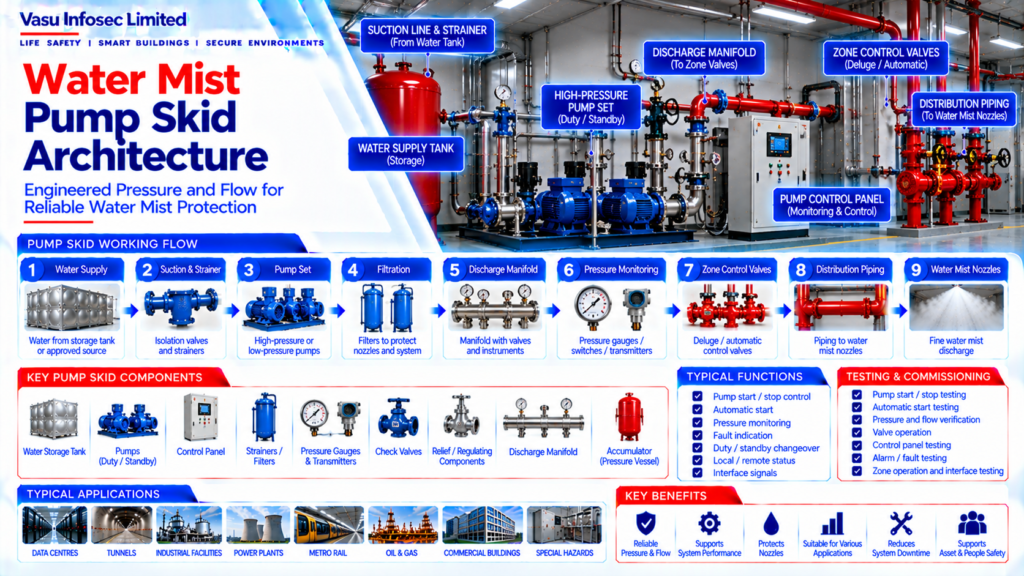
A water mist pump skid is the pressure-generation and flow-control assembly that supplies water to the distribution network at the pressure and flow required by the approved system design. Its configuration typically coordinates pumps, controls, valves, filtration, pressure monitoring and associated accessories. Final selection and configuration must follow the approved hydraulic calculation and the selected manufacturer’s requirements.
1. Engineering Overview
The Water Mist Pump Skid is the pressure-generation and flow-control assembly that supplies water to the water mist distribution network at the pressure and flow required by the approved system design. The skid integrates pumps, controls, valves, filtration, pressure monitoring and associated accessories into a coordinated package.
2. Pump Skid Architecture
Water Supply → Isolation / Suction Arrangement → Strainer / Filtration → Pump Set → Discharge Manifold → Pressure / Flow Monitoring → Zone Control Valves → Distribution Piping → Water Mist Nozzles
3. Major Pump Skid Components
A typical engineered pump skid may include:
- Main pump / pump set
- Standby or duty arrangement, where applicable
- Pump motor / driver
- Pump control panel
- Suction and discharge valves
- Strainers / filters
- Pressure gauges
- Pressure switches / transmitters
- Check valves
- Relief / regulating components, where required
- Discharge manifold
- Test / drain connections
- Accumulator / pressure vessel, where provided
4. Pump Selection Basis
The pump set should be selected from the approved hydraulic calculation. Selection should consider the required design flow, required pressure at the hydraulically most demanding nozzle / zone, system pressure losses, water supply conditions and manufacturer performance data.
5. Duty & Standby Philosophy
Where the approved system requires redundancy, duty and standby pump arrangements should be configured to maintain the required water mist system availability. Automatic changeover and supervisory functions should follow the approved control philosophy.
6. Pump Suction Arrangement
The suction arrangement should provide the pump with the required water supply under the design operating conditions. Suction piping, valves, strainers, fittings and available water level should be coordinated with the pump manufacturer’s requirements.
7. Pump Discharge Arrangement
The discharge side should connect the pump to the system distribution network through the approved manifold and control components. Pipe sizing, valves, check valves and pressure-rated components should be compatible with the design pressure and flow.
8. Filtration & Strainer Arrangement
Filtration / straining may be required to protect pumps, valves and water mist nozzles from contamination. Filter or strainer selection, rating and maintenance arrangement should follow the approved system design.
9. Control Panel Architecture
The pump control panel provides monitoring and control of the pump skid. Depending on the approved system, functions may include:
- Pump start / stop control
- Automatic start
- Pressure monitoring
- Pump running indication
- Fault indication
- Power supply monitoring
- Local / remote status
- Interface signals
10. Pressure Monitoring
Pressure gauges, switches or transmitters may be provided to monitor suction and discharge conditions. Monitoring devices should be installed and configured according to the approved pump skid design and control philosophy.
11. Zone Control Integration
The pump skid should be coordinated with the zone control arrangement so that water is supplied to the required protected zone when the approved release sequence operates.
12. Hydraulic Coordination
The pump skid performance should correspond with the hydraulic calculation. The selected pump must provide the required pressure and flow after accounting for piping, fittings, valves, elevation and nozzle losses.
13. Accumulator / Pressure Vessel
Where an accumulator or pressure vessel is included, it may support pressure stability and system operation as defined by the approved manufacturer design. Its capacity, pressure rating and connection arrangement should be verified against the system requirements.
14. Installation Requirements
Installation should verify:
- Correct pump orientation
- Secure skid foundation / supports
- Correct suction and discharge connections
- Correct valve arrangement
- Correct electrical connections
- Correct control wiring
- Correct pressure instruments
- Adequate maintenance access
- Correct identification / labelling
15. Testing & Commissioning
Pump skid commissioning may include:
- Pump start / stop testing
- Automatic start testing
- Pressure verification
- Flow verification
- Valve operation
- Control panel testing
- Alarm / fault testing
- Duty / standby changeover, where applicable
- Zone operation
- Interface testing
16. Common Engineering Considerations
Engineering review should verify:
- Pump duty point
- Water supply adequacy
- Pump pressure and flow
- Duty / standby philosophy
- Suction arrangement
- Discharge manifold
- Filtration
- Pressure monitoring
- Control panel
- Hydraulic calculation
- Maintenance access
17. Documentation
Pump skid documentation should include, as applicable:
- Pump datasheets
- Pump performance curves
- Hydraulic calculation
- Pump skid GA drawing
- Piping schematic
- Control panel details
- Valve schedule
- Instrument schedule
- Electrical / control drawings
- FAT / SAT records
- Commissioning report
- O&M manual
- As-built drawings
18. Engineering Objective
The engineering objective is:
Adequate Water Supply → Correct Pump Selection → Reliable Pressure Generation → Controlled Flow → Effective Filtration → Coordinated Zone Control → Verified Hydraulic Performance → Complete Testing & Commissioning → Reliable Water Mist System Operation
Frequently Asked Questions
What does a water mist pump skid do?
It supplies water to the water mist distribution network at the pressure and flow required by the approved system design.
How is the pump selected?
The pump set should be selected using the approved hydraulic calculation, required design flow and pressure, system pressure losses, water supply conditions and manufacturer performance data.
Does every pump skid need duty and standby pumps?
Not necessarily. Duty/standby arrangements and automatic changeover should be provided where required by the approved system design and control philosophy.
Why are filtration and strainers considered?
They may be required to protect pumps, valves and nozzle passages from contamination. Selection and maintenance requirements should follow the approved system design.
What should be checked during commissioning?
Depending on the approved procedure, checks may include pump start/stop, automatic start, pressure and flow, valve operation, control-panel functions, alarms/faults, duty/standby changeover where applicable, zone operation and interfaces.
SEO and Website Publishing Details
SEO title: Water Mist Pump Skid Architecture: Components, Selection and Commissioning
Meta description: Understand water mist pump skid architecture, key components, hydraulic selection, suction and discharge arrangements, controls, installation and commissioning considerations.
Suggested URL slug: /engineering/water-mist-pump-skid-architecture/
Primary keyword: water mist pump skid architecture
Related keywords: water mist pump selection, water mist pump skid components, hydraulic calculation, pump skid commissioning, water mist system controls
Suggested internal links: Water Mist System Complete Architecture; High-Pressure Water Mist Working Principle; Low-Pressure vs High-Pressure Water Mist.