
Article
Water Mist System: Complete Architecture
Oct 2026
Direct Answer
A water mist system is an engineered fire protection system that distributes finely divided water droplets through a designed network of water supply, pressure generation, filtration, control valves, piping and nozzles. Detection, release logic, monitoring and associated interfaces are coordinated to the approved application and system design.
1. Engineering Overview
A Water Mist System is an engineered fire protection system that uses finely divided water droplets to control, suppress or extinguish fire depending on the approved application and system design. The complete architecture integrates the water supply, pump or pressure source, filtration, control valves, distribution piping, nozzles, detection and release logic, drainage and associated monitoring interfaces.
2. Complete System Architecture
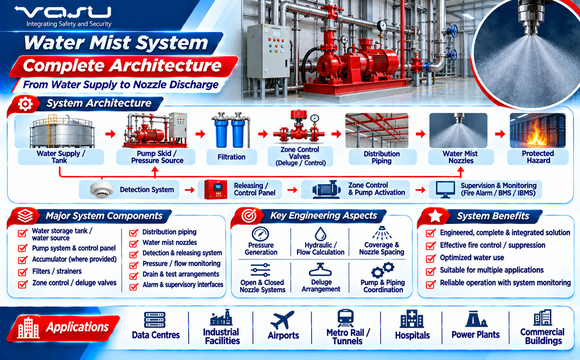
Water Supply / Tank → Pump Skid / Pressure Source → Filtration → Control / Zone Valves → Distribution Piping → Water Mist Nozzles → Protected Hazard
Detection System → Releasing / Control Panel → Zone Control → Pump / Valve Activation → Water Mist Discharge
Supervision / Monitoring → Fire Alarm / BMS / IBMS Interfaces
3. Major System Components
A typical engineered water mist system may include:
- Water storage tank or approved water source
- High-pressure or low-pressure pump system, as applicable
- Pump control panel
- Electric/diesel / other approved pump arrangement, where applicable
- Accumulator/pressure vessel, where provided
- Filters/strainers
- Zone control valves
- Deluge valves, where applicable
- Distribution piping
- Water mist nozzles
- Detection and releasing system
- Pressure/flow monitoring
- Drain and test arrangements
- Alarm and supervisory interfaces
4. Water Supply Arrangement
The water supply should provide the required quantity and quality of water for the approved system design. Storage capacity, water quality, tank configuration and supply reliability should be established from the system design and application requirements.
5. Pump Skid Architecture
The pump skid provides the pressure and flow required by the water mist system. Depending on the system design, the skid may incorporate pumps, controllers, pressure regulation, filters, valves, gauges, pressure switches, relief provisions and associated accessories.
6. Pressure Generation
Water mist systems may use different pressure regimes depending on the approved design. The pressure source should be selected to achieve the required nozzle flow and droplet characteristics for the specific application.
7. Filtration & Water Quality
Filtration may be provided to protect small water passages and nozzles from blockage. Filter selection, mesh / rating, maintenance arrangement and water quality requirements should follow the approved system design and manufacturer requirements.
8. Zone Control Arrangement
Protected areas may be divided into individual water mist zones. Each zone should have the required control valve arrangement, monitoring, drainage / test provisions and connection to the detection and release logic.
9. Distribution Piping
The distribution piping transports water from the pressure source and zone control assembly to the water mist nozzles. Pipe sizing, routing, fittings, supports, pressure rating and hydraulic characteristics should be established through the approved design calculation.
10. Water Mist Nozzles
Nozzles generate the designed water mist discharge pattern. Nozzle type, orifice, operating pressure, quantity, location, orientation and coverage should be selected from the approved manufacturer system and verified through the design calculation.
11. Detection & Release Architecture
The detection system identifies the fire condition and initiates the approved release sequence. Depending on the system type, detection may initiate zone valve operation, pump start, alarm notification and other associated interfaces.
12. Open & Closed Nozzle Systems
Water mist systems may use open nozzles in deluge-type arrangements or closed / automatic nozzles depending on the approved application. The nozzle arrangement should correspond with the selected release philosophy and system design.
13. Deluge Arrangement
Where a deluge arrangement is used, detection and releasing logic activates the zone control / deluge valve and allows water to flow to the open nozzles in the protected zone. The complete arrangement should be based on the approved system design.
14. Hydraulic / Flow Calculation
The hydraulic calculation verifies the required pressure and flow at the designed nozzles and throughout the distribution network. The calculation should account for pipe sizes, lengths, fittings, elevations, nozzle characteristics and the selected system configuration.
15. Pump & Piping Coordination
Pump selection and piping design should be coordinated with the hydraulic calculation. The pressure source should provide the required flow at the required pressure for the hydraulically most demanding design condition.
16. Coverage & Nozzle Spacing
Nozzle coverage and spacing should be determined from the approved manufacturer design criteria and application-specific testing / listing. Room geometry, hazard configuration, obstructions, ceiling height and equipment arrangement should be considered.
17. Detection, Alarm & Interfaces
The water mist system may interface with:
- Fire alarm system
- HVAC
- BMS / IBMS
- Access control
- Equipment shutdown systems
- Remote monitoring
- Pump status monitoring
- Zone valve supervision
18. Installation Architecture
Installation should follow approved drawings, manufacturer requirements and the coordinated site layout.
Installation should verify:
- Correct pipe routing
- Correct supports
- Correct valves
- Correct nozzle locations
- Correct pump skid installation
- Correct detection devices
- Correct wiring and termination
- Correct identification / labelling
19. Testing & Commissioning
Testing and commissioning should verify the complete system architecture.
Activities may include:
- Pump functional testing
- Valve operation testing
- Detection testing
- Release sequence testing
- Alarm testing
- Hydraulic / flow verification
- Nozzle inspection
- Zone testing
- Interface testing
- Drain / test arrangement verification
20. Documentation
System documentation should include, as applicable:
- Design basis
- System schematic
- Pump skid datasheets
- Water storage details
- Hydraulic calculation
- Piping drawings
- Nozzle schedule
- Zone control drawings
- Detection & Cause and Effect Matrix
- Testing and commissioning records
- As-built drawings
- O&M manual
21. Engineering Objective
The engineering objective is:
Reliable Water Supply → Correct Pressure Source → Effective Filtration → Controlled Zone Operation → Engineered Piping Network → Correct Nozzle Distribution → Verified Detection & Release → Effective Water Mist Discharge → Complete Testing & Commissioning → Reliable Water Mist Fire Protection
Frequently Asked Questions
What is a water mist system?
It is an engineered fire protection system that uses finely divided water droplets to control, suppress or extinguish fire depending on the approved application and system design.
What are the main components of a water mist system?
A typical arrangement may include a water source, pump or pressure source, filtration, control valves, piping, nozzles, detection and release equipment, monitoring, and drain/test arrangements.
Are all water mist systems high-pressure systems?
No. The source document states that systems may use different pressure regimes depending on the approved design.
How are water mist nozzles selected and positioned?
Nozzle type, orifice, operating pressure, quantity, location, orientation and coverage should follow the approved manufacturer system and design calculation, including applicable application-specific criteria.
What is the role of hydraulic calculation?
It verifies the required pressure and flow at the designed nozzles and throughout the distribution network, accounting for piping geometry, fittings, elevations and nozzle characteristics.
What should be checked during commissioning?
Activities may include pump and valve operation, detection and release sequence, alarms, hydraulic/flow verification, nozzles, zones, interfaces and drain/test arrangements.
SEO & Website Publishing Details
SEO title: Water Mist Fire Protection System: Complete Architecture and Components
Meta description: Explore water mist system architecture, including water supply, pumps, filtration, zone valves, piping, nozzles, detection, hydraulic calculations and commissioning.
Suggested URL slug: water-mist-system-complete-architecture
Primary keyword: water mist system architecture
Related keywords: water mist fire protection system; water mist nozzles; water mist pump skid; water mist hydraulic calculation; water mist system commissioning
Suggested internal links: Water Mist System Design and Applications; Water Mist Hydraulic / Flow Calculation; Water Mist Nozzle Arrangement and Coverage; Fire Detection and Release Logic; Inspection, Testing and Commissioning Guides