
Case Study
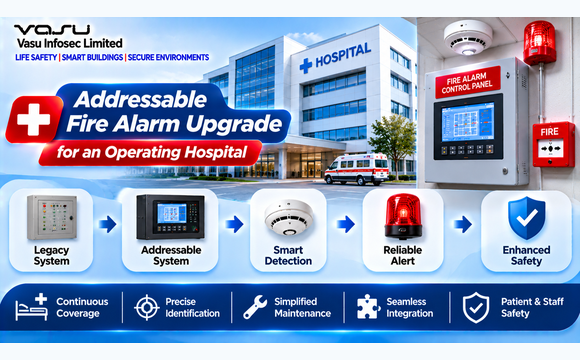
Addressable Fire Alarm Upgrade for an Operating Hospital
Nov 2026
Direct Engineering Answer
This illustrative case study explains the engineering considerations for addressable fire alarm upgrade for an operating hospital. The design approach should be developed from the approved fire strategy, facility conditions, applicable project requirements and the selected manufacturer’s verified technical data. Any layouts, quantities, calculations, interfaces and commissioning criteria shown in this knowledge example require project-specific review and approval before implementation.
1. Project Background
This case study presents an illustrative engineering approach for upgrading a fire alarm system within an operating hospital. The emphasis is on maintaining continuous life-safety coverage while migrating from a limited zone-based arrangement to an addressable architecture with improved event identification, fault diagnostics and system integration. The case is a knowledge-library example and is not presented as a verified record of a specific hospital project.
2. Facility / System Profile
| Parameter | Design Basis | Engineering Relevance |
| Facility | Operating multi-storey hospital | Continuous occupancy and critical patient-care functions require controlled migration. |
| Existing System | Conventional / zone-based fire alarm arrangement | Limited device-level identification and fault localisation. |
| Proposed System | Addressable fire alarm system | Individual device identification and improved diagnostics. |
| Protected Areas | Patient rooms, corridors, clinical and support areas | Different environmental conditions require application-specific detector selection. |
| Operational Constraint | Hospital remains occupied during works | Phased execution and temporary protection are critical. |
| Integration | Fire alarm, suppression, HVAC, access control and monitoring interfaces | Cause-and-effect coordination is required. |
3. Engineering Challenge
The principal engineering challenge is not simply replacement of the fire alarm panel. The upgrade must preserve detection capability during construction, minimise disruption to hospital operations, maintain clear alarm identification and coordinate interfaces with other life-safety systems.
- Maintain fire detection coverage during phased migration.
- Provide clear location information for hospital security and emergency-response personnel.
- Reduce nuisance alarms associated with dust, steam and construction activities.
- Coordinate detector selection with clinical, service and utility environments.
- Integrate approved fire alarm cause-and-effect sequences with connected systems.
- Complete testing without compromising normal hospital operations.
4. Engineering Basis and Applicable References
The supplied engineering reference material identifies NFPA 72, IS 2189, NBC India Part 4, EN 54, UL 268 and manufacturer installation guidance within the fire alarm engineering framework. Final design requirements must be checked against the edition and project specifications applicable to the actual facility.
| Reference | Engineering Application |
| NFPA 72 | Fire alarm and signaling system engineering, installation and testing. |
| IS 2189 | Selection, installation and maintenance of fire detection and alarm systems. |
| NBC India Part 4 | Building fire and life-safety provisions. |
| EN 54 | Applicable product/system requirements where specified. |
| UL 268 | Smoke detector listing requirements where applicable. |
| Manufacturer Guidelines | Device-specific application, mounting, spacing and environmental limitations. |
5. Existing Conditions / Assessment
- The existing arrangement is assumed to provide zone-level alarm information rather than individual device identification.
- Hospital areas have different environmental conditions, including patient areas, kitchens, electrical rooms, service spaces and plant areas.
- Fire alarm circuits may need to remain operational while sections are migrated.
- Existing interfaces must be surveyed before isolation or replacement.
- Historical nuisance-alarm records should be reviewed before final detector selection.
6. Proposed Engineering Solution
- Establish an asset register of existing panels, loops/zones, detectors, manual call points, notification appliances and interfaces.
- Prepare a phased migration strategy that defines which areas can be isolated and for how long.
- Install the new addressable architecture in accordance with the approved design.
- Retain temporary or compensatory fire-watch arrangements wherever required by the project risk assessment and approved method statement.
- Address and label every field device using a consistent location-based naming convention.
- Develop and approve the cause-and-effect matrix before final programming.
- Integrate approved interfaces with suppression, HVAC, access control, CCTV, BMS/SCADA or other systems.
- Perform device testing, loop testing, interface testing and Integrated System Testing before handover.
7. Addressable System Engineering Rationale
The supplied reference material describes addressable systems as providing individual device identification, intelligent communication, event logging, remote diagnostics and flexible programming. It also identifies faster incident identification, improved maintenance and better integration capability as key advantages. fileciteturn4file6L884-L910
- Individual device identification supports faster response to alarm location.
- Event history assists incident investigation and maintenance.
- Device-level fault information improves troubleshooting.
- Addressable architecture supports more structured integration with other building systems.
8. Detector Application Strategy
Detector selection should be based on the environmental and fire characteristics of each area rather than using one detector type throughout the hospital. The supplied reference material identifies smoke, heat, multi-criteria, flame, linear heat and aspirating smoke detection as available technologies. fileciteturn4file4L723-L733
| Area Type | Typical Engineering Consideration | Verification |
| Patient / Office Areas | Smoke detection generally provides early warning where environmental conditions permit. | Approved design and manufacturer data. |
| Kitchen / Steam-Prone Areas | Avoid unsuitable smoke detector application where steam or cooking aerosols are expected. | Hazard and false-alarm assessment. |
| Electrical / Plant Rooms | Detector type selected according to equipment and fire scenario. | Project fire strategy and manufacturer guidance. |
| Cable / Service Spaces | Linear or aspirating detection may be considered where geometry or access warrants it. | Detailed engineering assessment. |
| Critical Technical Areas | Early warning and system integration may require enhanced detection philosophy. | Project-specific fire engineering. |
9. Cause-and-Effect Engineering
The fire alarm system should act as the initiating platform for approved emergency sequences. The supplied reference material identifies typical interactions with water mist, sprinkler, clean-agent, smoke management, tunnel ventilation, SCADA, BMS, access control, CCTV, public address, emergency lighting and lift control. These interfaces should be documented and validated during Integrated System Testing. fileciteturn4file6L955-L1001
| Initiating Event | Typical Response | Validation |
| Smoke Detector Alarm | Identify exact device/area and initiate approved alarm sequence. | Functional test. |
| Manual Call Point | Initiate evacuation/alarm sequence as approved. | Functional test. |
| Suppression Interface | Initiate or supervise suppression sequence where designed. | Cause-and-effect and integrated test. |
| Fire Alarm to HVAC | Execute approved HVAC/damper response. | Interface test. |
| Fire Alarm to Access Control | Release designated emergency egress doors where specified. | Door release test. |
| Fire Alarm to CCTV/BMS/SCADA | Transmit alarm/event information for operator awareness. | Communication and display test. |
10. Execution and Commissioning Challenges
- Maintaining life-safety coverage during cutover.
- Coordinating shutdowns with hospital operations and infection-control requirements.
- Preventing construction dust and temporary works from generating repeated nuisance alarms.
- Maintaining correct device addresses after replacement or relocation.
- Verifying interfaces that cross contractor boundaries.
- Ensuring the final cause-and-effect matrix matches approved operational requirements.
11. Testing, Commissioning and Acceptance
- Verify every addressable device against the approved device schedule.
- Verify alarm and fault reporting at the fire alarm control panel.
- Check loop integrity and communication reliability.
- Test manual call points and notification appliances.
- Verify all approved supervisory inputs and outputs.
- Test cause-and-effect sequences for connected systems.
- Perform integrated emergency scenarios where practical.
- Record test results and update as-built documentation.
The supplied reference material states that commissioning should verify device addressing, loop integrity, alarm operation, fault monitoring, communication, interface functionality and cause-and-effect logic, while Integrated System Testing validates complete system interaction. fileciteturn4file6L988-L1001
12. Engineering Outcome
| Outcome | Engineering Result |
| System Architecture | Addressable fire alarm system. |
| Device Identification | Individual device-level identification. |
| Operational Strategy | Phased migration with continuity of life-safety protection. |
| Integration | Approved cause-and-effect interfaces. |
| Maintenance | Improved event history and fault localisation. |
| Acceptance | Device, interface and integrated testing prior to final handover. |
13. Lessons Learned
- Fire alarm upgrades in occupied hospitals are operational engineering projects, not simple equipment-replacement activities.
- Migration planning must be developed before isolating any live protection circuit.
- Detector selection should reflect the environment and potential false-alarm sources.
- Addressable architecture improves incident localisation and maintenance visibility.
- Cause-and-effect documentation should be frozen before programming and commissioning.
- Integrated testing provides stronger assurance than testing each system in isolation.
- Long-term reliability depends on maintenance, testing and periodic revalidation.
14. Design Review Checklist
☐ Existing fire alarm asset survey completed
☐ Fire strategy and zoning reviewed
☐ Detector application reviewed by area
☐ Addressable loop/device capacity verified
☐ Phased migration methodology approved
☐ Temporary protection / fire-watch requirements assessed
☐ Cause-and-effect matrix approved
☐ Interface responsibilities defined
☐ Device addressing schedule approved
☐ Testing and commissioning procedure approved
☐ Integrated System Testing completed
☐ As-built drawings and device database updated
15. Related Engineering Content
| Content Type | Reference |
| Engineering Calculations | EC-001 – Smoke Detector Quantity & Spacing Calculation; EC-002 to EC-020 – Fire Alarm Systems |
| Related Case Study | CS-001 – Fire Alarm System Design for a Multi-Storey Commercial Building |
| Related White Paper | VEP-005 – Fire Alarm Systems and Integrated Fire Protection Engineering |
| Related FAQs | Addressable vs Conventional Fire Alarm; Smoke Detector Selection; False Alarm Management; Cause-and-Effect Engineering |
| Related Engineering Diagram | ED-002 – Addressable Fire Alarm System Architecture |
16. Source Basis and Engineering Qualification
The engineering architecture and integration principles in this case study are based on the supplied fire alarm reference material. That material describes the Fire Alarm System as the central platform for detection, event evaluation, automatic control sequences and interfaces with suppression, smoke management, SCADA, BMS and other systems. fileciteturn4file4L684-L705
The case-specific hospital conditions, phased migration strategy and project parameters are illustrative engineering assumptions created for the case-study format; they are not claimed to be source-recorded facts of a particular hospital.