
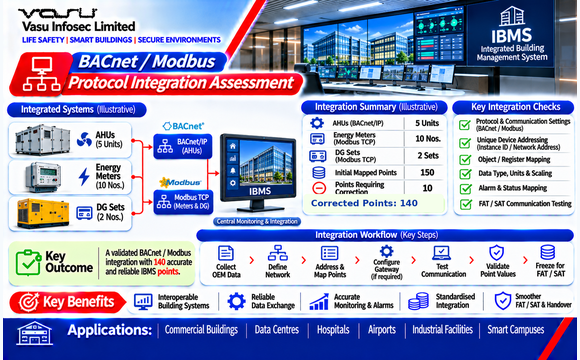
Case Study
BACnet / Modbus Protocol Integration Assessment
Nov 2026
Direct Engineering Answer
The illustrative BACnet/Modbus assessment starts with 150 mapped points, identifies 10 addressing, scaling or mapping discrepancies, and retains 140 corrected points. The discrepancy ratio is 6.67%. Final integration remains subject to OEM-confirmed protocol support, correct object/register mapping, addressing, data types, scaling and end-to-end FAT/SAT verification.
1. Project Background
This case study presents an illustrative engineering approach for integrating building-services equipment with an IBMS using BACnet and Modbus interfaces. The primary engineering objective is to establish reliable data exchange, correct point mapping, appropriate gateway architecture and controlled ownership of protocol interfaces. Final protocol selection and register/object mapping shall be based on approved OEM documentation and project specifications.
2. Facility / System Profile
| Parameter | Design Basis | Engineering Relevance |
| Facility | Commercial / critical facility | Multiple equipment systems require central monitoring. |
| IBMS | Central supervisory platform | Receives and displays approved data. |
| AHUs | 5 illustrative units | Typical BACnet integration candidates. |
| Energy Meters | 10 illustrative meters | Typical Modbus integration candidates. |
| DG Sets | 2 illustrative sets | May expose Modbus data. |
| Gateway | Protocol gateway where required | Provides protocol conversion/interface. |
| Network | IP-based building automation network | Supports approved communications. |
3. Engineering Challenge
Protocol integration can fail even when communication is physically established. Typical issues include incorrect device addressing, mismatched baud/parity settings, duplicate BACnet instance numbers, incorrect Modbus register offsets, unsupported data types and inconsistent scaling. The engineering process therefore requires a controlled interface schedule and end-to-end validation.
- Confirm OEM-supported protocol and communication parameters.
- Establish BACnet device/object or Modbus register mapping.
- Define IP/device addressing.
- Validate data types, units and scaling.
- Prevent duplicate addresses or instance identifiers.
- Map alarms and statuses into the IBMS.
- Test communication and point values at FAT/SAT.
4. Engineering Basis and Applicable References
The engineering framework for this library identifies the approved IBMS architecture, OEM protocol documents, BACnet and Modbus implementation documentation, equipment schedules and project specifications as the governing basis. Exact protocol features and register/object maps are equipment-specific and cannot be assumed without OEM confirmation.
| Reference | Engineering Application |
| Approved IBMS Architecture | Defines network and integration boundaries. |
| OEM Communication Manual | Defines supported protocol and data objects/registers. |
| BACnet Documentation | Defines devices, objects and communication parameters. |
| Modbus Documentation | Defines register addressing, function codes and data types. |
| Point List | Defines required IBMS information. |
| FAT/SAT Procedure | Defines communication and point-verification tests. |
5. Existing Conditions / Assessment Basis
- The illustrative IBMS integrates 5 AHUs using BACnet/IP.
- Ten energy meters are integrated using Modbus TCP.
- Two DG controllers provide Modbus TCP data.
- A central IBMS server receives the integrated data.
- An illustrative initial register/object list contains 150 mapped points.
- Ten points are assumed to require correction because of addressing, scaling or mapping discrepancies.
- All quantities and configuration details are illustrative.
6. Engineering Methodology
- Collect OEM protocol manuals and approved equipment schedules.
- Confirm physical and logical network architecture.
- Assign unique BACnet device instances or Modbus network addresses.
- Prepare object/register mapping sheets.
- Validate data types and engineering units.
- Configure gateways where protocol conversion is required.
- Perform communication testing.
- Validate point values against field instruments/controllers.
- Freeze the approved protocol map for FAT/SAT and handover.
7. Illustrative Protocol Architecture
| Equipment | Protocol | Illustrative Interface | IBMS Integration |
| AHU-01 to AHU-05 | BACnet/IP | Ethernet | Direct BACnet integration. |
| Energy Meter-01 to -10 | Modbus TCP | Ethernet | IBMS Modbus driver/gateway. |
| DG-01 / DG-02 | Modbus TCP | Ethernet | IBMS Modbus driver/gateway. |
| IBMS Server | BACnet/Modbus drivers | Server network | Central data acquisition. |
8. Illustrative Point Mapping Assessment
| System | Initial Points | Issues Identified | Corrected Points |
| AHUs | 60 | 4 | 56 |
| Energy Meters | 50 | 3 | 47 |
| DG Sets | 40 | 3 | 37 |
| Total | 150 | 10 | 140 |
9. Illustrative Mapping Accuracy
Initial mapped points = 150
Points requiring correction = 10
Corrected points = 150 − 10 = 140
Initial discrepancy ratio = 10 ÷ 150 × 100 = 6.67%
Illustrative mapping discrepancy ratio = 6.67%
The ratio is a project-control indicator only. It is not a universal acceptance benchmark.
10. Illustrative Protocol Validation Matrix
| Validation Parameter | BACnet/IP | Modbus TCP | Acceptance Focus |
| Network Address | IP + Device Instance | IP + Unit/Register Map | Unique addressing. |
| Data Object/Register | Object/property | Register/function code | Correct mapping. |
| Data Type | Per object definition | 16/32-bit or OEM-defined | Correct interpretation. |
| Scaling | Engineering units | OEM scaling | Correct displayed value. |
| Alarm/Status | Object/state | Register/bit | Correct IBMS indication. |
| Communication | Read/write as approved | Read/write as approved | Stable exchange. |
11. Engineering Solution
- Use the OEM-supported protocol rather than assuming protocol availability.
- Maintain a protocol-specific interface schedule.
- Assign unique BACnet device instances and valid network addressing.
- Validate Modbus register offsets and function codes against OEM documentation.
- Confirm scaling, signed/unsigned interpretation and word order for multi-register values where applicable.
- Separate monitoring points from command points.
- Test field-to-IBMS values using calibrated/known equipment conditions.
- Freeze the final protocol map and revision-control all subsequent changes.
12. IBMS Protocol Coordination
| Interface | Engineering Check | Verification |
| BACnet/IP | Device instance and object map | Live read test. |
| Modbus TCP | Register/function code | Register read test. |
| IP Network | Addressing and connectivity | Network test. |
| Gateway | Correct routing/conversion | End-to-end test. |
| Scaling | Correct engineering units | Field comparison. |
| Alarm | Correct state/event mapping | Alarm simulation. |
| Command | Only approved commands enabled | Functional test. |
13. Coordination and Execution Challenges
- OEM manuals may use different register numbering conventions.
- BACnet device-instance duplication can create unstable integration.
- Multi-register Modbus values require correct byte/word ordering.
- Gateway configuration changes can affect multiple downstream systems.
- Network segmentation and firewall rules can block otherwise correct protocol configurations.
- Firmware revisions can change available objects or registers.
- Late OEM changes require controlled revalidation of the point map.
14. Testing, Commissioning and Acceptance
- Verify network connectivity.
- Confirm BACnet device discovery/addressing.
- Verify BACnet objects and properties.
- Verify Modbus registers and function codes.
- Compare IBMS values against local equipment displays/meters.
- Test alarms and statuses.
- Test approved command points only.
- Record communication response and discrepancies.
- Close mapping issues and issue the final protocol schedule.
15. Engineering Outcome
| Outcome | Engineering Result |
| Facility | Illustrative commercial / critical facility. |
| BACnet Equipment | 5 AHUs. |
| Modbus Equipment | 10 meters + 2 DG controllers. |
| Initial Mapped Points | 150. |
| Points Requiring Correction | 10. |
| Corrected Points | 140. |
| Illustrative Discrepancy Ratio | 6.67%. |
| Final Acceptance | Requires OEM protocol confirmation, end-to-end testing and approved point mapping. |
16. Lessons Learned
- Successful protocol connection does not guarantee correct data interpretation.
- OEM documentation is the controlling source for register/object mapping.
- Addressing and scaling errors are common integration risks.
- Protocol maps should be revision-controlled alongside point lists.
- Field verification is essential for critical measurements and alarms.
- Commands should be enabled only where the approved control philosophy permits them.
17. Design Review Checklist
☐ OEM protocol manuals collected
☐ Network architecture approved
☐ BACnet device instances verified
☐ BACnet object mapping verified
☐ Modbus registers verified
☐ Function codes confirmed
☐ Data types/scaling confirmed
☐ Gateway configuration checked
☐ Alarm/status mapping tested
☐ Command permissions verified
☐ FAT/SAT completed
☐ Final protocol map issued
18. Related Engineering Content
| Content Type | Reference |
| Engineering Calculations | EC-066 to EC-075 – ELV & IBMS; EC-067 – BACnet / Modbus Protocol Integration Assessment |
| Related Case Studies | CS-066 – IBMS / ELV Integration and Point List Assessment |
| Related White Paper | BACnet, Modbus and IBMS Protocol Integration Engineering |
| Related FAQs | BACnet/IP; BACnet Device Instance; Modbus TCP; Register Mapping; Scaling; Gateway; Point Mapping |
| Related Engineering Diagram | ED-067 – BACnet and Modbus Multi-Protocol IBMS Integration Architecture |
19. Source Basis and Engineering Qualification
The equipment quantities, 150 initial points and 10 illustrative mapping discrepancies in this case study are engineering assumptions created to demonstrate protocol-integration governance. They are not claimed as project-recorded data, universal benchmarks or contractual requirements. Final protocol configuration shall be based on approved OEM documentation, project architecture and actual equipment.