
Case Study
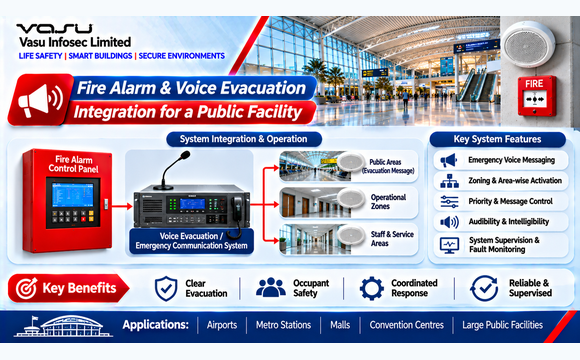
Fire Alarm and Voice Evacuation Integration for a Public Facility
Nov 2026
Direct Engineering Answer
This illustrative case study explains the engineering considerations for fire alarm and voice evacuation integration for a public facility. The design approach should be developed from the approved fire strategy, facility conditions, applicable project requirements and the selected manufacturer’s verified technical data. Any layouts, quantities, calculations, interfaces and commissioning criteria shown in this knowledge example require project-specific review and approval before implementation.
1. Project Background
This case study presents an illustrative engineering approach for integrating a fire alarm system with a voice evacuation / emergency communication system in a large public facility. The objective is to provide clear emergency notification, controlled message priority and coordinated evacuation information while keeping the fire alarm system and emergency communication functions aligned with the approved fire strategy. This is a knowledge-library example and is not represented as a verified record of a specific completed project.
2. Facility / System Profile
| Parameter | Design Basis | Engineering Relevance |
| Facility | Large public / institutional facility | Potentially high and unfamiliar occupant population. |
| Fire Alarm | Addressable fire alarm system | Provides alarm initiation and event identification. |
| Emergency Communication | Voice evacuation / public-address emergency system | Provides controlled emergency messaging. |
| Occupancy | Public, staff and visitors | Requires intelligible and appropriately prioritised notification. |
| Zoning | Multiple evacuation / operational zones | Messages may need area-specific activation. |
| Integration | Fire alarm, voice evacuation, BMS and other approved systems | Requires controlled cause-and-effect and interface testing. |
3. Engineering Challenge
The engineering challenge is to ensure that an alarm condition results in the correct audible and/or voice message in the affected area without creating conflicting announcements. Message priority, zoning, system supervision, emergency microphone functions and interface responsibilities must be established before programming and commissioning.
- Provide reliable emergency notification to occupants.
- Maintain clear separation between normal public-address functions and emergency functions.
- Define alarm priority and message precedence.
- Coordinate evacuation zones with the fire alarm zoning strategy.
- Verify intelligibility and audibility in representative occupied areas.
- Maintain supervised and fault-monitored emergency communication paths.
4. Engineering Basis and Applicable References
The fire alarm engineering framework used for this library identifies NFPA 72, IS 2189, NBC India Part 4, EN 54, UL 268 and manufacturer installation guidance as applicable references. Where voice alarm systems are specified, the applicable emergency voice communication and product requirements shall also be verified against the project specification and selected listed equipment. Final message zoning and priority shall follow the approved fire strategy.
| Reference | Engineering Application |
| NFPA 72 | Fire alarm and emergency communication system design, installation and testing where applicable. |
| IS 2189 | Fire detection and alarm system engineering and maintenance. |
| NBC India Part 4 | Fire and life-safety provisions for buildings. |
| EN 54 | Relevant fire detection / alarm and voice alarm product requirements where specified. |
| UL / Listed Product Requirements | Applicable listing requirements for selected system equipment. |
| Manufacturer Data | Amplifier loading, speaker circuits, supervision, priority and system interface characteristics. |
5. Existing Conditions / Assessment Basis
- The facility is assumed to contain public circulation areas, enclosed rooms and multiple operational zones.
- An addressable fire alarm system provides alarm initiation and location information.
- A dedicated emergency voice communication system provides emergency messages.
- Normal public-address operation may coexist with emergency communication functions.
- Final evacuation messaging is controlled by the approved emergency response strategy.
6. Engineering Methodology
- Review the approved fire strategy and evacuation philosophy.
- Define fire alarm zones and corresponding emergency communication zones.
- Identify alarm inputs that initiate voice evacuation functions.
- Define message priority, pre-recorded messages and authorised live emergency microphone functions.
- Confirm amplifier and speaker-circuit capacity using actual manufacturer data.
- Coordinate speaker locations with architectural and acoustic conditions.
- Establish supervised signal paths and fault indications.
- Develop the fire alarm-to-voice evacuation cause-and-effect matrix.
- Perform functional and integrated testing before acceptance.
7. Illustrative Voice Evacuation Loading Assessment
The following example is illustrative and demonstrates preliminary system planning. Assume three evacuation zones, each with 40 loudspeakers rated at 6 W nominal. The connected speaker load per zone is therefore 240 W before applying the selected manufacturer’s design criteria, spare capacity and circuit limitations.
| Parameter | Value | Unit | Engineering Comment |
| Evacuation Zones | 3 | Nos. | Illustrative zoning arrangement. |
| Speakers per Zone | 40 | Nos. | Illustrative quantity. |
| Speaker Rating | 6 | W | Nominal design input. |
| Connected Load per Zone | 240 | W | 40 × 6 W. |
| Total Connected Speaker Load | 720 | W | Three zones combined. |
| Final Amplifier Capacity | To be verified | W | Must include OEM design criteria and required margin. |
The 720 W value is an arithmetic planning figure only. Final amplifier selection shall consider the selected system architecture, speaker transformer settings, line losses, circuit supervision, spare capacity and the manufacturer’s specified loading limits. No universal amplifier margin is assumed in this case study.
8. Engineering Solution
- Separate emergency voice functions from routine public-address operation.
- Map fire alarm zones to the approved voice evacuation zones.
- Provide supervised speaker circuits and system fault monitoring.
- Use priority logic so emergency messages override lower-priority routine announcements.
- Provide approved pre-recorded evacuation messages and controlled live microphone functions where required.
- Coordinate speaker placement with room geometry, occupancy, finishes and background noise.
- Maintain clear zone identification at the fire alarm and emergency communication control points.
9. Cause-and-Effect and Message Priority
| Initiating Event | Emergency Communication Response | Verification |
| Automatic Fire Alarm | Activate approved evacuation message in designated zone(s). | Functional and integrated test. |
| Manual Call Point | Initiate approved emergency notification sequence. | Functional test. |
| Multi-Zone Alarm | Activate approved multi-zone evacuation strategy. | Scenario test. |
| Emergency Microphone | Authorised operator may issue controlled live message where designed. | Priority/interruption test. |
| System Fault | Generate fault indication without unintended emergency message. | Fault test. |
10. Acoustic and Operational Coordination
Voice evacuation effectiveness depends on both system functionality and intelligibility. Speaker selection and placement should therefore be coordinated with ceiling height, room geometry, background noise, reverberation, architectural finishes and occupancy. The final design should use the project-approved acoustic and system criteria rather than assuming that speaker quantity alone demonstrates adequate performance.
- Coordinate speaker locations with lighting, HVAC, ceiling services and architectural features.
- Review high-noise spaces separately.
- Provide suitable zoning for areas with different evacuation instructions.
- Ensure emergency messages remain understandable during expected operating conditions.
- Coordinate emergency communication with evacuation signage, fire alarm indications and emergency procedures.
11. Testing, Commissioning and Acceptance
- Verify every speaker circuit and zone against the approved schedule.
- Check normal and emergency message operation.
- Test message priority and interruption of routine announcements.
- Verify fire alarm initiation of the correct voice message and zone.
- Test emergency microphone functions where provided.
- Verify amplifier, circuit and communication fault indications.
- Perform integrated alarm scenarios involving multiple zones.
- Record final configuration, zone mapping and commissioning results.
12. Engineering Outcome
| Outcome | Engineering Result |
| Fire Alarm Architecture | Addressable fire alarm system. |
| Emergency Communication | Integrated voice evacuation system. |
| Illustrative Speaker Load | 720 W total connected load. |
| Evacuation Zoning | Three illustrative zones. |
| Priority | Emergency communication takes precedence according to approved logic. |
| Final Design Requirement | OEM, acoustic and project-specific verification required. |
13. Lessons Learned
- Voice evacuation should be engineered as part of the life-safety strategy, not treated as a normal public-address extension.
- Message zoning must align with the approved evacuation strategy.
- Amplifier selection requires actual speaker loads and manufacturer system limitations.
- Emergency message priority must be tested under realistic operating conditions.
- Speaker quantity alone does not demonstrate speech intelligibility.
- Integrated testing is necessary to verify fire alarm initiation, message selection, zoning and priority.
14. Design Review Checklist
☐ Fire strategy and evacuation philosophy reviewed
☐ Fire alarm zones mapped to voice zones
☐ Emergency messages approved
☐ Message priority defined
☐ Speaker schedule prepared
☐ Amplifier loading verified using OEM data
☐ Speaker circuit supervision verified
☐ High-noise areas assessed
☐ Emergency microphone functions defined
☐ Cause-and-effect matrix approved
☐ Integrated System Testing completed
☐ Final zone map and configuration records updated
15. Related Engineering Content
| Content Type | Reference |
| Engineering Calculations | EC-001 to EC-020 – Fire Alarm Systems; EC-010 – Fire Alarm and Voice Evacuation Integration |
| Related Case Studies | CS-001 to CS-009 – Fire Alarm Systems |
| Related White Paper | VEP-005 – Fire Alarm Systems and Integrated Fire Protection Engineering |
| Related FAQs | Voice Evacuation; Fire Alarm and PA Integration; Emergency Message Priority; Speaker Circuit Supervision; Speech Intelligibility |
| Related Engineering Diagram | ED-010 – Fire Alarm and Voice Evacuation Integration Architecture |
16. Source Basis and Engineering Qualification
The public-facility profile, three-zone arrangement and speaker loading example are illustrative engineering assumptions created for the knowledge-library format. They are not claimed as project-recorded data. Final voice evacuation design shall be based on approved drawings, the fire strategy, applicable standards, authority requirements, acoustic assessment and selected manufacturer data.