
Case Study
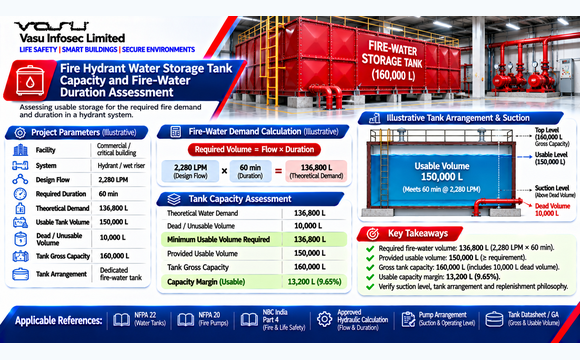
Fire Hydrant Water Storage Tank Capacity and Fire-Water Duration Assessment
Nov 2026
Direct Engineering Answer
The illustrative 2,280 LPM demand over 60 minutes requires 136,800 L; 150,000 L usable storage provides a 13,200 L margin and approximately 65.79 minutes of theoretical duration, subject to approved demand and operating-level verification.
1. Project Background
This case study presents an illustrative engineering approach for assessing dedicated fire-water storage capacity for a hydrant/fire-fighting system. The objective is to establish the usable water volume required for the approved fire demand and duration, while accounting for unusable tank volume, operational reserve and the arrangement of fire-water suction connections. Final tank capacity shall be based on the approved hydraulic/fire strategy, applicable standards, authority requirements, pump duty and project-specific fire-water duration criteria.
2. Facility / System Profile
| Parameter | Design Basis | Engineering Relevance |
| Facility | Commercial / critical building | Requires dedicated emergency firefighting water. |
| System | Hydrant / wet riser system | Requires reliable stored fire-water supply. |
| Design Fire Flow | 2,280 LPM illustrative | Basis for storage-duration assessment. |
| Required Duration | 60 min illustrative | Worked-example fire-water duration. |
| Theoretical Demand | 136,800 L | Flow × duration. |
| Usable Tank Volume | 150,000 L illustrative | Available operating volume. |
| Unusable/Dead Volume | 10,000 L illustrative | Not available to firefighting pumps. |
| Tank Arrangement | Dedicated fire-water tank | Supports emergency supply. |
3. Engineering Challenge
Fire-water tank sizing must distinguish total physical tank volume from the water volume actually available to the fire pumps. The assessment must consider the approved fire demand, required duration, tank operating levels, suction arrangement, dead storage, replenishment philosophy and any other approved fire-water demands. A tank that appears large enough by gross volume may still fail the usable-volume requirement.
- Establish the approved fire-water demand.
- Confirm required fire-water duration.
- Calculate theoretical water demand.
- Account for dead/unusable tank volume.
- Determine minimum usable storage.
- Check tank gross capacity.
- Review suction level and pump accessibility.
- Verify refill/replenishment philosophy where applicable.
4. Engineering Basis and Applicable References
The governing basis should comprise the approved hydraulic calculation, fire-water demand calculation, applicable fire protection standards, project specification, authority requirements and tank/pump manufacturer information. Exact duration, reserve and tank arrangement requirements are project-specific and shall be verified from the approved design.
| Reference | Engineering Application |
| NFPA 22 | Water tanks for private fire protection framework where applicable. |
| NFPA 20 | Fire pump suction/supply considerations where applicable. |
| NBC India Part 4 | Fire and life-safety provisions. |
| Approved Hydraulic Calculation | Defines fire-water flow and duration. |
| Tank Datasheet/GA | Defines gross and usable volume. |
| Pump Arrangement | Defines suction and minimum operating level. |
5. Existing Conditions / Assessment Basis
- The illustrative fire demand is 2,280 LPM.
- An illustrative fire-water duration of 60 minutes is assumed.
- The tank has 160,000 L gross capacity.
- An illustrative 10,000 L dead/unusable volume is assumed.
- Therefore, usable volume is 150,000 L.
- No additional approved demand is included in this simplified example.
- All quantities and criteria are illustrative.
6. Engineering Methodology
- Confirm the approved design flow.
- Confirm the required duration.
- Convert flow and duration into water volume.
- Identify dead/unusable tank volume.
- Determine minimum usable storage.
- Add any approved reserve or additional fire demand.
- Select tank gross capacity.
- Verify pump suction arrangement and minimum water level.
- Document the final storage calculation.
7. Illustrative Fire-Water Demand Calculation
Design flow = 2,280 LPM
Required duration = 60 min
Required water volume = 2,280 × 60 = 136,800 L
Required water volume = 136.8 m³
8. Illustrative Usable Storage Assessment
Gross tank capacity = 160,000 L
Dead/unusable volume = 10,000 L
Usable fire-water volume = 160,000 − 10,000 = 150,000 L
Usable storage margin = 150,000 − 136,800 = 13,200 L
Storage margin = 13,200 ÷ 136,800 × 100 ≈ 9.65%
The illustrative tank therefore provides sufficient usable volume for the stated 60-minute demand, subject to all approved hydraulic and authority criteria.
9. Illustrative Fire-Water Duration Available
Available duration = usable volume ÷ design flow
Available duration = 150,000 ÷ 2,280 ≈ 65.79 minutes
The illustrative tank provides approximately 65.8 minutes of theoretical operation at the stated constant flow, before considering any additional approved demands or operational limitations.
10. Gross-to-Usable Storage Efficiency
Storage efficiency = usable volume ÷ gross volume × 100
Storage efficiency = 150,000 ÷ 160,000 × 100 = 93.75%
This is an illustrative tank utilisation indicator. Actual usable volume must be based on the tank geometry, suction arrangement, minimum operating level and approved fire-pump requirements.
11. Engineering Solution
- Size the tank from approved fire-water demand and duration rather than gross dimensions alone.
- Clearly identify gross, usable and dead storage levels.
- Maintain the required minimum suction water level for the fire pumps.
- Coordinate tank outlet and suction arrangement with pump-room hydraulics.
- Provide level monitoring and approved low-level indications.
- Protect the dedicated fire-water supply from unintended consumption.
- Verify replenishment arrangements where required by the project.
- Record the final tank capacity and operating levels on the approved drawings.
12. Water Storage Coordination Matrix
| Design Item | Engineering Check | Verification |
| Fire Demand | Approved flow confirmed | Hydraulic calculation. |
| Duration | Approved duration confirmed | Fire strategy/specification. |
| Gross Volume | Tank capacity confirmed | Tank GA/datasheet. |
| Dead Volume | Minimum usable level established | Tank/pump arrangement. |
| Usable Volume | Meets calculated demand | Storage calculation. |
| Suction Level | Pump suction remains effective | Hydraulic/layout review. |
| Level Monitoring | Alarm/status provisions confirmed | Instrumentation schedule. |
| Refill | Approved replenishment philosophy | MEP/civil coordination. |
13. Illustrative Tank Capacity Scenarios
| Scenario | Flow | Duration | Required Volume | Assessment vs 150,000 L Usable |
| Base Case | 2,280 LPM | 60 min | 136,800 L | Adequate; 13,200 L margin |
| Extended Duration | 2,280 LPM | 65 min | 148,200 L | Adequate; 1,800 L margin |
| Extended Duration | 2,280 LPM | 70 min | 159,600 L | Not adequate |
| Higher Demand | 2,500 LPM | 60 min | 150,000 L | No margin |
14. Coordination and Execution Challenges
- Tank gross volume may not equal usable firefighting volume.
- Pump suction levels can restrict the amount of water that is practically available.
- Additional fire-water demands can materially increase storage requirements.
- Tank level instrumentation must distinguish normal, low and critical operating conditions.
- Dedicated fire-water storage should not be compromised by non-fire consumption.
- Changes to pump duty or required duration require a storage-capacity revalidation.
15. Testing, Commissioning and Acceptance
- Verify tank dimensions and installed capacity.
- Confirm suction outlet arrangement and minimum operating level.
- Verify level indicators and alarms.
- Check tank isolation valves and accessibility.
- Confirm the fire-water tank is dedicated/controlled as approved.
- Verify pump operation at representative water levels where required.
- Record tank level and pump suction conditions.
- Verify replenishment arrangement where specified.
- Update final tank GA, level schedule and hydraulic documentation.
16. Engineering Outcome
| Outcome | Engineering Result |
| Facility | Illustrative commercial / critical building. |
| Design Fire Flow | 2,280 LPM. |
| Required Duration | 60 min. |
| Theoretical Demand | 136,800 L / 136.8 m³. |
| Gross Tank Capacity | 160,000 L / 160 m³. |
| Dead/Unusable Volume | 10,000 L. |
| Usable Fire-Water Volume | 150,000 L / 150 m³. |
| Storage Margin | 13,200 L / 9.65%. |
| Theoretical Available Duration | ≈65.79 min. |
| Final Acceptance | Requires approved fire-water demand, duration, usable level and authority verification. |
17. Lessons Learned
- Fire-water tank sizing must be based on usable volume, not only gross volume.
- Required duration is a critical design input.
- Dead storage and minimum pump suction levels can materially reduce available capacity.
- Any increase in fire demand should trigger a tank-capacity review.
- Tank level monitoring and protection against unintended water consumption are essential.
- Final tank capacity should be reconciled with the approved hydraulic calculation and pump arrangement.
18. Design Review Checklist
☐ Approved fire-water demand confirmed
☐ Required duration confirmed
☐ Theoretical water volume calculated
☐ Gross tank capacity confirmed
☐ Dead/unusable volume established
☐ Usable volume calculated
☐ Minimum suction level checked
☐ Storage margin reviewed
☐ Tank level monitoring reviewed
☐ Replenishment arrangement reviewed
☐ Commissioning checks completed
☐ Final tank/as-built documentation issued
19. Related Engineering Content
| Content Type | Reference |
| Engineering Calculations | EC-086 onward – Fire Fighting & Hydrant Systems; EC-088 – Fire Hydrant Water Storage Tank Capacity and Fire-Water Duration Assessment |
| Related Case Studies | CS-086 – Hydraulic Flow and Pressure; CS-087 – Pump Duty and Pump Room Capacity |
| Related White Paper | Fire-Water Storage Tank Sizing, Usable Capacity and Fire-Fighting Duration Engineering |
| Related FAQs | Fire Water Tank; Usable Volume; Dead Storage; Fire-Water Duration; Tank Capacity; Pump Suction Level; Replenishment |
| Related Engineering Diagram | ED-088 – Fire-Water Storage Tank, Suction Arrangement, Operating Levels and Pump Supply |
20. Source Basis and Engineering Qualification
The 2,280 LPM flow, 60-minute duration, 160,000 L gross tank, 10,000 L dead volume and 150,000 L usable storage used in this case study are illustrative assumptions created to demonstrate fire-water storage methodology. They are not claimed as project-recorded data, universal storage requirements or contractual acceptance criteria. Final tank capacity shall use the approved fire strategy, hydraulic calculation, applicable standards and actual tank/pump data.