
Case Study
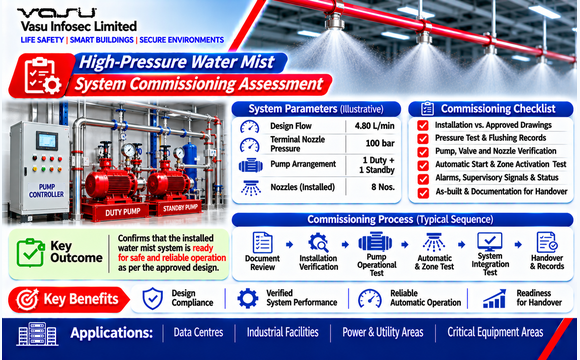
High-Pressure Water Mist System Commissioning Assessment
Nov 2026
Direct Engineering Answer
The illustrative readiness review shows 11 of 12 checkpoints closed, equivalent to 91.67% readiness before the final integrated test. This is a project-control indicator only, not a code acceptance criterion; final acceptance requires completion of the approved commissioning and handover process.
1. Project Background
This case study presents an illustrative engineering approach for commissioning a high-pressure water mist system after completion of installation, testing and pre-commissioning inspections. Commissioning confirms that the installed system corresponds with the approved design and that hydraulic, electrical, control and functional interfaces operate as intended. The final commissioning procedure shall be governed by the selected OEM, approved project specification, QAP/ITP and applicable requirements.
2. Facility / System Profile
| Parameter | Design Basis | Engineering Relevance |
| Facility | Critical technical equipment area | Protected by high-pressure water mist. |
| Pump Set | High-pressure duty/standby arrangement | Provides system flow and pressure. |
| Pipe Network | High-pressure distribution system | Requires integrity and hydraulic verification. |
| Nozzles | OEM-listed high-pressure nozzles | Require correct location, model and hydraulic performance. |
| Control System | Detection/release and pump controls | Coordinates automatic system operation. |
| Commissioning | Integrated functional verification | Confirms readiness for handover. |
3. Engineering Challenge
Commissioning must demonstrate the complete system rather than isolated component operation. The engineer must verify the mechanical installation, pressure integrity, pump performance, nozzle arrangement, control sequence, monitoring interfaces and documentation. Any deviation between the installed system and approved hydraulic model must be resolved before final acceptance.
- Verify installation against approved drawings.
- Confirm pressure-test and flushing records.
- Verify pump and controller operation.
- Confirm nozzle quantity, model and location.
- Verify automatic start and release interfaces.
- Test alarms, supervisory signals and system status.
- Reconcile as-built conditions with the approved hydraulic calculation.
- Complete integrated functional testing and handover documentation.
4. Engineering Basis and Applicable References
The engineering framework for this library identifies NFPA 750, applicable local fire and building requirements, approved fire strategy, OEM installation/commissioning documentation and project QAP/ITP as relevant references. Exact commissioning tests and acceptance criteria are system-specific and shall follow the approved project and OEM procedure.
| Reference | Engineering Application |
| NFPA 750 | Water mist system installation, testing and commissioning considerations where applicable. |
| NBC India Part 4 | Fire and life-safety provisions. |
| Applicable Authority Requirements | Local fire-protection acceptance requirements. |
| OEM Commissioning Manual | Equipment-specific commissioning sequence and acceptance criteria. |
| Approved Hydraulic Calculation | Confirms installed network against design. |
| QAP / ITP | Defines inspection, testing, witnessing and records. |
5. Existing Conditions / Assessment Basis
- The illustrative system has completed installation and pressure testing.
- The design-zone flow is 4.80 L/min at an illustrative required terminal pressure of 100 bar.
- The pump duty is based on the previously developed illustrative hydraulic assessment.
- Eight ceiling-mounted nozzles are installed in the illustrative protected room.
- One duty pump and one standby pump are provided.
- Automatic pump start and zone activation interfaces are available for functional testing.
- All values are illustrative and must be replaced by actual project/OEM data.
6. Engineering Methodology
- Review approved drawings, hydraulic calculations and equipment schedules.
- Verify completion of installation inspections and pressure tests.
- Confirm pump, controller, valve and nozzle identification.
- Verify electrical power and control interfaces.
- Check system static pressure and readiness condition.
- Perform pump operational tests.
- Test automatic start and zone activation.
- Verify alarm, supervisory and fault indications.
- Reconcile installed conditions with the approved hydraulic model.
- Complete final integrated testing and documentation.
7. Illustrative Commissioning Sequence
| Stage | Activity | Illustrative Acceptance Focus |
| 1 | Document review | Approved drawings, calculations, datasheets and test records available. |
| 2 | Visual inspection | Pipework, supports, valves and nozzles correctly installed. |
| 3 | Pressure verification | System integrity confirmed from approved test record. |
| 4 | Pump test | Duty/standby pumps operate as intended. |
| 5 | Control test | Automatic start and control logic verified. |
| 6 | Zone test | Correct zone receives water on approved activation. |
| 7 | Alarm test | Required alarm/status indications confirmed. |
| 8 | Final reconciliation | As-built installation matches approved design. |
| 9 | Handover | Commissioning dossier completed. |
8. Illustrative Commissioning Readiness Calculation
For the illustrative readiness review, 12 major commissioning checkpoints are identified. Assume 11 checkpoints have been satisfactorily closed before the final integrated test.
Readiness completion = Closed checkpoints ÷ Total checkpoints × 100
Readiness completion = 11 ÷ 12 × 100 = 91.67%
Illustrative pre-integrated-test readiness = 91.67%
The remaining checkpoint must be closed before final acceptance. This calculation is a project-control indicator only and is not a code acceptance criterion.
9. Illustrative Functional Test Matrix
| Test | Expected Result | Status Basis |
| Pump Auto Start | Pump starts at approved demand condition | Pass when verified. |
| Duty Pump Operation | Required operating condition achieved | Pass when verified. |
| Standby Pump | Starts under approved failure/changeover condition | Pass when verified. |
| Zone Valve | Correct zone valve operates | Pass when verified. |
| Nozzle Network | Correct zone is supplied | Pass when verified. |
| Alarm/Status | Required indications appear at control panel | Pass when verified. |
| Fault Monitoring | Required fault/supervisory conditions identified | Pass when verified. |
| Reset | System returns to approved normal condition | Pass when verified. |
10. Engineering Solution
- Use a controlled commissioning checklist based on the approved QAP/ITP.
- Complete document and installation verification before live functional testing.
- Verify pump performance against the approved duty.
- Test automatic and standby pump functions.
- Verify zone control and water delivery sequence.
- Confirm all alarms and supervisory indications.
- Reconcile the final installation with the approved hydraulic calculation.
- Close all punch points before final handover.
11. Commissioning and Handover Coordination
| Deliverable | Engineering Check | Verification |
| Approved Drawings | Latest revision available | Document review. |
| Hydraulic Calculation | Matches installed configuration | Engineering review. |
| Pressure Test Record | Accepted and traceable | QA/QC review. |
| Pump Test Record | Duty verified | Commissioning record. |
| Control Test Record | Auto/manual/fault functions verified | Functional test. |
| Nozzle Schedule | Model and locations confirmed | Site inspection. |
| Cause-and-Effect | Installed logic matches approved sequence | Integrated test. |
| As-Built Documentation | Final field condition recorded | Handover review. |
12. Coordination and Execution Challenges
- Commissioning can expose discrepancies between the hydraulic model and field routing.
- Unclosed punch points can delay integrated testing.
- Incorrect nozzle identification can result in an invalid hydraulic configuration.
- Control logic changes require coordinated retesting.
- Pump performance should be assessed against the actual installed network.
- Final documentation must reflect the system that was actually commissioned.
13. Testing, Commissioning and Acceptance
- Review approved commissioning procedure.
- Confirm pressure-test and installation records.
- Verify pump and controller identification.
- Check static system condition.
- Test automatic pump start.
- Test duty and standby pump operation.
- Test zone activation and control-valve operation.
- Verify alarm, supervisory and fault indications.
- Confirm final nozzle arrangement.
- Reconcile field installation with hydraulic calculation.
- Record all results and close punch points.
- Obtain required client/consultant/OEM acceptance.
14. Engineering Outcome
| Outcome | Engineering Result |
| Facility | Illustrative critical technical equipment area. |
| Design Flow | 4.80 L/min. |
| Terminal Pressure | 100 bar illustrative. |
| Nozzle Arrangement | 8 illustrative nozzles. |
| Pump Arrangement | Duty + standby. |
| Illustrative Readiness | 91.67% before final integrated test. |
| Final Acceptance | Requires complete integrated testing, approved documentation and closure of all outstanding items. |
15. Lessons Learned
- Commissioning is an integrated engineering verification activity, not merely a functional test.
- The hydraulic model and installed system must be reconciled before handover.
- Pump, valve, nozzle and control-system performance must be demonstrated together.
- Documentation quality is part of technical acceptance.
- All punch points affecting system performance should be closed before final acceptance.
- Final as-built records should reflect the commissioned condition.
16. Design Review Checklist
☐ Approved commissioning procedure available
☐ Approved drawings verified
☐ Hydraulic calculation reviewed
☐ Pressure-test record accepted
☐ Pump and controller verified
☐ Nozzle schedule verified
☐ Auto-start tested
☐ Duty/standby operation tested
☐ Zone activation tested
☐ Alarm/supervisory functions tested
☐ As-built reconciliation completed
☐ Punch points closed
☐ Handover dossier completed
17. Related Engineering Content
| Content Type | Reference |
| Engineering Calculations | EC-041 to EC-055 – Water Mist Systems; EC-050 – High-Pressure Water Mist System Commissioning Assessment |
| Related Case Studies | CS-041 to CS-049 – Water Mist Systems |
| Related White Paper | High-Pressure Water Mist System Testing, Commissioning and Handover |
| Related FAQs | Water Mist Commissioning; Pump Testing; Zone Testing; Nozzle Verification; Integrated Functional Testing; Handover |
| Related Engineering Diagram | ED-050 – High-Pressure Water Mist System Integrated Commissioning Test Flow |
18. Source Basis and Engineering Qualification
The 12-checkpoint readiness review, 11 closed checkpoints, 4.80 L/min design flow and eight-nozzle arrangement in this case study are illustrative engineering assumptions created to demonstrate the commissioning workflow. They are not claimed as project-recorded data, OEM requirements or universal acceptance criteria. Final commissioning shall follow the approved project QAP/ITP, OEM procedure and applicable requirements.