
Case Study
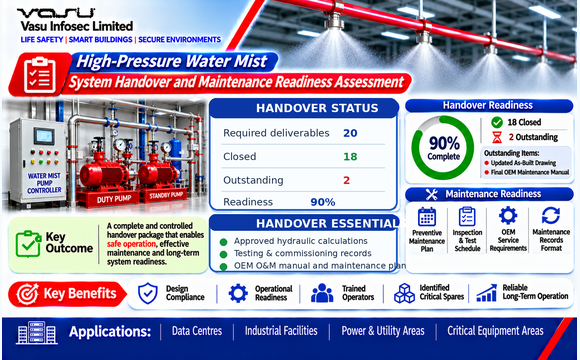
High-Pressure Water Mist System Handover and Maintenance Readiness Assessment
Nov 2026
Direct Engineering Answer
On the illustrative basis, 18 of 20 handover deliverables are closed, giving 90% document completion. However, the updated as-built drawing and final OEM maintenance manual remain outstanding. Therefore, 90% closure does not by itself establish readiness for final handover; operationally significant documents must be completed and accepted in accordance with the approved project and OEM requirements.
1. Project Background
This case study presents an illustrative engineering approach for assessing handover and maintenance readiness of a high-pressure water mist system. A technically complete installation is not sufficient for operational handover; the owner must receive controlled drawings, calculations, test records, equipment information, commissioning records, maintenance requirements and identified spares. The final handover package shall follow the approved project specification, OEM requirements and applicable authority requirements.
2. Facility / System Profile
| Parameter | Design Basis | Engineering Relevance |
| Facility | Critical technical equipment area | Requires reliable long-term water mist availability. |
| System | High-pressure water mist | Contains pumps, valves, pipework, nozzles and controls. |
| Documentation | As-built and commissioning dossier | Provides operational traceability. |
| Maintenance | Preventive maintenance programme | Maintains system readiness. |
| Training | Owner/operator training | Supports competent operation and inspection. |
| Spares | Critical replacement components | Reduces maintenance downtime. |
3. Engineering Challenge
Handover frequently becomes a documentation and readiness bottleneck even after physical installation is complete. The engineering objective is to establish a controlled close-out package demonstrating that the installed system is consistent with the approved design and that the owner can operate, inspect and maintain it.
- Reconcile as-built drawings with the installed system.
- Close commissioning and inspection records.
- Compile approved hydraulic calculations.
- Compile equipment datasheets and manuals.
- Establish preventive maintenance requirements.
- Identify critical spares and consumables.
- Complete operator training and handover.
- Track outstanding punch points to closure.
4. Engineering Basis and Applicable References
The engineering framework for this library identifies NFPA 750, applicable local requirements, approved fire strategy, selected OEM documentation and project handover requirements as relevant references. Exact maintenance frequencies, spares and acceptance requirements are system-specific and shall follow the approved OEM/project documentation.
| Reference | Engineering Application |
| NFPA 750 | Water mist system installation, testing and maintenance considerations where applicable. |
| NBC India Part 4 | Fire and life-safety provisions. |
| Applicable Authority Requirements | Local fire-protection requirements. |
| OEM O&M Manual | Equipment maintenance, inspection and service requirements. |
| Approved Hydraulic Calculation | Final system design reference. |
| Project Handover Specification | Required close-out documents and training. |
5. Existing Conditions / Assessment Basis
- The illustrative water mist system has completed installation and commissioning.
- The final system consists of a duty/standby pump arrangement, zone control valves, high-pressure pipework and eight nozzles.
- An illustrative handover register contains 20 required deliverables.
- 18 deliverables are assumed closed and 2 remain outstanding.
- One outstanding item is an updated as-built drawing and the second is the final OEM maintenance manual.
- All values are illustrative and must be replaced by actual project records.
6. Engineering Methodology
- Prepare the contractual/project handover document matrix.
- Verify each document against the final installed system.
- Reconcile drawings and hydraulic calculations.
- Verify all testing and commissioning records are complete.
- Confirm equipment schedules and identification.
- Compile O&M manuals and maintenance procedures.
- Identify critical spares and service requirements.
- Complete operator training.
- Close outstanding punch points.
- Obtain formal handover acceptance.
7. Illustrative Handover Readiness Assessment
| Deliverable Category | Required | Closed | Outstanding |
| Approved/As-Built Drawings | 4 | 4 | 0 |
| Hydraulic/Technical Calculations | 3 | 3 | 0 |
| Testing & Commissioning Records | 5 | 5 | 0 |
| OEM Datasheets/Manuals | 4 | 2 | 2 |
| Training & Handover Records | 2 | 2 | 0 |
| Spare Parts / Maintenance Schedule | 2 | 2 | 0 |
| Total | 20 | 18 | 2 |
8. Illustrative Handover Completion Calculation
Handover completion = Closed deliverables ÷ Total deliverables × 100
Handover completion = 18 ÷ 20 × 100 = 90%
Illustrative handover readiness = 90%
The remaining two documents are operationally significant because the as-built drawing establishes the final configuration and the OEM maintenance manual provides the maintenance basis. Therefore, 90% document closure does not automatically mean the system is ready for final handover.
9. Illustrative Maintenance Readiness Matrix
| Maintenance Element | Illustrative Requirement | Readiness Status |
| Pump Inspection | Periodic inspection and performance verification | Ready after O&M approval. |
| Zone Valves | Operational/status verification | Ready. |
| Nozzles | Visual inspection and condition check | Ready. |
| Pipework | Leakage/support/corrosion inspection | Ready. |
| Controls | Functional/alarm verification | Ready. |
| O&M Manual | OEM-approved maintenance instructions | Outstanding. |
| As-Built Drawing | Final installed configuration | Outstanding. |
10. Engineering Solution
- Use a formal handover matrix with document owner, status and acceptance reference.
- Release the final as-built drawings only after field reconciliation.
- Include the approved hydraulic calculation and final equipment schedule.
- Provide OEM O&M manuals and maintenance requirements.
- Identify critical spares and recommended service support.
- Train operators on normal operation, alarm response and basic inspection.
- Close all operationally significant outstanding documents before final handover.
- Archive the final controlled dossier for future maintenance and modification activities.
11. Handover and Maintenance Coordination
| Deliverable | Engineering Check | Verification |
| As-Built Drawings | Match installed system | Field reconciliation. |
| Hydraulic Calculation | Matches final pipe/nozzle arrangement | Engineering review. |
| Pump Data | Final model and duty recorded | OEM datasheet. |
| Valve Schedule | Final valve identification recorded | Site inspection. |
| Nozzle Schedule | Model and locations recorded | Site inspection. |
| O&M Manual | Current OEM revision available | Document review. |
| Training | Owner personnel trained | Training record. |
| Spare List | Critical items identified | Maintenance review. |
12. Coordination and Execution Challenges
- Late receipt of OEM manuals can delay operational handover.
- As-built drawings can become inaccurate if field changes are not controlled.
- Maintenance requirements may differ between OEM components.
- Unresolved punch points can create ambiguity over system responsibility.
- Training should be based on the actual installed system rather than generic documentation.
- Future modifications depend on accurate final drawings and hydraulic records.
13. Testing, Commissioning and Acceptance
- Verify all commissioning records are complete.
- Reconcile final installation with approved drawings.
- Confirm hydraulic calculation reflects the installed configuration.
- Verify equipment identification and nameplates.
- Compile final O&M manuals.
- Complete operator training.
- Verify critical spares and maintenance tools.
- Close all outstanding punch points.
- Submit final handover dossier for acceptance.
- Obtain signed handover/acceptance documentation.
14. Engineering Outcome
| Outcome | Engineering Result |
| Facility | Illustrative critical technical equipment area. |
| System | Duty/standby high-pressure water mist system. |
| Handover Deliverables | 20 illustrative items. |
| Closed | 18 items. |
| Outstanding | 2 items. |
| Illustrative Completion | 90%. |
| Critical Outstanding Items | As-built drawing and OEM maintenance manual. |
| Final Acceptance | Recommended only after operationally significant documentation is closed. |
15. Lessons Learned
- Handover readiness is a technical deliverable, not merely an administrative close-out.
- As-built documentation is essential for future hydraulic and modification engineering.
- OEM maintenance information is required for sustainable system operation.
- Training should reflect the actual installed system.
- Outstanding documents should be risk-ranked rather than treated equally.
- A controlled handover dossier reduces future maintenance and troubleshooting risk.
16. Design Review Checklist
☐ Handover document matrix prepared
☐ As-built drawings reconciled
☐ Hydraulic calculation updated
☐ Equipment schedules verified
☐ Test records complete
☐ OEM manuals received
☐ O&M manual approved
☐ Preventive maintenance schedule prepared
☐ Critical spares identified
☐ Operator training completed
☐ Punch points closed
☐ Final handover accepted
17. Related Engineering Content
| Content Type | Reference |
| Engineering Calculations | EC-041 to EC-055 – Water Mist Systems; EC-055 – High-Pressure Water Mist System Handover and Maintenance Readiness Assessment |
| Related Case Studies | CS-041 to CS-054 – Water Mist Systems |
| Related White Paper | High-Pressure Water Mist Handover, O&M and Lifecycle Readiness |
| Related FAQs | Water Mist Handover; O&M Manual; As-Built Drawings; Maintenance Schedule; Critical Spares; Operator Training |
| Related Engineering Diagram | ED-055 – High-Pressure Water Mist Handover and Maintenance Readiness Workflow |
18. Source Basis and Engineering Qualification
The 20-deliverable handover register, 18 closed items and 90% completion value in this case study are illustrative engineering assumptions created to demonstrate the handover-readiness workflow. They are not claimed as project-recorded data, contractual acceptance criteria or universal requirements. Final handover shall follow the approved project specification, OEM documentation and authority requirements.