
Case Study
IBMS Alarm Priority and Cause-and-Effect Assessment
Nov 2026
Direct Engineering Answer
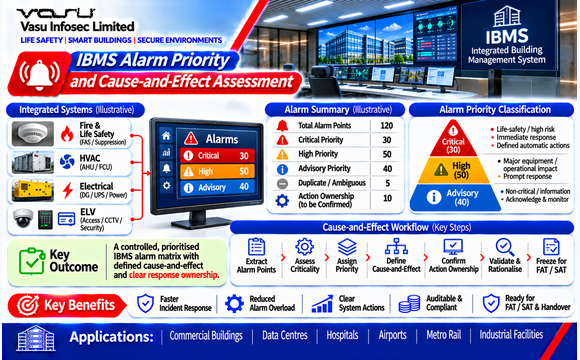
The illustrative alarm assessment classifies 120 alarm/event points as 30 critical, 50 high and 40 advisory, with five duplicate or ambiguous descriptions (4.17% of the initial list). Final priorities, automatic actions, acknowledgement and reset behaviour must follow the approved cause-and-effect matrix and control philosophy; life-safety control remains with the designated dedicated system.
1. Project Background
This case study presents an illustrative engineering approach for establishing alarm priorities and cause-and-effect relationships within an Integrated Building Management System (IBMS). The objective is to ensure that critical alarms are differentiated from routine status events and that approved automatic responses are clearly defined. Final alarm priorities, actions and interlocks shall be based on the approved cause-and-effect matrix, fire strategy, control philosophy, OEM documentation and project specifications.
2. Facility / System Profile
| Parameter | Design Basis | Engineering Relevance |
| Facility | Commercial / critical facility | Multiple systems generate alarms and events. |
| IBMS | Central supervisory platform | Receives, prioritises and displays approved alarms. |
| Fire & Life Safety | Fire alarm / suppression interfaces | High-priority events requiring controlled response. |
| HVAC | AHU/FCU plant | Equipment faults and operational alarms. |
| Electrical | DG/UPS/power systems | Critical equipment status and fault monitoring. |
| ELV | Access/CCTV/security interfaces | Security and operational events. |
| Operator Workstation | Alarm console and graphics | Supports response and acknowledgement. |
3. Engineering Challenge
A large volume of alarms can reduce operator effectiveness if priorities are not rationalised. The engineering challenge is to classify alarms according to consequence, define the required response, avoid duplicate notifications and establish an auditable cause-and-effect matrix. Life-safety interfaces must remain governed by their dedicated systems and approved control philosophy rather than unrestricted IBMS commands.
- Identify all alarm-generating systems.
- Classify alarms by operational criticality.
- Define alarm priority and acknowledgement requirements.
- Map alarms to the correct IBMS points.
- Define approved automatic responses and interlocks.
- Identify alarms requiring operator action.
- Validate cause-and-effect against the approved project philosophy.
4. Engineering Basis and Applicable References
The engineering framework for this library identifies the approved IBMS architecture, fire alarm cause-and-effect, project control philosophy, OEM documentation, equipment schedules and applicable life-safety requirements as the governing basis. Exact alarm priorities and automatic actions are project-specific and shall not be assumed without approved documentation.
| Reference | Engineering Application |
| Approved Cause-and-Effect Matrix | Defines required alarm responses and interlocks. |
| IBMS Alarm Philosophy | Defines priority, acknowledgement and escalation. |
| Fire Alarm Cause-and-Effect | Controls fire/life-safety system interactions. |
| OEM Control Philosophy | Defines equipment-specific responses. |
| Point List | Provides source point and alarm identity. |
| Project Specification | Defines contractual monitoring/integration requirements. |
5. Existing Conditions / Assessment Basis
- The illustrative IBMS contains 120 alarm/event points.
- 30 points are classified as critical, 50 as high, and 40 as advisory.
- Five alarm descriptions are duplicated or ambiguous.
- Ten points require confirmation of automatic response ownership.
- The assessment aims to establish a controlled alarm matrix and eliminate ambiguity before FAT/SAT.
- All quantities and classifications are illustrative.
6. Engineering Methodology
- Extract alarm points from the approved master point list.
- Identify source system and equipment.
- Assess consequence and operational criticality.
- Assign approved alarm priority.
- Define alarm text and operator response.
- Map any automatic cause-and-effect action.
- Confirm whether the action is executed by the source system, gateway or IBMS.
- Remove duplicate/ambiguous alarm definitions.
- Freeze the approved alarm matrix for FAT/SAT.
7. Illustrative Alarm Priority Matrix
| Priority | Illustrative Quantity | Typical Meaning | Operator Response |
| Critical | 30 | Immediate life-safety/critical operational condition | Immediate response/escalation. |
| High | 50 | Major equipment or operational fault | Prompt investigation. |
| Advisory | 40 | Non-critical condition/status exception | Review as per operating procedure. |
| Total | 120 | All alarm/event points | Controlled alarm management. |
8. Illustrative Alarm Rationalisation
Initial alarm/event points = 120
Duplicated/ambiguous descriptions = 5
Potentially affected points = 5 ÷ 120 × 100 = 4.17%
Illustrative alarm-description rationalisation requirement = 4.17%.
This is a project-control indicator only. It does not establish a universal acceptable alarm rate.
9. Illustrative Cause-and-Effect Matrix
| Source Event | Priority | Illustrative Cause | Approved Response / Interface |
| Fire Alarm General | Critical | Fire alarm active | IBMS alarm/event; fire system retains primary control. |
| Fire Pump Running | High | Pump starts | IBMS status indication and event logging. |
| AHU Critical Fault | High | AHU controller fault | Alarm display; operator investigation. |
| DG Common Fault | Critical/High per approved philosophy | DG fault | Alarm and operator escalation. |
| High Tank Level | Advisory | Level above setpoint | IBMS indication and maintenance review. |
| Access Door Forced | High | Security event | IBMS/security alarm indication. |
10. Engineering Solution
- Create a master alarm matrix linked to the approved point list.
- Use a controlled priority hierarchy with clear operational meaning.
- Keep fire/life-safety automatic actions within the approved dedicated control philosophy.
- Define alarm text that identifies system, equipment and condition.
- Specify acknowledgement, reset and escalation behaviour.
- Distinguish status, alarm and supervisory events.
- Validate every cause-and-effect relationship during FAT/SAT.
- Revision-control all alarm matrix changes.
11. IBMS Alarm Coordination
| Interface | Engineering Check | Verification |
| Point List | Alarm tag matches source point | Document review. |
| Priority | Approved priority assigned | Alarm matrix. |
| Alarm Text | Clear and unique description | Graphics review. |
| Cause-and-Effect | Action matches approved philosophy | Functional test. |
| Acknowledgement | Operator response defined | Workstation test. |
| Reset | Reset authority defined | Functional test. |
| Event Log | Time-stamped event recorded | Historian/event test. |
12. Coordination and Execution Challenges
- Alarm priority can become inconsistent when multiple vendors define their own conventions.
- Fire/life-safety systems may have control logic that must not be overridden by IBMS.
- Duplicate alarms can overwhelm operators and obscure the governing event.
- Alarm text should remain consistent across graphics, reports and event logs.
- Late changes to equipment sequences can invalidate cause-and-effect testing.
- Responsibility for automatic action must be clearly allocated between source controller, gateway and IBMS.
13. Testing, Commissioning and Acceptance
- Verify each alarm point against the approved point list.
- Simulate representative alarm conditions.
- Confirm correct priority and alarm text.
- Verify workstation indication and event logging.
- Confirm acknowledgement and reset behaviour.
- Test approved cause-and-effect actions.
- Verify that prohibited or unintended commands are not generated.
- Record FAT/SAT results and close discrepancies.
- Freeze the final alarm matrix for handover.
14. Engineering Outcome
| Outcome | Engineering Result |
| Facility | Illustrative commercial / critical facility. |
| Initial Alarm/Event Points | 120. |
| Critical | 30. |
| High | 50. |
| Advisory | 40. |
| Duplicate/Ambiguous Descriptions | 5. |
| Illustrative Rationalisation Ratio | 4.17%. |
| Primary Deliverable | Approved IBMS Alarm Priority and Cause-and-Effect Matrix. |
| Final Acceptance | Requires approved control philosophy, integrated testing and documented FAT/SAT closure. |
15. Lessons Learned
- Alarm management is an operational engineering discipline, not merely a graphics configuration task.
- Alarm priority must reflect consequence and required response.
- Cause-and-effect ownership must be explicit at every interface.
- Life-safety control logic should remain governed by the approved dedicated system.
- Duplicate alarms reduce operator effectiveness and should be rationalised.
- FAT/SAT should validate actual alarm behaviour rather than only point communication.
16. Design Review Checklist
☐ Master alarm list prepared
☐ Source equipment identified
☐ Alarm priorities assigned
☐ Alarm text standardised
☐ Cause-and-effect mapped
☐ Control ownership defined
☐ Fire/life-safety interfaces reviewed
☐ Acknowledgement/reset logic defined
☐ Event logging verified
☐ FAT alarm matrix prepared
☐ SAT functional tests completed
☐ Final alarm matrix issued
17. Related Engineering Content
| Content Type | Reference |
| Engineering Calculations | EC-066 to EC-075 – ELV & IBMS; EC-068 – IBMS Alarm Priority and Cause-and-Effect Assessment |
| Related Case Studies | CS-066 – IBMS / ELV Point List; CS-067 – BACnet / Modbus Protocol Integration |
| Related White Paper | IBMS Alarm Management, Priority Rationalisation and Cause-and-Effect Engineering |
| Related FAQs | IBMS Alarm Priority; Cause-and-Effect; Alarm Rationalisation; Event Logging; Acknowledgement; Interlocks |
| Related Engineering Diagram | ED-068 – IBMS Alarm Priority, Cause-and-Effect and Operator Response Workflow |
18. Source Basis and Engineering Qualification
The 120 alarm/event points, priority distribution and five ambiguous descriptions in this case study are illustrative engineering assumptions created to demonstrate alarm-governance methodology. They are not claimed as project-recorded data, universal alarm benchmarks or contractual requirements. Final priorities and cause-and-effect actions shall be based on approved project documentation and OEM/system control philosophy.