
Case Study
IBMS Cybersecurity and Access Control Assessment
Nov 2026
Direct Engineering Answer
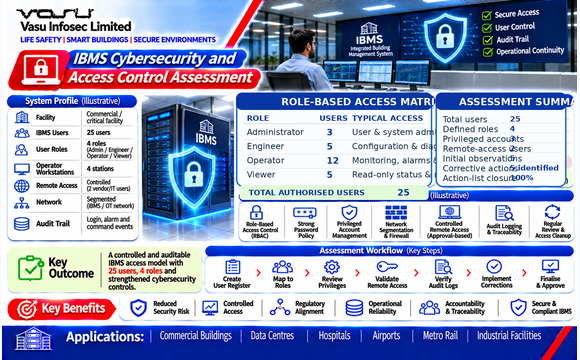
The illustrative assessment identifies five access-control observations and five corresponding corrective actions, giving 100% closure of the listed assessment actions. This is an action-list closure calculation only, not a cybersecurity compliance score; final controls require IT/OT security and OEM confirmation.
1. Project Background
This case study presents an illustrative engineering approach for assessing cybersecurity and access-control controls associated with an Integrated Building Management System (IBMS). The assessment focuses on user access, privilege management, network exposure, remote access, account governance and auditability. Final controls shall be based on the approved IT/OT cybersecurity policy, project architecture, OEM capabilities and the responsible IT/security authority.
2. Facility / System Profile
| Parameter | Design Basis | Engineering Relevance |
| Facility | Commercial / critical facility | IBMS supports operational monitoring. |
| IBMS Users | 25 illustrative users | Requires controlled account governance. |
| User Roles | 4 illustrative roles | Supports least-privilege access. |
| Operator Workstations | 4 illustrative stations | Controlled user access points. |
| Remote Access | Approved vendor/IT access where required | Requires controlled session management. |
| Network | Segmented IBMS/OT network | Limits unnecessary exposure. |
| Audit Trail | Login, alarm and command events | Supports accountability. |
3. Engineering Challenge
IBMS cybersecurity risk can arise from shared accounts, excessive privileges, unmanaged remote access, default credentials, unnecessary services and inadequate audit trails. The engineering objective is to establish a controlled access model while preserving operational availability and ensuring that authorised personnel can perform their defined duties.
- Identify IBMS user groups and responsibilities.
- Define role-based access privileges.
- Review privileged and administrator accounts.
- Assess remote-access controls.
- Verify account lifecycle and password governance.
- Review audit logging and traceability.
- Coordinate cybersecurity controls with IT/OT policy.
4. Engineering Basis and Applicable References
The governing basis should comprise the approved IT/OT cybersecurity policy, project network architecture, IBMS OEM security capabilities, user-role matrix, remote-access procedure and applicable organisational security requirements. Exact password, authentication, encryption and retention requirements are project-specific and shall be confirmed by the responsible authority.
| Reference | Engineering Application |
| Approved IT/OT Cybersecurity Policy | Defines mandatory security controls. |
| IBMS OEM Security Guide | Defines supported authentication, roles and logging. |
| Network Architecture | Defines trust boundaries and access paths. |
| User Role Matrix | Defines permissions. |
| Remote Access Procedure | Defines controlled vendor/administrator access. |
| Audit/Logging Policy | Defines event retention and review requirements. |
5. Existing Conditions / Assessment Basis
- The illustrative IBMS has 25 authorised users.
- Four roles are defined: Administrator, Engineer, Operator and Viewer.
- Three privileged accounts are identified for administrative functions.
- Two remote-access users are assumed to require controlled vendor/IT support.
- Five initial access-control observations are identified for correction.
- All quantities and observations are illustrative.
6. Engineering Methodology
- Prepare the authorised-user register.
- Map each user to an approved role.
- Review privileges against job responsibilities.
- Identify shared, dormant or unnecessary accounts.
- Review privileged-account controls.
- Validate remote-access mechanism and approval workflow.
- Verify audit logging of authentication and critical commands.
- Record findings and corrective actions.
- Freeze the approved access-control matrix.
7. Illustrative Role-Based Access Matrix
| Role | Users | Typical Access | Engineering Principle |
| Administrator | 3 | Configuration, user administration, approved maintenance | Restricted privileged access. |
| Engineer | 5 | Engineering configuration and diagnostics | Controlled technical access. |
| Operator | 12 | Monitoring, alarms and approved operational controls | Operational access. |
| Viewer | 5 | Read-only monitoring/reports | Minimum privilege. |
| Total | 25 | — | Controlled role-based access. |
8. Illustrative Privilege Assessment
| Observation | Initial Condition | Risk | Illustrative Corrective Action |
| Shared Account | 1 shared maintenance account | Traceability reduced | Replace with named accounts. |
| Dormant Account | 2 accounts | Unauthorised access exposure | Disable after approval. |
| Excess Privilege | 2 users | Unnecessary configuration access | Reduce to role-required privilege. |
| Remote Access | 2 users | External exposure | Controlled approved access. |
| Audit Review | Periodic/manual | Delayed detection | Define scheduled review. |
9. Illustrative Access-Control Rationalisation
Initial observations = 5
Corrective actions identified = 5
Illustrative closure scope = 5 ÷ 5 × 100 = 100%
This represents completion of the illustrative assessment action list, not a universal cybersecurity compliance score.
10. Engineering Solution
- Use named user accounts wherever supported.
- Apply role-based access and least-privilege principles.
- Restrict administrator privileges to authorised personnel.
- Disable dormant accounts following the approved account-management procedure.
- Control remote access through an approved mechanism with explicit authorisation.
- Maintain audit logs for authentication, configuration changes and critical operational commands.
- Review access rights periodically and after personnel-role changes.
- Coordinate all security hardening with the IBMS OEM to avoid unsupported configuration changes.
11. Access-Control Coordination Matrix
| Control | Engineering Check | Verification |
| User Account | Named/authorised user | Account-register review. |
| Role | Correct role assigned | Privilege test. |
| Administrator | Restricted access | Administrative login test. |
| Remote Access | Approved route and authorisation | Controlled session test. |
| Audit Log | Login/critical action recorded | Event-log test. |
| Dormant Accounts | Disabled as approved | Account audit. |
| Password/Authentication | Policy-compliant configuration | Security review. |
12. Coordination and Execution Challenges
- Security hardening can affect vendor-supported IBMS functionality.
- Some legacy controllers may not support modern authentication mechanisms.
- Remote vendor access must balance troubleshooting needs and security exposure.
- Shared credentials can persist from commissioning unless formally removed.
- Excessive privilege can remain unnoticed if role reviews are not periodic.
- Cybersecurity changes should be tested before production deployment.
13. Testing, Commissioning and Acceptance
- Verify all authorised accounts against the approved register.
- Test each role’s permitted and restricted functions.
- Verify administrator access controls.
- Test remote-access approval and session termination.
- Verify authentication and critical-action audit logging.
- Confirm dormant accounts are disabled as approved.
- Check that security controls do not disrupt required IBMS functions.
- Record FAT/SAT or cybersecurity test results.
- Update the final access-control matrix.
14. Engineering Outcome
| Outcome | Engineering Result |
| Facility | Illustrative commercial / critical facility. |
| Authorised Users | 25. |
| Defined Roles | 4. |
| Privileged Accounts | 3 illustrative. |
| Remote Users | 2 illustrative. |
| Initial Findings | 5. |
| Illustrative Action Closure | 100% of listed illustrative actions. |
| Primary Deliverable | Approved IBMS cybersecurity and access-control matrix. |
| Final Acceptance | Requires IT/OT security approval, OEM compatibility confirmation and documented testing. |
15. Lessons Learned
- IBMS cybersecurity should be treated as an operational engineering requirement.
- Least privilege reduces unnecessary exposure without restricting legitimate duties.
- Named accounts improve accountability and auditability.
- Remote access requires explicit ownership and approval.
- Cybersecurity controls must remain compatible with the selected IBMS and field devices.
- Access rights should be reviewed whenever responsibilities or personnel change.
16. Design Review Checklist
☐ Authorised-user register prepared
☐ Role matrix approved
☐ Privileged accounts identified
☐ Shared accounts reviewed
☐ Dormant accounts reviewed
☐ Remote-access method approved
☐ Least-privilege review completed
☐ Audit logging verified
☐ Password/authentication policy checked
☐ OEM compatibility confirmed
☐ Security testing completed
☐ Final access-control matrix issued
17. Related Engineering Content
| Content Type | Reference |
| Engineering Calculations | EC-066 to EC-075 – ELV & IBMS; EC-074 – IBMS Cybersecurity and Access Control Assessment |
| Related Case Studies | CS-066 – Point List; CS-067 – BACnet/Modbus; CS-068 – Alarm/Cause-and-Effect; CS-069 – HMI; CS-070 – Historian; CS-071 – Network; CS-072 – Server Capacity; CS-073 – Redundancy |
| Related White Paper | IBMS Cybersecurity, Role-Based Access and OT Access Governance |
| Related FAQs | IBMS Cybersecurity; User Roles; Least Privilege; Remote Access; Audit Logs; Administrator Accounts; Account Governance |
| Related Engineering Diagram | ED-074 – IBMS Role-Based Access, Remote Access and Audit-Control Architecture |
18. Source Basis and Engineering Qualification
The 25 users, four roles, three privileged accounts, two remote users and five illustrative observations in this case study are engineering assumptions created to demonstrate access-control governance. They are not claimed as project-recorded data, universal cybersecurity benchmarks or contractual requirements. Final controls shall follow the approved IT/OT cybersecurity policy, OEM capabilities and project-specific requirements.