
Case Study
IBMS FAT, SAT, Integrated Testing and Handover Assessment
Nov 2026
Direct Engineering Answer
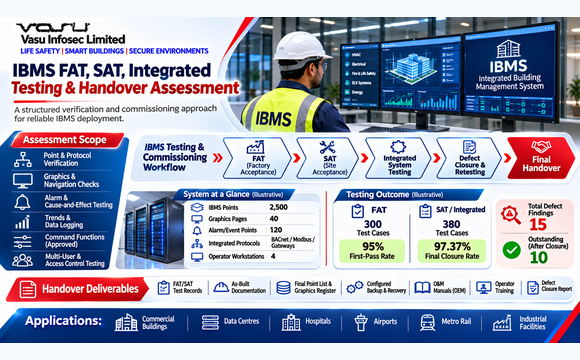
The source table and calculations use 300 FAT cases and 380 SAT/integrated cases, with illustrative first-pass FAT of 95% and final SAT/integrated closure of 97.37%. The source’s existing-conditions paragraph separately states 400 planned SAT/integrated cases; this discrepancy is retained and requires confirmation before publication or acceptance.
1. Project Background
This case study presents an illustrative engineering framework for Factory Acceptance Testing (FAT), Site Acceptance Testing (SAT), integrated system testing and final handover of an Integrated Building Management System (IBMS). The objective is to establish a traceable verification process from approved design and point lists through factory configuration, site installation, system integration, functional testing, defect closure and final documentation. Final test criteria shall be based on the approved Inspection and Test Plan (ITP), FAT/SAT procedures, project specification, OEM documentation and approved cause-and-effect.
2. Facility / System Profile
| Parameter | Design Basis | Engineering Relevance |
| Facility | Commercial / critical facility | Requires integrated monitoring and controlled handover. |
| IBMS Points | 2,500 illustrative points | Forms the functional verification baseline. |
| Graphics Pages | 40 illustrative pages | Requires screen-by-screen verification. |
| Alarm/Event Points | 120 illustrative points | Requires alarm priority and response testing. |
| Integrated Protocols | BACnet / Modbus / gateways | Requires end-to-end communication validation. |
| Operator Workstations | 4 illustrative stations | Requires user-interface and access testing. |
| FAT/SAT Records | Controlled test sheets | Provide contractual and engineering traceability. |
3. Engineering Challenge
IBMS commissioning is an integrated verification exercise rather than a simple point-to-point communication check. The engineering challenge is to prove that field equipment, controllers, gateways, network, IBMS application, graphics, alarms, historian and approved commands operate together as designed. Handover must also demonstrate that test records, as-built information and outstanding defects are controlled.
- Establish a complete FAT/SAT test matrix.
- Trace every test to an approved requirement or point.
- Verify protocol communication and point values.
- Validate alarms, cause-and-effect and operator response.
- Verify graphics, trends and event logging.
- Test approved command functions.
- Record, classify and close defects.
- Compile final handover documentation.
4. Engineering Basis and Applicable References
The governing basis should comprise the approved ITP, FAT/SAT procedures, master point list, graphics register, alarm/cause-and-effect matrix, protocol interface matrix, approved drawings, OEM manuals and project specification. Exact acceptance criteria, sample percentages and witness requirements are project-specific and shall be taken from the approved contractual documents.
| Reference | Engineering Application |
| Approved ITP | Defines inspection and test sequence and responsibilities. |
| FAT Procedure | Defines factory configuration and functional verification. |
| SAT Procedure | Defines site-installed system verification. |
| Master Point List | Defines point-level acceptance baseline. |
| Alarm/Cause-and-Effect Matrix | Defines functional response testing. |
| Approved Drawings/As-Built | Defines installed configuration and final records. |
5. Existing Conditions / Assessment Basis
- The illustrative IBMS has 2,500 unique points.
- Forty graphics pages are included.
- One hundred twenty alarm/event points are included.
- BACnet/Modbus and gateway interfaces are integrated.
- An illustrative FAT matrix contains 300 planned test cases.
- An illustrative SAT/integrated test matrix contains 400 planned test cases.
- All quantities and results in this case study are illustrative.
6. Engineering Methodology
- Freeze the approved design and test baselines.
- Prepare FAT test cases against the approved configuration.
- Verify point mapping and graphics at FAT.
- Test alarm, event and approved command functions.
- Verify protocol interfaces and representative equipment responses.
- Install and configure the site system.
- Execute SAT point-by-point or according to the approved test strategy.
- Perform integrated cause-and-effect testing.
- Record defects and retest after corrective action.
- Compile handover records and final as-built documentation.
7. Illustrative FAT/SAT Test Matrix
| Test Category | FAT Cases | SAT/Integrated Cases | Primary Objective |
| Point Mapping | 120 | 160 | Verify correct source-to-IBMS mapping. |
| Graphics/HMI | 40 | 40 | Verify display, navigation and values. |
| Alarms/Events | 60 | 80 | Verify priority, text and event logging. |
| Protocol Integration | 40 | 50 | Verify BACnet/Modbus/gateway communication. |
| Commands/Control | 20 | 30 | Verify approved commands. |
| Historian/Trends | 20 | 20 | Verify historical data. |
| Total | 300 | 380 | Illustrative planned test base. |
8. Illustrative FAT Pass-Rate Calculation
FAT planned test cases = 300
Assume 285 cases passed on first execution.
First-pass FAT rate = 285 ÷ 300 × 100 = 95%
Cases requiring corrective action/retest = 300 − 285 = 15
The 95% first-pass rate is an illustrative project-quality indicator only and is not a universal acceptance criterion.
9. Illustrative SAT / Integrated Test Closure
SAT/integrated planned cases = 380
Assume 370 cases ultimately passed after corrective action and retest.
Final closure rate = 370 ÷ 380 × 100 = 97.37%
Outstanding cases = 380 − 370 = 10
Outstanding items must be classified according to the approved punch-list process and cannot be treated as closed until contractual acceptance requirements are satisfied.
10. Illustrative Defect Classification
| Defect Class | Illustrative Quantity | Typical Treatment |
| Critical | 2 | Immediate corrective action before acceptance. |
| Major | 5 | Correction and witnessed retest. |
| Minor | 8 | Correction or approved punch-list closure. |
| Total Findings | 15 | All findings tracked to closure. |
11. Engineering Solution
- Use a traceable requirement-to-test matrix.
- Maintain separate FAT, SAT and integrated cause-and-effect test records.
- Use the approved point list as the baseline for point verification.
- Record actual field values and expected values during testing.
- Retest failed points after correction rather than overwriting the original result.
- Maintain a controlled defect/punch list with responsibility and target closure.
- Verify final graphics, historian, alarms and event logs before handover.
- Compile as-built drawings, point lists, test reports, manuals, backups and training records into the handover dossier.
12. Integrated Testing Matrix
| System / Function | Test Activity | Acceptance Evidence |
| BACnet/Modbus | Communication and point validation | Signed test sheet. |
| Fire/Life-Safety Interface | Approved alarm/status interface | Cause-and-effect test record. |
| HVAC | Status, alarm and approved commands | Functional test. |
| Electrical/DG | Status, alarm and measurements | Functional test. |
| HMI | Graphics/navigation verification | Screen checklist. |
| Historian | Trend/event retrieval | Trend test record. |
| User Access | Role/permission verification | Access test record. |
13. Coordination and Execution Challenges
- FAT configuration may differ from the final site equipment configuration.
- Site network and third-party interfaces can introduce defects not visible during FAT.
- Cause-and-effect testing requires coordination across multiple vendors.
- Field equipment availability can delay integrated testing.
- Changes to point lists or graphics during SAT can create documentation mismatches.
- Punch-list closure must be controlled to prevent unresolved defects from being hidden in final records.
14. Testing, Commissioning and Acceptance
- Confirm approved FAT/SAT procedures and test baselines.
- Verify FAT configuration and record results.
- Verify site installation and network readiness.
- Execute SAT point and interface tests.
- Perform integrated alarm/cause-and-effect tests.
- Test graphics, trends and event history.
- Test approved control functions.
- Record defects and assign responsibility.
- Retest corrected items.
- Verify final documentation and backups.
- Obtain required consultant/client/OEM sign-off.
15. Engineering Outcome
| Outcome | Engineering Result |
| Facility | Illustrative commercial / critical facility. |
| Unique Points | 2,500. |
| Graphics Pages | 40. |
| Alarm/Event Points | 120. |
| FAT Planned Cases | 300. |
| Illustrative FAT First-Pass Rate | 95%. |
| SAT/Integrated Planned Cases | 380. |
| Illustrative Final Closure Rate | 97.37%. |
| Illustrative Findings | 15. |
| Primary Deliverable | Complete IBMS testing and handover dossier. |
| Final Acceptance | Subject to approved contractual test criteria, defect closure and stakeholder sign-off. |
16. Lessons Learned
- FAT reduces site integration risk but does not replace SAT.
- Every failed test should remain traceable through correction and retest.
- Integrated testing is essential where multiple systems contribute to a single operational response.
- Point lists, graphics, alarm matrices and test sheets must use consistent revision baselines.
- Handover quality depends on documentation completeness as much as functional performance.
- Outstanding defects must be controlled through an approved punch-list and acceptance process.
17. Design Review / Handover Checklist
☐ Approved FAT procedure issued
☐ Approved SAT/ITP issued
☐ Point list frozen
☐ Graphics register frozen
☐ Alarm/cause-and-effect matrix approved
☐ Protocol interface matrix approved
☐ FAT completed
☐ SAT completed
☐ Integrated testing completed
☐ Defect/punch list closed or formally accepted
☐ As-built drawings issued
☐ Final point list and backups issued
☐ O&M manuals issued
☐ Training completed where specified
☐ Final handover/sign-off obtained
18. Related Engineering Content
| Content Type | Reference |
| Engineering Calculations | EC-066 to EC-075 – ELV & IBMS; EC-075 – IBMS FAT, SAT, Integrated Testing and Handover Assessment |
| Related Case Studies | CS-066 to CS-074 – ELV & IBMS |
| Related White Paper | IBMS FAT, SAT, Integrated Testing, Defect Closure and Handover Engineering |
| Related FAQs | IBMS FAT; SAT; Integrated Testing; Cause-and-Effect Testing; Punch List; Handover; As-Built; Test Records |
| Related Engineering Diagram | ED-075 – IBMS FAT-to-SAT-to-Integrated Testing and Handover Workflow |
19. Source Basis and Engineering Qualification
The 2,500 points, 40 graphics pages, 120 alarm/event points, 300 FAT cases, 380 SAT/integrated cases and illustrative test results in this case study are engineering assumptions created to demonstrate a controlled commissioning and handover methodology. They are not claimed as project-recorded data, universal test quantities, pass-rate benchmarks or contractual acceptance criteria. Final testing shall follow approved project documents.