
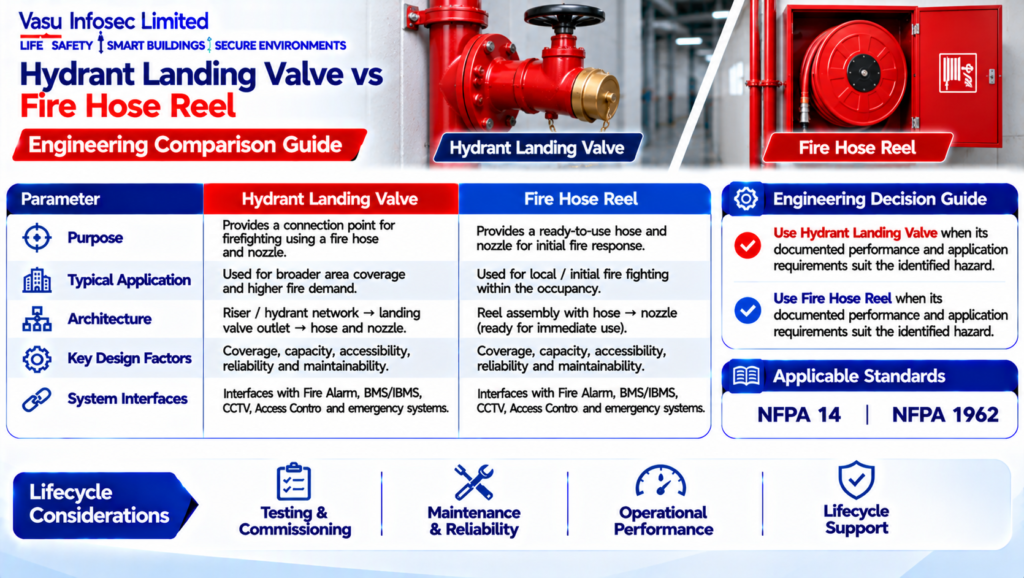
Comparison Guide
Hydrant Landing Valve vs Fire Hose Reel
Nov 2026
Direct Answer
Hydrant Landing Valve and Fire Hose Reel should be compared against the identified hazard, documented performance, environment, interfaces and lifecycle requirements. The supplied source guide does not establish that either option is universally preferable; selection must follow the approved project design basis and risk assessment.
At a Glance
| Comparison topic | Hydrant Landing Valve vs Fire Hose Reel |
| Decision basis | Approved risk assessment and design basis |
| Key review factors | Application, performance, compatibility, environment and interfaces |
| Testing | Installation, functionality, alarms/controls, interfaces and approved sequences |
| Lifecycle | Inspection, functional testing, defect records and impairment control |
Technical Content
1. Engineering Overview
Hydrant Landing Valve and Fire Hose Reel address related engineering requirements but differ in application, architecture, performance, interfaces and lifecycle considerations. The comparison should be evaluated against the approved project design basis and identified risk.
2. Technical Comparison
3. Key Engineering Differences
Hydrant Landing Valve: Evaluate its operating principle, coverage, installation requirements, interfaces and limitations within the approved design.
Fire Hose Reel: Evaluate its operating principle, coverage, installation requirements, interfaces and limitations within the approved design.
4. Testing & Commissioning
Verify equipment installation, identification, functionality, alarm/control response, cause-and-effect, interfaces, fault conditions, emergency power and representative integrated scenarios.
5. Maintenance & Reliability
Establish planned inspection, functional testing, calibration where applicable, defect management, records and impairment controls in accordance with the approved maintenance philosophy and manufacturer requirements.
6. Engineering Decision Guide
Select Hydrant Landing Valve when its documented technical performance and application requirements provide the appropriate solution for the identified hazard.
Select Fire Hose Reel when its documented technical performance and application requirements provide the appropriate solution for the identified hazard.
7. Final Engineering Note
Final selection should be based on the approved risk assessment, design basis, project specification, applicable codes and standards, authority requirements, manufacturer requirements and lifecycle considerations.
Technical Comparison Table
| Comparison Parameter | Hydrant Landing Valve | Fire Hose Reel |
| Primary Purpose | Applied where hydrant landing valve meets the identified project requirement. | Applied where fire hose reel meets the identified project requirement. |
| Typical Application | Selected according to hazard, occupancy, environment and performance requirements. | Selected according to hazard, occupancy, environment and performance requirements. |
| Architecture | Equipment / devices → control / processing → outputs → monitoring. | Equipment / devices → control / processing → outputs → monitoring. |
| Key Design Factors | Coverage, capacity, compatibility, reliability, environmental suitability and maintainability. | Coverage, capacity, compatibility, reliability, environmental suitability and maintainability. |
| System Interfaces | Coordinate with applicable fire alarm, BMS / IBMS, CCTV, access control, power and emergency systems. | Coordinate with applicable fire alarm, BMS / IBMS, CCTV, access control, power and emergency systems. |
| Testing & Commissioning | Verify installation, functionality, alarms / controls, interfaces, fault monitoring and approved sequences. | Verify installation, functionality, alarms / controls, interfaces, fault monitoring and approved sequences. |
| Maintenance | Inspection, functional testing, defect correction, records and impairment control. | Inspection, functional testing, defect correction, records and impairment control. |
| Engineering Selection | Select when documented performance and project requirements best match the identified risk. | Select when documented performance and project requirements best match the identified risk. |
Frequently Asked Questions
Is one option always better?
No universal preference is established by the source guide. Compare both options against the identified hazard, approved design basis, project specification and manufacturer requirements.
What should be reviewed before selection?
Review the approved risk assessment, design basis, project specification, applicable codes and standards, authority requirements, manufacturer instructions, interfaces and lifecycle considerations.
What should testing and commissioning verify?
The source calls for checking equipment installation, identification, functionality, alarm/control response, cause-and-effect, interfaces, fault conditions, emergency power and representative integrated scenarios.
What should maintenance include?
Planned inspection, functional testing, calibration where applicable, defect management, records and impairment controls, in accordance with the approved maintenance philosophy and manufacturer requirements.
SEO & Publishing Details
SEO title: Hydrant Landing Valve vs Fire Hose Reel | CG-020
Meta description: Engineering comparison guide for Hydrant Landing Valve vs Fire Hose Reel. Review design factors, system interfaces, testing, maintenance and project-specific selection criteria.
Suggested URL slug: cg-020-hydrant-landing-valve-vs-fire-hose-reel
Primary keyword: Hydrant Landing Valve vs Fire Hose Reel
Secondary keywords: Hydrant Landing Valve; Fire Hose Reel; fire protection engineering; fire suppression system; system selection; design basis; risk assessment; testing and commissioning; maintenance; manufacturer requirements; fire safety
Suggested image alt text: Engineering comparison guide illustrating Hydrant Landing Valve vs Fire Hose Reel.