
Comparison Guide
Prescriptive Design vs Performance-Based Design
Nov 2026
Direct Answer
Prescriptive Design vs Performance-Based Design should be evaluated against the approved project design basis and identified risk. The source guide does not establish a universal preferred option or provide detailed comparative performance data; final selection should be based on documented project requirements.
At a Glance
| Comparison topic | Prescriptive Design vs Performance-Based Design |
| Decision basis | Approved risk assessment and project design basis |
| Key review factors | Application, performance, compatibility, environment and interfaces |
| Verification required | Project specification, applicable codes and standards, authority and manufacturer requirements |
| Source detail level | High-level framework; detailed comparative performance data and selection thresholds are not supplied |
Technical Content
1. Engineering Overview
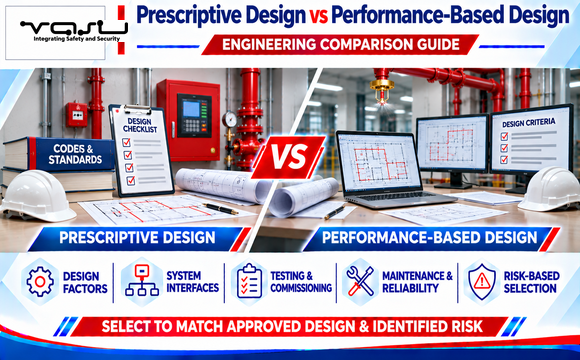
Prescriptive Design and Performance-Based Design address related engineering requirements but differ in application, architecture, performance, interfaces and lifecycle considerations. The comparison should be evaluated against the approved project design basis and identified risk.
2. Technical Comparison
| Comparison Parameter | Prescriptive Design | Performance-Based Design |
| Primary Purpose | Applied where prescriptive design meets the identified project requirement. | Applied where performance-based design meets the identified project requirement. |
| Typical Application | Selected according to hazard, occupancy, environment and performance requirements. | Selected according to hazard, occupancy, environment and performance requirements. |
| Architecture | Equipment / devices → control / processing → outputs → monitoring. | Equipment / devices → control / processing → outputs → monitoring. |
| Key Design Factors | Coverage, capacity, compatibility, reliability, environmental suitability and maintainability. | Coverage, capacity, compatibility, reliability, environmental suitability and maintainability. |
| System Interfaces | Coordinate with applicable fire alarm, BMS / IBMS, CCTV, access control, power and emergency systems. | Coordinate with applicable fire alarm, BMS / IBMS, CCTV, access control, power and emergency systems. |
| Testing & Commissioning | Verify installation, functionality, alarms / controls, interfaces, fault monitoring and approved sequences. | Verify installation, functionality, alarms / controls, interfaces, fault monitoring and approved sequences. |
| Maintenance | Inspection, functional testing, defect correction, records and impairment control. | Inspection, functional testing, defect correction, records and impairment control. |
| Engineering Selection | Select when documented performance and project requirements best match the identified risk. | Select when documented performance and project requirements best match the identified risk. |
3. Key Engineering Differences
Prescriptive Design: Evaluate its operating principle, coverage, installation requirements, interfaces and limitations within the approved design.
Performance-Based Design: Evaluate its operating principle, coverage, installation requirements, interfaces and limitations within the approved design.
4. Testing & Commissioning
Verify equipment installation, identification, functionality, alarm/control response, cause-and-effect, interfaces, fault conditions, emergency power and representative integrated scenarios.
5. Maintenance & Reliability
Establish planned inspection, functional testing, calibration where applicable, defect management, records and impairment controls in accordance with the approved maintenance philosophy and manufacturer requirements.
6. Engineering Decision Guide
Select Prescriptive Design when its documented technical performance and application requirements provide the appropriate solution for the identified hazard.
Select Performance-Based Design when its documented technical performance and application requirements provide the appropriate solution for the identified hazard.
7. Final Engineering Note
Final selection should be based on the approved risk assessment, design basis, project specification, applicable codes and standards, authority requirements, manufacturer requirements and lifecycle considerations.
Frequently Asked Questions
Is one option always better?
No universal preference is established by the source guide. Compare Prescriptive Design vs Performance-Based Design against the identified hazard, approved design basis and documented project requirements.
What should be reviewed before selection?
Review the approved risk assessment, design basis, project specification, applicable codes and standards, authority requirements, manufacturer requirements and lifecycle considerations.
What should testing and commissioning verify?
Verify equipment installation, identification, functionality, alarm/control response, cause-and-effect, interfaces, fault conditions, emergency power and representative integrated scenarios.
What should maintenance include?
Establish planned inspection, functional testing, calibration where applicable, defect management, records and impairment controls in accordance with the approved maintenance philosophy and manufacturer requirements.