
Engineering Calculation
Battery Bank Capacity Calculation
Nov 2026
Direct Answer
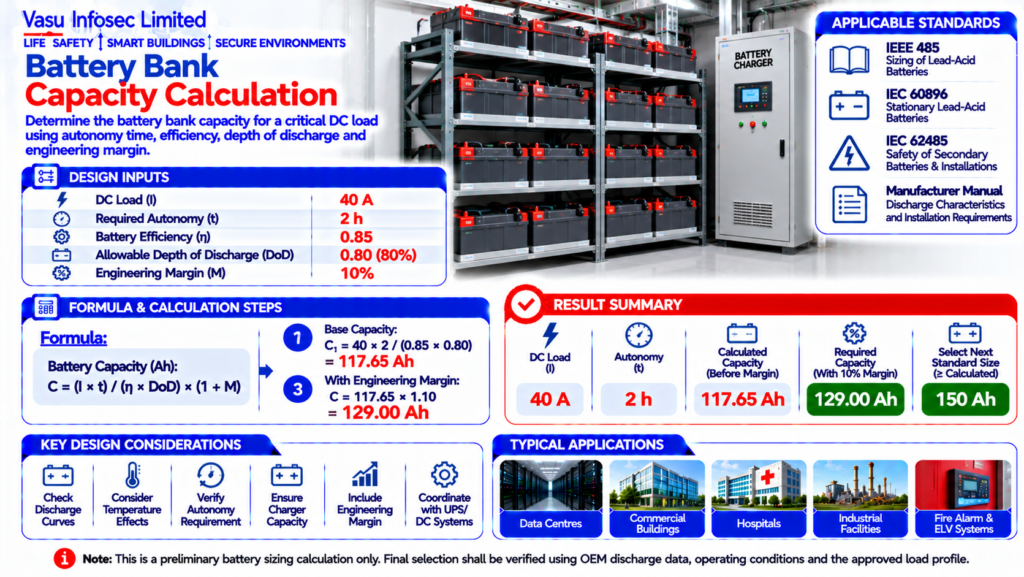
Battery capacity is determined from DC load and required autonomy, then adjusted for battery efficiency, allowable depth of discharge and engineering margin. For a 40 A load and 2-hour autonomy, the worked example requires approximately 129 Ah.
At a Glance
| Resource ID | EC-090 |
| DC Load | I | 40 | A |
| Required Autonomy | t | 2 | h |
| Battery Efficiency | η | 0.85 | – |
| Allowable Depth of Discharge | DoD | 0.80 | – |
| Engineering Margin | M | 10 | % |
| Source detail | Refer to Technical Content |
| Source detail | Refer to Technical Content |
Calculation Method & Worked Example
Area: A = L × W
Detector Quantity: N = A / C
Area = 30 × 18 = 540 m²
Detector Quantity = 540 ÷ 81 = 6.67
Round Up = 7 Smoke Detectors.
Room Area: 540 m²
Coverage: 81 m² per detector
Calculated Quantity: 6.67
Required Quantity: 7 Nos.
Applicable Standards Listed in the Source
| IEEE 485 | Sizing of Lead-Acid Batteries for Stationary Applications |
| IEC 60896 | Stationary Lead-Acid Batteries |
| IEC 62485 | Safety Requirements for Secondary Batteries and Battery Installations |
| Manufacturer Manual | Battery discharge characteristics, end voltage and installation requirements |
Technical Content
1. Purpose
To determine the battery bank capacity required to support a critical DC load for the specified backup duration while accounting for battery efficiency, allowable depth of discharge and engineering margin.
2. Engineering Objective
To establish the required battery capacity in ampere-hours from the DC load, required autonomy time, discharge allowance and engineering margin.
3. Applicable Standards
Standards and descriptions are reproduced from the source document.
4. Design Inputs
DC Load | I | 40 | A
Required Autonomy | t | 2 | h
Battery Efficiency | η | 0.85 | –
Allowable Depth of Discharge | DoD | 0.80 | –
Engineering Margin | M | 10 | %
5. Assumptions
The critical DC load is 40 A at the battery system voltage. Required autonomy is 2 hours. Battery efficiency is taken as 0.85, allowable depth of discharge is 0.80, and a 10% engineering margin is applied for the worked example. Final sizing shall follow the selected battery manufacturer’s discharge data.
6. Formula(s)
Area: A = L × W
Detector Quantity: N = A / C
Final Quantity = Round Up(N)
Area: A = L × W
Detector Quantity: N = A / C
Final Quantity = Round Up(N)
Room Area: 540 m²
Coverage: 81 m² per detector
Calculated Quantity: 6.67
Required Quantity: 7 Nos.
7. Variables Explained
C = Battery capacity (Ah), I = DC load current (A), t = autonomy time (h), η = battery efficiency, DoD = allowable depth of discharge, M = engineering margin.
8. Step-by-Step Calculation
Area = 30 × 18 = 540 m²
Detector Quantity = 540 ÷ 81 = 6.67
Round Up = 7 Smoke Detectors.
Area = 30 × 18 = 540 m²
Detector Quantity = 540 ÷ 81 = 6.67
Round Up = 7 Smoke Detectors.
Room Area: 540 m²
Coverage: 81 m² per detector
Calculated Quantity: 6.67
Required Quantity: 7 Nos.
9. Worked Engineering Example
A critical DC load of 40 A requiring 2 hours of autonomy results in a calculated battery requirement of approximately 129 Ah after efficiency, depth-of-discharge and engineering-margin allowances. A suitable standard battery capacity shall be selected above this calculated value.
10. Engineering Output
Room Area: 540 m²
Coverage: 81 m² per detector
Calculated Quantity: 6.67
Required Quantity: 7 Nos.
Room Area: 540 m²
Coverage: 81 m² per detector
Calculated Quantity: 6.67
Required Quantity: 7 Nos.
Room Area: 540 m²
Coverage: 81 m² per detector
Calculated Quantity: 6.67
Required Quantity: 7 Nos.
Room Area: 540 m²
Coverage: 81 m² per detector
Calculated Quantity: 6.67
Required Quantity: 7 Nos.
11. Design Considerations
Verify the battery manufacturer’s discharge curves at the actual end voltage, temperature and duty cycle. Consider standby and alarm loads separately where applicable.
12. Common Design Mistakes
Using nominal Ah without discharge-rate verification, ignoring temperature effects, applying an arbitrary depth of discharge, or omitting the end-of-life capacity allowance.
13. Practical Site Notes
Coordinate battery sizing with charger capacity, DC distribution, UPS/DC systems, emergency loads, enclosure ventilation and battery maintenance access.
14. Limitations
Preliminary battery sizing calculation only. Final battery selection shall be verified using OEM discharge data/software and the approved load profile.
15. Related Engineering Systems
UPS System, DC Distribution, Battery Charger, Critical Control Panels, Emergency Lighting, Fire Alarm and Security Systems.
16. Cross References
Related FAQ: Fire Detection & Alarm Systems
Related White Paper: VEP-001
Related Case Study: CS-001
Related Diagram: ED-001
17. SEO Meta Title
Battery Bank Capacity Calculation | EC-090
18. SEO Meta Description
Engineering calculation for battery bank capacity using DC load, autonomy time, efficiency, allowable depth of discharge and engineering margin.
19. URL Slug
ec-090-battery-bank-capacity-calculation
20. Keywords (15)
Battery Bank Capacity, Battery Sizing, Ah Calculation, DC Backup, Battery Autonomy, UPS Battery, IEC 60896, IEEE 485, Critical Power, DC System, Battery Charger, Electrical Engineering, Backup Power, Engineering Calculation, Energy Storage
21. AI Search Summary
Battery capacity is determined from DC load and required autonomy, then adjusted for battery efficiency, allowable depth of discharge and engineering margin. For a 40 A load and 2-hour autonomy, the worked example requires approximately 129 Ah.
Frequently Asked Questions
What is the purpose of EC-090?
To determine the battery bank capacity required to support a critical DC load for the specified backup duration while accounting for battery efficiency, allowable depth of discharge and engineering margin.
What result does the source example report?
A critical DC load of 40 A requiring 2 hours of autonomy results in a calculated battery requirement of approximately 129 Ah after efficiency, depth-of-discharge and engineering-margin allowances. A suitable standard battery capacity shall be selected above this calculated value.
Can this preliminary calculation be used as final design approval?
Preliminary battery sizing calculation only. Final battery selection shall be verified using OEM discharge data/software and the approved load profile.
What should be checked before final selection or implementation?
Verify the battery manufacturer’s discharge curves at the actual end voltage, temperature and duty cycle. Consider standby and alarm loads separately where applicable.
SEO & Publishing Details
| SEO meta title | Battery Bank Capacity Calculation | EC-090 |
| Meta description | Engineering calculation for battery bank capacity using DC load, autonomy time, efficiency, allowable depth of discharge and engineering margin. |
| Primary keyword | Battery Bank Capacity |
| Secondary keywords | Battery Sizing; Ah Calculation; DC Backup; Battery Autonomy; UPS Battery; IEC 60896 |
| Suggested URL slug | ec-090-battery-bank-capacity-calculation |
| Suggested image alt text | Battery Bank Capacity Calculation – Engineering Calculation EC-090. |