
Engineering Calculation
CCTV Camera Coverage Area Calculation
Nov 2026
At a Glance
| Resource ID | EC-079 |
| Installation Height | H | 4.0 | m |
| Horizontal Field of View | FOV | 90 | deg |
| Observation Distance | D | 12 | m |
| Lens Type | Fixed | – |
| Source detail | Refer to Technical Content |
| Source detail | Refer to Technical Content |
| Source detail | Refer to Technical Content |
Technical Content
1. Purpose
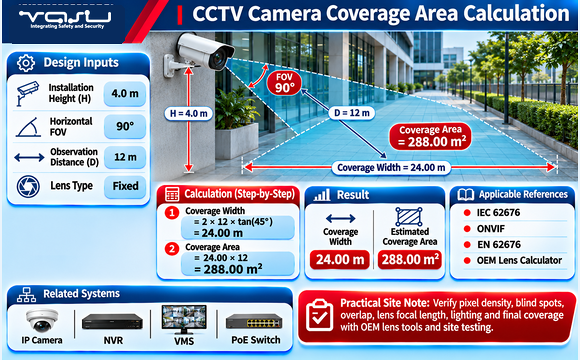
To estimate the ground coverage area of a CCTV camera based on installation height and field of view for preliminary surveillance planning.
2. Engineering Objective
To determine the approximate horizontal coverage width and monitored area for camera placement. Final coverage shall be verified using OEM lens calculators and site testing.
3. Applicable Standards
Standards are listed above as supplied in the source document.
4. Design Inputs
Installation Height = H = 4.0 = m; Horizontal Field of View = FOV = 90 = deg; Observation Distance = D = 12 = m; Lens Type = Fixed = –
5. Assumptions
Flat terrain is assumed with no obstructions. Coverage is based on horizontal field of view only.
6. Formula(s)
Coverage Width = 2 × Distance × tan(FOV/2)
Coverage Area = Width × Distance
Coverage Width = 2 × Distance × tan(FOV/2)
Coverage Area = Width × Distance
Coverage Width: 24.00 m
Estimated Coverage Area: 288.00 m²
7. Variables Explained
H = Camera height; D = Observation distance; FOV = Horizontal field of view.
8. Step-by-Step Calculation
Coverage Width = 2 × 12.0 × tan(45°) = 24.00 m
Coverage Area = 24.00 × 12.0 = 288.00 m²
Coverage Width = 2 × 12.0 × tan(45°) = 24.00 m
Coverage Area = 24.00 × 12.0 = 288.00 m²
Coverage Width: 24.00 m
Estimated Coverage Area: 288.00 m²
9. Worked Engineering Example
A camera installed at 4.0 m with a 90° field of view monitoring up to 12 m covers approximately 24.00 m in width and 288.00 m² of ground area.
10. Engineering Output
Coverage Width: 24.00 m
Estimated Coverage Area: 288.00 m²
Coverage Width: 24.00 m
Estimated Coverage Area: 288.00 m²
Coverage Width: 24.00 m
Estimated Coverage Area: 288.00 m²
Coverage Width: 24.00 m
Estimated Coverage Area: 288.00 m²
11. Design Considerations
Verify identification criteria, pixel density, lens focal length, lighting conditions, blind spots and overlap.
12. Common Design Mistakes
Ignoring pixel density, excessive mounting height, inadequate overlap and incorrect lens selection.
13. Practical Site Notes
Validate camera view on site and adjust mounting angle to eliminate blind spots.
14. Limitations
Preliminary engineering calculation only. Final coverage shall be confirmed using OEM lens design tools and field testing.
15. Related Engineering Systems
IP Cameras, NVR, VMS, PoE Switches, Network Infrastructure.
16. Keywords (15)
CCTV Coverage,Camera Coverage,Lens Calculation,IEC62676,ONVIF,Field of View,CCTV Design,Engineering Calculation,Surveillance,Camera Placement,Security Systems,Pixel Density,Lens,FOV,NVR
17. AI Search Summary
CCTV camera coverage area is estimated from the observation distance and horizontal field of view. In this example, the camera covers approximately 288.00 m². Final verification should be completed using the camera manufacturer’s lens calculator and site validation.
Frequently Asked Questions
How is the preliminary detector quantity calculated?
CCTV camera coverage area is estimated from the observation distance and horizontal field of view. In this example, the camera covers approximately 288.00 m². Final verification should be completed using the camera manufacturer’s lens calculator and site validation.
What is the result for this example?
A camera installed at 4.0 m with a 90° field of view monitoring up to 12 m covers approximately 24.00 m in width and 288.00 m² of ground area.
Does this establish the final detector layout?
Preliminary engineering calculation only. Final coverage shall be confirmed using OEM lens design tools and field testing.
What design factors should be checked?
Verify identification criteria, pixel density, lens focal length, lighting conditions, blind spots and overlap.