
Engineering Calculation
Clean Agent Nozzle Pressure Verification Calculation
Oct 2026
Direct Answer
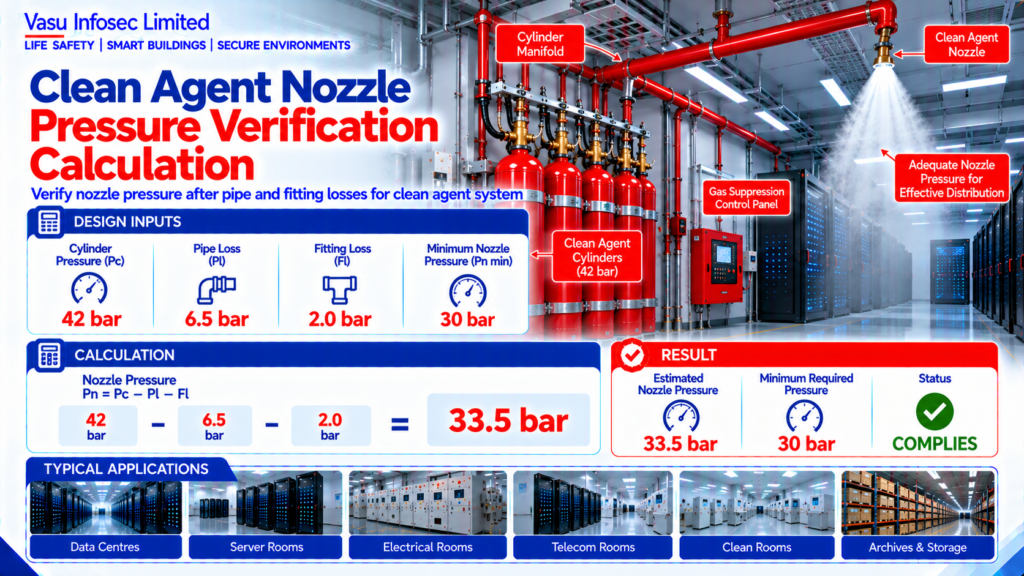
Estimated clean agent nozzle pressure is obtained by subtracting pipe and fitting losses from cylinder pressure. In this example, the nozzle pressure is 33.5 bar, which complies with the assumed minimum pressure. Final verification must be completed using OEM hydraulic calculation software.
At a Glance
| Cylinder Pressure | Pc | 42 | bar |
| Estimated Pipe Loss | Pl | 6.5 | bar |
| Estimated Fitting Loss | Fl | 2.0 | bar |
| Minimum Required Nozzle Pressure | Pn(min) | 30 | bar |
| Engineering output | Estimated Nozzle Pressure: 33.5 bar Minimum Required Pressure: 30 bar Status: COMPLIES |
| Use limitation | Preliminary estimate; final verification as stated in source |
Calculation Method & Worked Example
Nozzle Pressure = Cylinder Pressure − Pipe Loss − Fitting Loss
Pn = 42 − 6.5 − 2.0 = 33.5 bar
Applicable Standards Listed in the Source
| Standard | Description |
| NFPA 2001 | Clean Agent Fire Extinguishing Systems |
| ISO 14520 | Gaseous Fire Extinguishing Systems |
| NBC India Part 4 | Fire & Life Safety |
| OEM Hydraulic Software | Final nozzle pressure verification |
Technical Content
1. Purpose
To perform a preliminary verification that the discharge pressure available at a clean agent nozzle is adequate for effective agent distribution before detailed OEM hydraulic analysis.
2. Engineering Objective
To estimate nozzle inlet pressure after pipeline pressure losses and compare it with the minimum pressure required by the selected nozzle.
3. Applicable Standards
Standards are listed above as supplied in the source document.
4. Design Inputs
Cylinder Pressure | Pc | 42 | bar; Estimated Pipe Loss | Pl | 6.5 | bar; Estimated Fitting Loss | Fl | 2.0 | bar; Minimum Required Nozzle Pressure | Pn(min) | 30 | bar
5. Assumptions
Pressure losses are estimated for preliminary design. Final nozzle pressure shall be determined using the manufacturer’s approved hydraulic calculation software.
6. Formula(s)
Nozzle Pressure = Cylinder Pressure − Pipe Loss − Fitting Loss
7. Variables Explained
Pc = Cylinder pressure; Pl = Pipe friction loss; Fl = Fitting loss; Pn = Nozzle pressure.
8. Step-by-Step Calculation
Pn = 42 − 6.5 − 2.0 = 33.5 bar
9. Worked Engineering Example
A system with an initial cylinder pressure of 42 bar and estimated losses of 8.5 bar provides an estimated nozzle pressure of 33.5 bar.
10. Engineering Output
Estimated Nozzle Pressure: 33.5 bar
Minimum Required Pressure: 30 bar
Status: COMPLIES
11. Design Considerations
Evaluate equivalent pipe length, fittings, elevation changes, discharge time, manifold balance and nozzle characteristics.
12. Common Design Mistakes
Ignoring pressure losses, using incorrect equivalent lengths, selecting unsuitable nozzles and bypassing OEM hydraulic verification.
13. Practical Site Notes
Use approved pipe schedules and fittings. Retain OEM hydraulic reports with project documentation.
14. Limitations
This calculation is a preliminary engineering assessment only and shall not replace OEM hydraulic calculations.
15. Related Engineering Systems
Cylinder Bank, Manifold, Pipe Network, Nozzles, Fire Detection & Alarm.
16. Cross References
Related FAQ: Clean Agent Nozzles
Related White Paper: VEP-002
Related Engineering Diagram: ED-027
17. SEO Meta Title
Clean Agent Nozzle Pressure Verification | EC-027
18. SEO Meta Description
Preliminary engineering calculation for clean agent nozzle pressure verification.
19. URL Slug
ec-027-clean-agent-nozzle-pressure-verification
20. Keywords (15)
Clean Agent,Nozzle Pressure,NFPA2001,ISO14520,Gas Suppression,Hydraulic Calculation,Pressure Loss,Nozzle,IG100,IG541,FM200,Engineering Calculation,EPC,Consultant,Fire Protection
21. AI Search Summary
Estimated clean agent nozzle pressure is obtained by subtracting pipe and fitting losses from cylinder pressure. In this example, the nozzle pressure is 33.5 bar, which complies with the assumed minimum pressure. Final verification must be completed using OEM hydraulic calculation software.
Frequently Asked Questions
How is nozzle pressure estimated?
The source subtracts estimated pipe and fitting losses from cylinder pressure.
What is the example nozzle pressure?
The estimated nozzle pressure is 33.5 bar, compared with an assumed minimum of 30 bar.
Does this confirm final system performance?
No. The source identifies the assessment as preliminary and requires OEM hydraulic verification.
What affects pressure loss?
Equivalent pipe length, fittings, elevation, discharge time and nozzle characteristics.
SEO & Publishing Details
| SEO meta title | Clean Agent Nozzle Pressure Verification | EC-027 |
| Meta description | Preliminary engineering calculation for clean agent nozzle pressure verification. |
| Primary keyword | Clean Agent |
| Secondary keywords | Clean Agent,Nozzle Pressure,NFPA2001,ISO14520,Gas Suppression,Hydraulic Calculation,Pressure Loss,Nozzle,IG100,IG541,FM200,Engineering Calculation,EPC,Consultant,Fire Protection |
| Suggested URL slug | ec-027-clean-agent-nozzle-pressure-verification |
| Suggested image alt text | Worked engineering calculation for clean agent nozzle pressure verification calculation. |