
Engineering Calculation
Clean Agent Pipe Pressure Loss Calculation
Oct 2026
Direct Answer
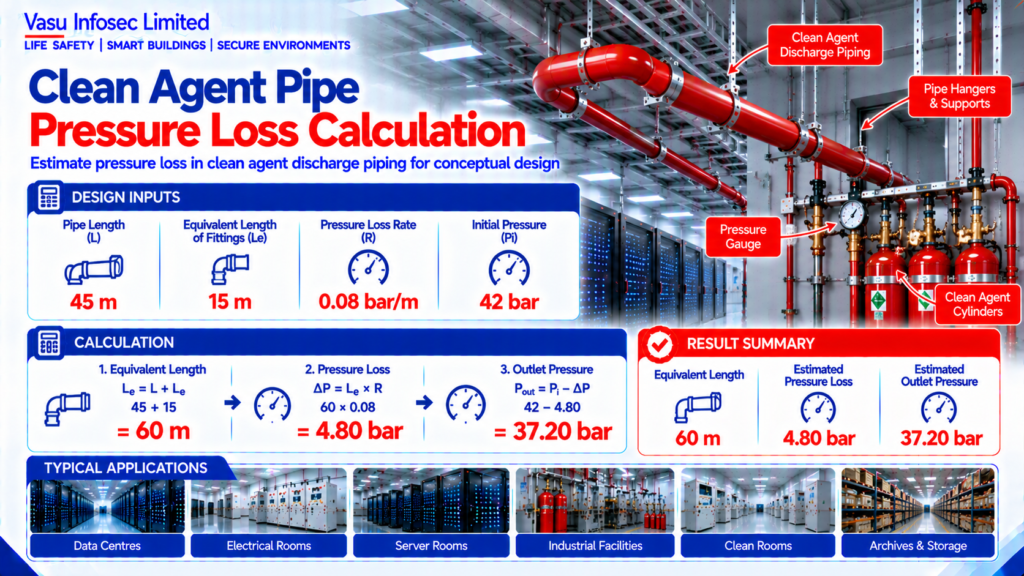
Estimated clean agent pipe pressure loss is calculated from equivalent pipe length and an assumed pressure-loss rate. In this example, the pressure loss is 4.80 bar. Final values must be verified using the manufacturer’s approved hydraulic calculation software.
At a Glance
| Pipe Length | L | 45 | m |
| Equivalent Length of Fittings | Le | 15 | m |
| Pressure Loss Rate | R | 0.08 | bar/m |
| Initial Pressure | Pi | 42 | bar |
| Engineering output | Equivalent Length: 60 m Estimated Pressure Loss: 4.80 bar Estimated Outlet Pressure: 37.20 bar |
| Use limitation | Preliminary estimate; final verification as stated in source |
Calculation Method & Worked Example
Equivalent Length = L + Le
Pressure Loss = Equivalent Length × Loss Rate
Outlet Pressure = Initial Pressure − Pressure Loss
Equivalent Length = 45+15=60 m
Pressure Loss = 60×0.08=4.80 bar
Outlet Pressure = 42-4.80=37.20 bar
Applicable Standards Listed in the Source
| Standard | Description |
| NFPA 2001 | Clean Agent Fire Extinguishing Systems |
| ISO 14520 | Gaseous Fire Extinguishing Systems |
| NBC India Part 4 | Fire & Life Safety |
| OEM Hydraulic Software | Final pressure-loss verification |
Technical Content
1. Purpose
To estimate the preliminary pressure loss through clean agent discharge piping for conceptual design prior to manufacturer hydraulic verification.
2. Engineering Objective
To determine approximate friction loss in a clean agent pipeline using simplified engineering assumptions for routing and budgeting.
3. Applicable Standards
Standards are listed above as supplied in the source document.
4. Design Inputs
Pipe Length | L | 45 | m; Equivalent Length of Fittings | Le | 15 | m; Pressure Loss Rate | R | 0.08 | bar/m; Initial Pressure | Pi | 42 | bar
5. Assumptions
Pressure-loss rate is assumed constant for preliminary estimation. Compressible flow effects are ignored. Final design shall use OEM hydraulic software.
6. Formula(s)
Equivalent Length = L + Le
Pressure Loss = Equivalent Length × Loss Rate
Outlet Pressure = Initial Pressure − Pressure Loss
7. Variables Explained
L = Straight pipe length; Le = Equivalent fitting length; R = Pressure-loss rate; Pi = Initial pressure.
8. Step-by-Step Calculation
Equivalent Length = 45+15=60 m
Pressure Loss = 60×0.08=4.80 bar
Outlet Pressure = 42-4.80=37.20 bar
9. Worked Engineering Example
A pipeline with 45 m straight length and 15 m equivalent fittings has an equivalent length of 60 m. At an assumed loss rate of 0.08 bar/m, the estimated pressure loss is 4.80 bar.
10. Engineering Output
Equivalent Length: 60 m
Estimated Pressure Loss: 4.80 bar
Estimated Outlet Pressure: 37.20 bar
11. Design Considerations
Consider equivalent lengths, elevation changes, manifold balance, nozzle pressure requirements and discharge duration.
12. Common Design Mistakes
Ignoring fitting losses, excessive elbows, incorrect pipe sizing and using manual calculations for final approval.
13. Practical Site Notes
Keep pipe routes as short and direct as practical and coordinate with structural and MEP services.
14. Limitations
This is a preliminary engineering calculation only. Final pressure-loss calculations shall be performed using OEM-listed hydraulic software.
15. Related Engineering Systems
Cylinder Bank, Manifold, Nozzles, Fire Detection & Alarm.
16. Cross References
Related FAQ: Gas Suppression Pipework
Related White Paper: VEP-002
Related Engineering Diagram: ED-028
17. SEO Meta Title
Clean Agent Pipe Pressure Loss Calculation | EC-028
18. SEO Meta Description
Preliminary engineering calculation for clean agent pipe pressure loss.
19. URL Slug
ec-028-clean-agent-pipe-pressure-loss-calculation
20. Keywords (15)
Clean Agent, Pipe Pressure Loss, NFPA2001, ISO14520, Hydraulic Calculation, Gas Suppression, Pipe Sizing, Pressure Drop, Engineering Calculation, Fire Protection, IG100, IG541, FM200, EPC, Consultant
21. AI Search Summary
Estimated clean agent pipe pressure loss is calculated from equivalent pipe length and an assumed pressure-loss rate. In this example, the pressure loss is 4.80 bar. Final values must be verified using the manufacturer’s approved hydraulic calculation software.
Frequently Asked Questions
How is the pressure loss estimated?
The source multiplies equivalent pipe length by an assumed pressure-loss rate.
What is the example pressure loss?
The estimated pressure loss is 4.80 bar over an equivalent length of 60 m.
What outlet pressure is estimated?
The source calculates 37.20 bar from an initial pressure of 42 bar.
Can this replace OEM hydraulic calculations?
No. The source requires final verification using OEM-listed hydraulic software.
SEO & Publishing Details
| SEO meta title | Clean Agent Pipe Pressure Loss Calculation | EC-028 |
| Meta description | Preliminary engineering calculation for clean agent pipe pressure loss. |
| Primary keyword | Clean Agent |
| Secondary keywords | Clean Agent,Pipe Pressure Loss,NFPA2001,ISO14520,Hydraulic Calculation,Gas Suppression,Pipe Sizing,Pressure Drop,Engineering Calculation,Fire Protection,IG100,IG541,FM200,EPC,Consultant |
| Suggested URL slug | ec-028-clean-agent-pipe-pressure-loss-calculation |
| Suggested image alt text | Worked engineering calculation for clean agent pipe pressure loss calculation. |