
Engineering Calculation
Clean Agent System Battery Backup Capacity Calculation
Oct 2026
Direct Answer
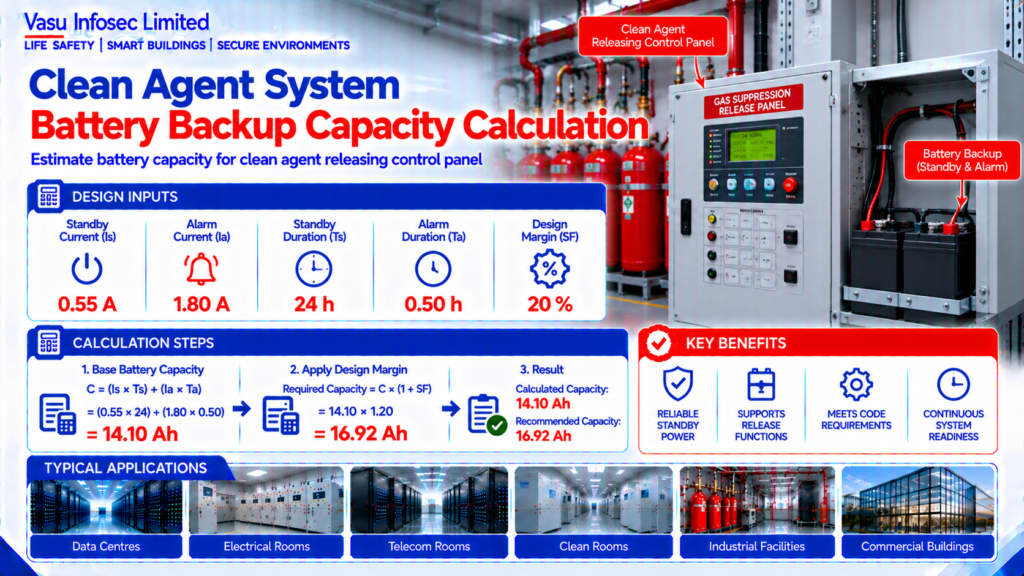
Battery backup capacity is calculated from standby current, alarm current and their respective operating durations. In this example, the minimum recommended battery capacity is 16.92 Ah after applying a 20% engineering margin.
At a Glance
| Item | Source value / outcome |
| Resource ID | EC-039 |
| Standby Current | 0.55 A |
| Alarm Current | 1.80 A |
| Standby Duration | 24 h |
| Alarm Duration | 0.50 h |
| Design Margin | 20 % |
| Engineering output | Calculated Battery Capacity: 14.10 Ah; Recommended Minimum Capacity: 16.92 Ah |
Calculation Method & Worked Example
Battery Capacity (Ah) = (Standby Current × Standby Time) + (Alarm Current × Alarm Time)
Required Capacity = Calculated Capacity × Safety Factor
Base Capacity = (0.55×24) + (1.8×0.5) = 14.10 Ah
Required Capacity = 14.10 × 1.20 = 16.92 Ah
A releasing panel drawing 0.55 A in standby for 24 hours and 1.80 A in alarm for 0.50 hours requires approximately 16.92 Ah after applying a 20% engineering margin.
Applicable Standards Listed in the Source
| Standard | Description |
| NFPA 72 | National Fire Alarm and Signaling Code |
| NFPA 2001 | Clean Agent Fire Extinguishing Systems |
| IS 2189 | Fire Detection & Alarm Systems |
| OEM Manual | Battery sizing requirements |
Technical Content
1. Purpose
To estimate the minimum battery capacity required to support a clean agent releasing control panel during standby and alarm conditions.
2. Engineering Objective
To calculate the battery ampere-hour (Ah) capacity based on standby load, alarm load, standby duration and alarm duration.
3. Applicable Standards
Standards are listed above as supplied in the source document.
4. Design Inputs
| Parameter | Symbol | Value | Unit |
| Standby Current | Is | 0.55 | A |
| Alarm Current | Ia | 1.80 | A |
| Standby Duration | Ts | 24 | h |
| Alarm Duration | Ta | 0.50 | h |
| Design Margin | SF | 20 | % |
5. Assumptions
Battery ageing, temperature effects and a 20% engineering margin are considered. Final battery selection shall comply with the OEM requirements.
6. Formula(s)
Battery Capacity (Ah) = (Standby Current × Standby Time) + (Alarm Current × Alarm Time)
Required Capacity = Calculated Capacity × Safety Factor
7. Variables Explained
Is = Standby current; Ia = Alarm current; Ts = Standby duration; Ta = Alarm duration.
8. Step-by-Step Calculation
Base Capacity = (0.55×24) + (1.8×0.5) = 14.10 Ah
Required Capacity = 14.10 × 1.20 = 16.92 Ah
9. Worked Engineering Example
A releasing panel drawing 0.55 A in standby for 24 hours and 1.80 A in alarm for 0.50 hours requires approximately 16.92 Ah after applying a 20% engineering margin.
10. Engineering Output
Calculated Battery Capacity: 14.10 Ah
Recommended Minimum Capacity: 16.92 Ah
11. Design Considerations
Verify charger capacity, battery type, ambient temperature, ageing factor, release circuit loads and applicable code requirements.
12. Common Design Mistakes
Ignoring alarm duration, omitting safety margin, undersizing batteries and failing to verify OEM charging limits.
13. Practical Site Notes
Perform battery load testing during commissioning and replace batteries at the interval recommended by the manufacturer.
14. Limitations
Final battery capacity shall be confirmed using the approved equipment current ratings and project-specific standby requirements.
15. Related Engineering Systems
Gas Suppression Release Panel, Fire Alarm Control Panel, Releasing Circuits, Standby Power Supply.
16. Cross References
Related FAQ: Battery Backup
Related White Paper: VEP-002
Related Engineering Diagram: ED-039
17. SEO Meta Title
Clean Agent Battery Backup Capacity Calculation | EC-039
18. SEO Meta Description
Engineering calculation for clean agent system battery backup capacity.
19. URL Slug
ec-039-clean-agent-system-battery-backup-capacity-calculation
20. Keywords (15)
Battery Backup,NFPA72,NFPA2001,IS2189,Clean Agent,Release Panel,Battery Sizing,Engineering Calculation,Fire Protection,Standby Power,Ah Calculation,EPC,Consultant,Life Safety,Control Panel
21. AI Search Summary
Battery backup capacity is calculated from standby current, alarm current and their respective operating durations. In this example, the minimum recommended battery capacity is 16.92 Ah after applying a 20% engineering margin.
Frequently Asked Questions
What does this calculation determine?
To estimate the minimum battery capacity required to support a clean agent releasing control panel during standby and alarm conditions.
What is the result for this example?
Calculated Battery Capacity: 14.10 Ah
Recommended Minimum Capacity: 16.92 Ah
Can this preliminary calculation be used as final design approval?
Final battery capacity shall be confirmed using the approved equipment current ratings and project-specific standby requirements.
What should be verified before final design?
Verify charger capacity, battery type, ambient temperature, ageing factor, release circuit loads and applicable code requirements.
SEO & Publishing Details
| Field | Details |
| SEO meta title | Clean Agent Battery Backup Capacity Calculation | EC-039 |
| Meta description | Engineering calculation for clean agent system battery backup capacity. |
| Primary keyword | Battery Backup |
| Secondary keywords | Battery Backup,NFPA72,NFPA2001,IS2189,Clean Agent,Release Panel,Battery Sizing,Engineering Calculation,Fire Protection,Standby Power,Ah Calculation,EPC,Consultant,Life Safety,Control Panel |
| Suggested URL slug | ec-039-clean-agent-system-battery-backup-capacity-calculation |
| AI search summary | Battery backup capacity is calculated from standby current, alarm current and their respective operating durations. In this example, the minimum recommended battery capacity is 16.92 Ah after applying a 20% engineering margin. |