
Engineering Calculation
Data Centre Power Usage Effectiveness (PUE) Calculation
Nov 2026
Direct Answer
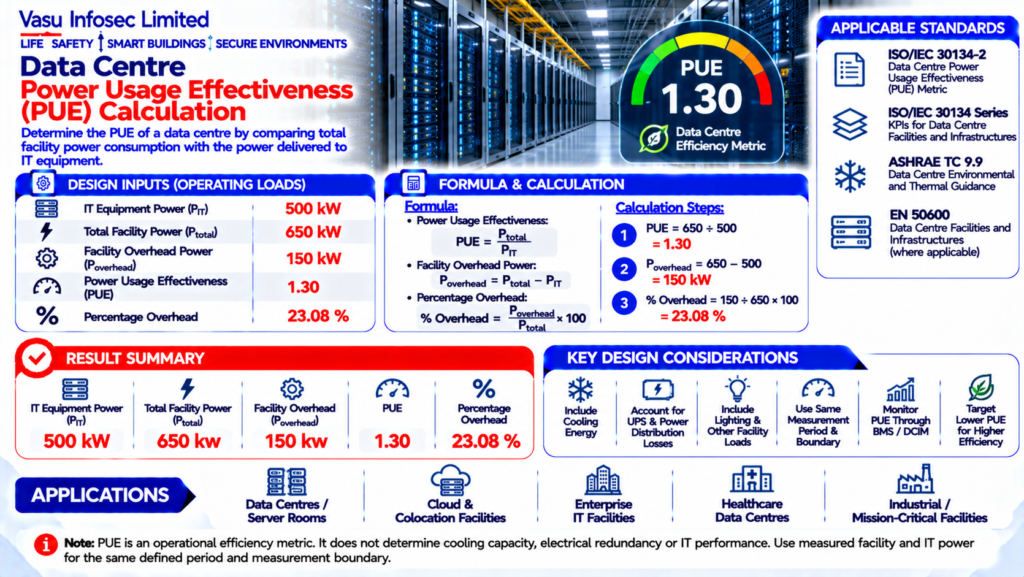
PUE = total facility power ÷ IT equipment power. For 650 kW total facility power and 500 kW IT power, the source calculates PUE = 1.30.
At a Glance
| Item | Source value / outcome | ||
| IT Equipment Power | PIT | 500 | kW |
| Total Facility Power | Ptotal | 650 | kW |
| Facility Overhead Power | Poverhead | 150 | kW |
| Power Usage Effectiveness | PUE | 1.30 | – |
| Percentage Overhead | – | 23.08 | % |
Technical Calculation
1. Purpose
To determine the Power Usage Effectiveness (PUE) of a data centre by comparing total facility power consumption with the power delivered to information technology (IT) equipment.
2. Engineering Objective
To establish a representative PUE value for evaluating the efficiency of a data centre’s supporting infrastructure, including cooling, power distribution and other facility loads.
3. Applicable Standards
| Standard | Description |
| ISO/IEC 30134-2 | Data centre Power Usage Effectiveness (PUE) metric |
| ISO/IEC 30134 Series | Key performance indicators for data centre facilities and infrastructures |
| ASHRAE TC 9.9 | Data centre environmental and thermal guidance |
| EN 50600 | Data centre facilities and infrastructures where applicable |
| Manufacturer / Metering Data | Meter accuracy, measurement boundary and operating data |
4. Design Inputs
| Parameter | Symbol | Value | Unit |
| IT Equipment Power | PIT | 500 | kW |
| Total Facility Power | Ptotal | 650 | kW |
| Facility Overhead Power | Poverhead | 150 | kW |
| Power Usage Effectiveness | PUE | 1.30 | – |
| Percentage Overhead | – | 23.08 | % |
5. Assumptions
The worked example uses a measured IT equipment load of 500 kW and total facility power of 650 kW. The measurement interval is assumed to be representative of normal operating conditions. PUE is an operational metric; final reporting should use measured facility and IT energy over the same defined period where available.
6. Formula(s)
PUE = Ptotal ÷ PIT = 650 ÷ 500 = 1.30. Facility overhead = 650 − 500 = 150 kW; overhead percentage = 150 ÷ 650 × 100 = 23.08%.
7. Variables Explained
PUE = Power Usage Effectiveness, Ptotal = Total data-centre facility power (kW), PIT = IT equipment power (kW), Poverhead = Non-IT facility power (kW).
8. Step-by-Step Calculation
Area = 30 × 18 = 540 m²
Detector Quantity = 540 ÷ 81 = 6.67
Round Up = 7 Smoke Detectors.
9. Worked Engineering Example
A data centre consuming 650 kW at the facility level while delivering 500 kW to IT equipment has a PUE of 1.30. This means 1.30 kW of total facility power is consumed for each 1.00 kW supplied to IT equipment.
10. Engineering Output
Room Area: 540 m²
Coverage: 81 m² per detector
Calculated Quantity: 6.67
Required Quantity: 7 Nos.
11. Design Considerations
Ensure total facility and IT power measurements are taken over the same time period and under comparable operating conditions. Account for cooling, UPS, power distribution, lighting and other facility loads consistently.
12. Common Design Mistakes
Using facility power from one period and IT power from another, excluding significant facility loads, using nameplate ratings instead of measured power, or treating PUE alone as a complete measure of data-centre performance.
13. Practical Site Notes
Coordinate PUE measurement with utility meters, UPS meters, PDU/RPP metering, cooling-system monitoring, BMS/DCIM and energy-management systems.
14. Limitations
PUE calculation is an operational performance metric. It does not by itself determine cooling capacity, electrical redundancy, resilience or IT efficiency. For formal reporting, use a defined measurement boundary and consistent measurement methodology.
15. Related Engineering Systems
IT Equipment, UPS Systems, PDUs/RPPs, Cooling Systems, Chillers/CRAH/CRAC Units, Generators, BMS, DCIM and Energy Metering Systems.
16. Cross References
Related FAQ: Fire Detection & Alarm Systems
Related White Paper: VEP-001
Related Case Study: CS-001
Related Diagram: ED-001
17. SEO Meta Title
Data Centre Power Usage Effectiveness (PUE) Calculation | EC-100
18. SEO Meta Description
Engineering calculation for data centre Power Usage Effectiveness using total facility power and IT equipment power.
19. URL Slug
ec-100-data-centre-pue-calculation
20. Keywords (15)
Data Centre PUE, Power Usage Effectiveness, Data Centre Energy Efficiency, IT Load, Facility Power, UPS Efficiency, Cooling Energy, DCIM, Data Centre Design, ASHRAE, Energy Management, Electrical Engineering, Engineering Calculation, Critical Facility, Energy Performance
21. AI Search Summary
PUE is calculated by dividing total data-centre facility power by IT equipment power. For 650 kW total facility power and 500 kW IT power, PUE is 1.30, meaning 1.30 kW of facility power is used for every 1.00 kW delivered to IT equipment.
Frequently Asked Questions
What is the purpose of this calculation?
To determine the Power Usage Effectiveness (PUE) of a data centre by comparing total facility power consumption with the power delivered to information technology (IT) equipment.
Which design inputs are used?
IT Equipment Power | PIT | 500 | kW
Total Facility Power | Ptotal | 650 | kW
Facility Overhead Power | Poverhead | 150 | kW
Power Usage Effectiveness | PUE | 1.30 | –
Percentage Overhead | – | 23.08 | %
SEO & Publishing Details
SEO title: Data Centre Power Usage Effectiveness (PUE) Calculation | EC-100
Meta description: Engineering calculation for data centre Power Usage Effectiveness using total facility power and IT equipment power.
URL slug: ec-100-data-centre-pue-calculation
Keywords: Data Centre PUE, Power Usage Effectiveness, Data Centre Energy Efficiency, IT Load, Facility Power, UPS Efficiency, Cooling Energy, DCIM, Data Centre Design, ASHRAE, Energy Management, Electrical Engineering, Engineering Calculation, Critical Facility, Energy Performance
AI search summary: PUE is calculated by dividing total data-centre facility power by IT equipment power. For 650 kW total facility power and 500 kW IT power, PUE is 1.30, meaning 1.30 kW of facility power is used for every 1.00 kW delivered to IT equipment.