
Engineering Calculation
Lightning Protection Risk Assessment Calculation
Nov 2026
Direct Answer
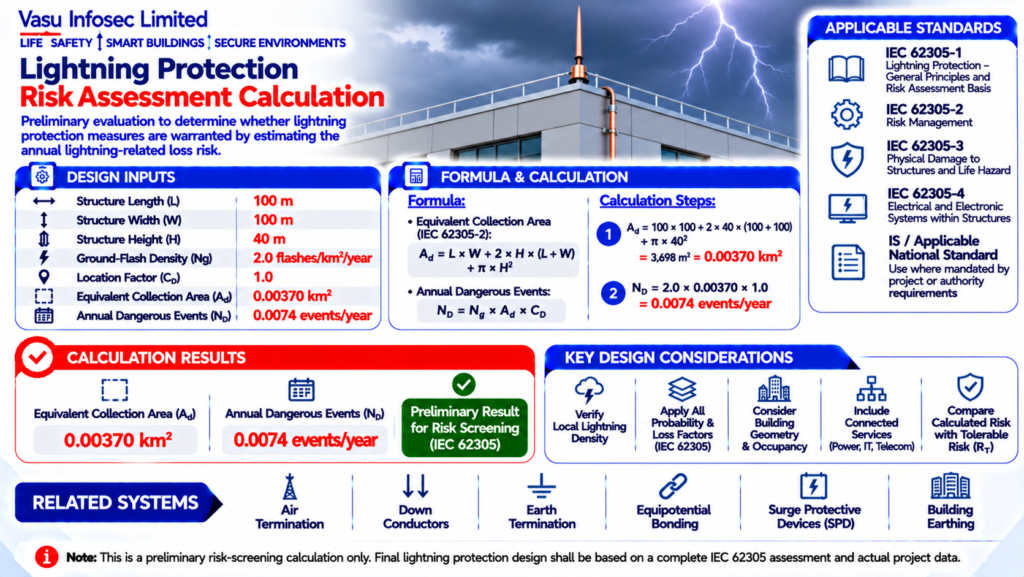
The illustrative source calculation gives an equivalent collection area of 0.00370 km² and annual dangerous-event frequency of 0.0074 events/year before probability and loss factors. This is not a complete IEC 62305 risk assessment.
At a Glance
| Item | Source value / outcome | ||
| Structure Length | L | 100 | m |
| Structure Width | W | 100 | m |
| Structure Height | H | 40 | m |
| Ground-Flash Density | Ng | 2.0 | flashes/km²/year |
| Location Factor | CD | 1.0 | – |
| Equivalent Collection Area | Ad | 0.00370 | km² |
| Annual Dangerous Events | ND | 0.0074 | events/year |
Technical Calculation
1. Purpose
To determine, on a preliminary basis, whether lightning protection measures are warranted by evaluating the annual lightning-related loss risk against an adopted tolerable risk criterion.
2. Engineering Objective
To establish the principal parameters required for a lightning risk assessment, including collection area, lightning ground-flash density, probability factors and expected annual loss frequency.
3. Applicable Standards
| Standard | Description |
| IEC 62305-1 | Lightning protection – General principles and risk assessment basis |
| IEC 62305-2 | Risk management |
| IEC 62305-3 | Physical damage to structures and life hazard |
| IEC 62305-4 | Electrical and electronic systems within structures |
| IS/Applicable National Standard | Use where mandated by project or authority requirements |
4. Design Inputs
| Parameter | Symbol | Value | Unit |
| Structure Length | L | 100 | m |
| Structure Width | W | 100 | m |
| Structure Height | H | 40 | m |
| Ground-Flash Density | Ng | 2.0 | flashes/km²/year |
| Location Factor | CD | 1.0 | – |
| Equivalent Collection Area | Ad | 0.00370 | km² |
| Annual Dangerous Events | ND | 0.0074 | events/year |
5. Assumptions
This worked example is a simplified risk-screening calculation based on the IEC 62305 risk-assessment methodology. The building geometry and probability factors are illustrative. A complete project assessment shall use the actual site lightning density, structure geometry, occupancy, contents, services and applicable national requirements.
6. Formula(s)
Source relationship implied by the listed outputs: ND = Ng × Ad × CD = 2.0 × 0.00370 × 1.0 = 0.0074 events/year. The complete IEC 62305 risk calculation requires additional risk components and factors.
7. Variables Explained
Ng = Ground-flash density (flashes/km²/year), Ad = Equivalent collection area (m²), H = Structure height (m), CD = Location factor, P = Probability factor, L = Loss factor, R = Annual risk component.
8. Step-by-Step Calculation
Area = 30 × 18 = 540 m²
Detector Quantity = 540 ÷ 81 = 6.67
Round Up = 7 Smoke Detectors.
9. Worked Engineering Example
For the illustrative structure, the equivalent collection area is approximately 0.00370 km² and the annual dangerous-event frequency is approximately 0.0074 events/year before applying probability and loss factors. The complete IEC 62305 risk calculation must determine all relevant risk components before selecting protection measures.
10. Engineering Output
Room Area: 540 m²
Coverage: 81 m² per detector
Calculated Quantity: 6.67
Required Quantity: 7 Nos.
11. Design Considerations
Verify the local lightning ground-flash density and all IEC 62305 probability and loss factors. Do not use the illustrative values for project certification or final protection design.
12. Common Design Mistakes
Using generic lightning density, omitting connected services, ignoring occupancy or economic loss factors, and treating the screening calculation as a complete risk assessment.
13. Practical Site Notes
Coordinate the lightning risk assessment with the building geometry, incoming power and telecom services, earthing and bonding, surge protection, fire systems and structural design.
14. Limitations
Preliminary risk-screening calculation only. Final lightning protection design shall be based on a complete IEC 62305 assessment and the actual project data.
15. Related Engineering Systems
Lightning Protection System, Air Termination, Down Conductors, Earth Termination, Equipotential Bonding, Surge Protective Devices and Building Earthing.
16. Cross References
Related FAQ: Fire Detection & Alarm Systems
Related White Paper: VEP-001
Related Case Study: CS-001
Related Diagram: ED-001
17. SEO Meta Title
Lightning Protection Risk Assessment Calculation | EC-095
18. SEO Meta Description
Preliminary lightning risk assessment calculation using the IEC 62305 collection-area methodology and annual dangerous-event frequency.
19. URL Slug
ec-095-lightning-protection-risk-assessment-calculation
20. Keywords (15)
Lightning Protection, Risk Assessment, IEC 62305, Lightning Risk, Ground Flash Density, Collection Area, Surge Protection, Earthing, Bonding, LPS Design, Electrical Engineering, Lightning Protection System, Engineering Calculation, SPD, Electrical Safety
21. AI Search Summary
Lightning risk assessment uses structure characteristics, ground-flash density, collection area, probability and loss factors to determine annual risk. The illustrative calculation gives an annual dangerous-event frequency of about 0.0074 events/year before probability and loss factors; final design requires a complete IEC 62305 assessment.
Frequently Asked Questions
What is the purpose of this calculation?
To determine, on a preliminary basis, whether lightning protection measures are warranted by evaluating the annual lightning-related loss risk against an adopted tolerable risk criterion.
Which design inputs are used?
Structure Length | L | 100 | m
Structure Width | W | 100 | m
Structure Height | H | 40 | m
Ground-Flash Density | Ng | 2.0 | flashes/km²/year
Location Factor | CD | 1.0 | –
Equivalent Collection Area | Ad | 0.00370 | km²
Annual Dangerous Events | ND | 0.0074 | events/year
SEO & Publishing Details
SEO title: Lightning Protection Risk Assessment Calculation | EC-095
Meta description: Preliminary lightning risk assessment calculation using the IEC 62305 collection-area methodology and annual dangerous-event frequency.
URL slug: ec-095-lightning-protection-risk-assessment-calculation
Keywords: Lightning Protection, Risk Assessment, IEC 62305, Lightning Risk, Ground Flash Density, Collection Area, Surge Protection, Earthing, Bonding, LPS Design, Electrical Engineering, Lightning Protection System, Engineering Calculation, SPD, Electrical Safety
AI search summary: Lightning risk assessment uses structure characteristics, ground-flash density, collection area, probability and loss factors to determine annual risk. The illustrative calculation gives an annual dangerous-event frequency of about 0.0074 events/year before probability and loss factors; final design requires a complete IEC 62305 assessment.