
Engineering Calculation
Tunnel Emergency Evacuation Time Calculation
Nov 2026
Direct Answer
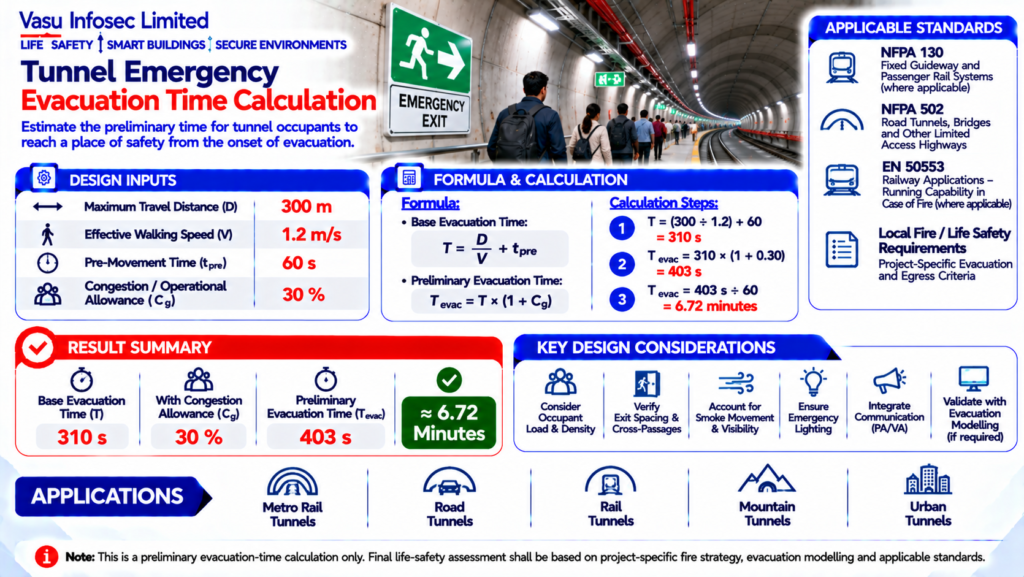
The source reports a preliminary tunnel evacuation time of 403 seconds (6.72 minutes), based on 300 m travel distance, 1.2 m/s effective walking speed, 60 seconds pre-movement time and a 30% congestion/operational allowance.
At a Glance
| Item | Source value / outcome | ||
| Maximum Travel Distance | D | 300 | m |
| Effective Walking Speed | V | 1.2 | m/s |
| Pre-Movement Time | tpre | 60 | s |
| Congestion / Operational Allowance | Cg | 30 | % |
| Base Evacuation Time | T | 310 | s |
| Preliminary Evacuation Time | Tevac | 403 | s |
Technical Calculation
1. Purpose
To estimate the preliminary time required for tunnel occupants to reach a place of safety or designated safe refuge from the onset of evacuation movement.
2. Engineering Objective
To establish the preliminary evacuation travel time by combining pre-movement time, travel time and an allowance for congestion or operational delay.
3. Applicable Standards
| Standard | Description |
| NFPA 130 | Fixed Guideway and Passenger Rail Systems where applicable |
| NFPA 502 | Road Tunnels, Bridges, and Other Limited Access Highways where applicable |
| EN 50553 | Railway applications – requirements for running capability in case of fire on board rolling stock where applicable |
| Local Fire/Life Safety Requirements | Project-specific evacuation and egress criteria |
| Project Fire Strategy | Approved tunnel fire and emergency evacuation design basis |
4. Design Inputs
| Parameter | Symbol | Value | Unit |
| Maximum Travel Distance | D | 300 | m |
| Effective Walking Speed | V | 1.2 | m/s |
| Pre-Movement Time | tpre | 60 | s |
| Congestion / Operational Allowance | Cg | 30 | % |
| Base Evacuation Time | T | 310 | s |
| Preliminary Evacuation Time | Tevac | 403 | s |
5. Assumptions
The worked example assumes a maximum evacuation travel distance of 300 m, an average effective walking speed of 1.2 m/s, a pre-movement time of 60 s and a 30% allowance for congestion and operational delay. These are illustrative design inputs and are not universal code values. Final evacuation assessment shall use the project fire strategy, occupant characteristics, tunnel geometry and applicable requirements.
6. Formula(s)
Travel time component: D ÷ V = 300 ÷ 1.2 = 250 s. The source separately states base time T = 310 s and final time Tevac = 403 s. Full formula and allowance sequence are not supplied and must be confirmed.
7. Variables Explained
D = Maximum travel distance (m), V = Effective walking speed (m/s), tpre = Pre-movement time (s), Cg = Congestion/operational allowance, Tevac = Preliminary evacuation time (s).
8. Step-by-Step Calculation
Area = 30 × 18 = 540 m²
Detector Quantity = 540 ÷ 81 = 6.67
Round Up = 7 Smoke Detectors.
9. Worked Engineering Example
For a maximum tunnel evacuation travel distance of 300 m, an effective walking speed of 1.2 m/s, a 60 s pre-movement period and a 30% congestion/operational allowance, the preliminary evacuation time is approximately 403 s, or 6.72 minutes.
10. Engineering Output
Room Area: 540 m²
Coverage: 81 m² per detector
Calculated Quantity: 6.67
Required Quantity: 7 Nos.
11. Design Considerations
Verify occupant load, train/passenger density, exit spacing, cross-passages, walkways, door capacities, smoke movement, visibility, emergency lighting, communication systems and the project-specific evacuation criteria. Final assessment may require evacuation modelling.
12. Common Design Mistakes
Using a single walking speed for all occupants, ignoring pre-movement time, neglecting congestion, assuming all occupants start moving simultaneously, and using travel distance without checking actual available escape routes.
13. Practical Site Notes
Coordinate evacuation calculations with tunnel ventilation, fire detection, water mist/fire suppression, emergency lighting, signage, public-address/communication systems, cross-passages and emergency response procedures.
14. Limitations
Preliminary evacuation-time calculation only. Final life-safety assessment shall be based on project-specific fire and evacuation modelling, approved egress design and applicable tunnel requirements.
15. Related Engineering Systems
Tunnel Ventilation, Fire Detection, Water Mist/Fire Suppression, Emergency Lighting, Emergency Communication, Cross-Passages, Escape Walkways and SCADA/BMS.
16. Cross References
Related FAQ: Fire Detection & Alarm Systems
Related White Paper: VEP-001
Related Case Study: CS-001
Related Diagram: ED-001
17. SEO Meta Title
Tunnel Emergency Evacuation Time Calculation | EC-098
18. SEO Meta Description
Preliminary tunnel evacuation-time calculation using travel distance, effective walking speed, pre-movement time and a congestion allowance.
19. URL Slug
ec-098-tunnel-emergency-evacuation-time-calculation
20. Keywords (15)
Tunnel Evacuation Time, Emergency Evacuation, NFPA 130, Tunnel Fire Safety, Egress Calculation, Evacuation Modelling, Travel Distance, Walking Speed, Pre-Movement Time, Smoke Control, Emergency Exit, Fire Engineering, Life Safety, Engineering Calculation, Tunnel Design
21. AI Search Summary
Preliminary tunnel evacuation time combines pre-movement and travel time with an allowance for congestion and operational delay. For 300 m travel at 1.2 m/s, 60 s pre-movement and 30% allowance, the illustrative result is about 403 s, or 6.72 minutes.
Frequently Asked Questions
What is the purpose of this calculation?
To estimate the preliminary time required for tunnel occupants to reach a place of safety or designated safe refuge from the onset of evacuation movement.
Which design inputs are used?
Maximum Travel Distance | D | 300 | m
Effective Walking Speed | V | 1.2 | m/s
Pre-Movement Time | tpre | 60 | s
Congestion / Operational Allowance | Cg | 30 | %
Base Evacuation Time | T | 310 | s
Preliminary Evacuation Time | Tevac | 403 | s
SEO & Publishing Details
SEO title: Tunnel Emergency Evacuation Time Calculation | EC-098
Meta description: Preliminary tunnel evacuation-time calculation using travel distance, effective walking speed, pre-movement time and a congestion allowance.
URL slug: ec-098-tunnel-emergency-evacuation-time-calculation
Keywords: Tunnel Evacuation Time, Emergency Evacuation, NFPA 130, Tunnel Fire Safety, Egress Calculation, Evacuation Modelling, Travel Distance, Walking Speed, Pre-Movement Time, Smoke Control, Emergency Exit, Fire Engineering, Life Safety, Engineering Calculation, Tunnel Design
AI search summary: Preliminary tunnel evacuation time combines pre-movement and travel time with an allowance for congestion and operational delay. For 300 m travel at 1.2 m/s, 60 s pre-movement and 30% allowance, the illustrative result is about 403 s, or 6.72 minutes.