
Engineering Calculation
UPS Capacity Calculation
Nov 2026
Direct Answer
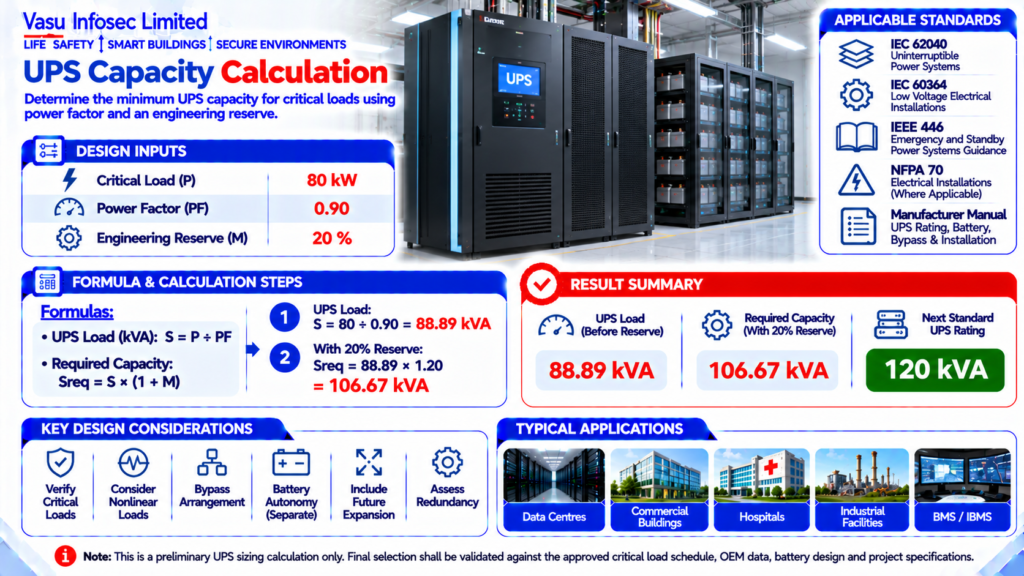
UPS capacity is determined by converting critical load from kW to kVA using power factor and applying an engineering reserve. For 80 kW at 0.90 power factor, the base requirement is 88.89 kVA; with 20% reserve, 120 kVA is the next suitable standard rating.
At a Glance
| Resource ID | EC-089 |
| Critical Load | P | 80 | kW |
| Power Factor | PF | 0.90 | – |
| Engineering Reserve | M | 20 | % |
| Calculated UPS Load | S | 88.89 | kVA |
| Required Capacity with Reserve | Sreq | 106.67 | kVA |
| Source detail | Refer to Technical Content |
| Source detail | Refer to Technical Content |
Calculation Method & Worked Example
Area: A = L × W
Detector Quantity: N = A / C
Area = 30 × 18 = 540 m²
Detector Quantity = 540 ÷ 81 = 6.67
Round Up = 7 Smoke Detectors.
Room Area: 540 m²
Coverage: 81 m² per detector
Calculated Quantity: 6.67
Required Quantity: 7 Nos.
Applicable Standards Listed in the Source
| IEC 62040 | Uninterruptible Power Systems |
| IEC 60364 | Low Voltage Electrical Installations |
| IEEE 446 | Emergency and Standby Power Systems guidance where applicable |
| NFPA 70 | Electrical installation requirements where applicable |
| Manufacturer Manual | UPS rating, battery, bypass and installation requirements |
Technical Content
1. Purpose
To determine the minimum UPS capacity required to supply critical electrical loads continuously during utility disturbances while allowing an appropriate engineering reserve.
2. Engineering Objective
To establish the UPS apparent-power rating from the critical load, power factor and engineering reserve.
3. Applicable Standards
Standards and descriptions are reproduced from the source document.
4. Design Inputs
Critical Load | P | 80 | kW
Power Factor | PF | 0.90 | –
Engineering Reserve | M | 20 | %
Calculated UPS Load | S | 88.89 | kVA
Required Capacity with Reserve | Sreq | 106.67 | kVA
5. Assumptions
The critical connected load is 80 kW. An operating power factor of 0.90 and a 20% engineering reserve are adopted for the worked example. Battery autonomy is excluded from this calculation and shall be calculated separately.
6. Formula(s)
Area: A = L × W
Detector Quantity: N = A / C
Final Quantity = Round Up(N)
Area: A = L × W
Detector Quantity: N = A / C
Final Quantity = Round Up(N)
Room Area: 540 m²
Coverage: 81 m² per detector
Calculated Quantity: 6.67
Required Quantity: 7 Nos.
7. Variables Explained
S = Apparent power (kVA), P = Critical load (kW), PF = Power factor, M = Engineering margin, Sreq = Required UPS capacity (kVA).
8. Step-by-Step Calculation
Area = 30 × 18 = 540 m²
Detector Quantity = 540 ÷ 81 = 6.67
Round Up = 7 Smoke Detectors.
Area = 30 × 18 = 540 m²
Detector Quantity = 540 ÷ 81 = 6.67
Round Up = 7 Smoke Detectors.
Room Area: 540 m²
Coverage: 81 m² per detector
Calculated Quantity: 6.67
Required Quantity: 7 Nos.
9. Worked Engineering Example
A critical facility load of 80 kW at 0.90 power factor requires 88.89 kVA of UPS capacity before reserve. With a 20% engineering reserve, the calculated requirement is 106.67 kVA; the next suitable standard rating is 120 kVA.
10. Engineering Output
Room Area: 540 m²
Coverage: 81 m² per detector
Calculated Quantity: 6.67
Required Quantity: 7 Nos.
Room Area: 540 m²
Coverage: 81 m² per detector
Calculated Quantity: 6.67
Required Quantity: 7 Nos.
Room Area: 540 m²
Coverage: 81 m² per detector
Calculated Quantity: 6.67
Required Quantity: 7 Nos.
Room Area: 540 m²
Coverage: 81 m² per detector
Calculated Quantity: 6.67
Required Quantity: 7 Nos.
11. Design Considerations
Verify critical loads, power factor, nonlinear loads, crest factor, bypass arrangement, redundancy, battery autonomy and UPS efficiency before final selection.
12. Common Design Mistakes
Sizing the UPS from kW alone, ignoring power factor and nonlinear loads, omitting future expansion, or selecting a rating without checking bypass and battery requirements.
13. Practical Site Notes
Coordinate UPS sizing with critical LT panels, battery banks, bypass panels, downstream distribution, earthing and generator systems.
14. Limitations
Preliminary UPS sizing calculation only. Final selection shall be validated against the approved critical load schedule, OEM data, battery design and project specifications.
15. Related Engineering Systems
Critical IT Loads, Data Network, Fire Alarm, Security Systems, BMS, Battery Bank, Generator, Bypass Panel and Distribution Boards.
16. Cross References
Related FAQ: Fire Detection & Alarm Systems
Related White Paper: VEP-001
Related Case Study: CS-001
Related Diagram: ED-001
17. SEO Meta Title
UPS Capacity Calculation | EC-089
18. SEO Meta Description
Engineering calculation for UPS capacity based on critical load, power factor and engineering reserve; battery autonomy is calculated separately.
19. URL Slug
ec-089-ups-capacity-calculation
20. Keywords (15)
UPS Capacity, UPS Sizing, Uninterruptible Power Supply, Critical Load, Power Factor, kVA Calculation, Battery Backup, IEC 62040, Critical Power, Electrical Engineering, UPS Design, Power Distribution, Engineering Calculation, Data Centre Power, Backup Power
21. AI Search Summary
UPS capacity is determined by converting critical load from kW to kVA using power factor and applying an engineering reserve. For 80 kW at 0.90 power factor, the base requirement is 88.89 kVA; with 20% reserve, 120 kVA is the next suitable standard rating.
Frequently Asked Questions
What is the purpose of EC-089?
To determine the minimum UPS capacity required to supply critical electrical loads continuously during utility disturbances while allowing an appropriate engineering reserve.
What result does the source example report?
A critical facility load of 80 kW at 0.90 power factor requires 88.89 kVA of UPS capacity before reserve. With a 20% engineering reserve, the calculated requirement is 106.67 kVA; the next suitable standard rating is 120 kVA.
Can this preliminary calculation be used as final design approval?
Preliminary UPS sizing calculation only. Final selection shall be validated against the approved critical load schedule, OEM data, battery design and project specifications.
What should be checked before final selection or implementation?
Verify critical loads, power factor, nonlinear loads, crest factor, bypass arrangement, redundancy, battery autonomy and UPS efficiency before final selection.
SEO & Publishing Details
| SEO meta title | UPS Capacity Calculation | EC-089 |
| Meta description | Engineering calculation for UPS capacity based on critical load, power factor and engineering reserve; battery autonomy is calculated separately. |
| Primary keyword | UPS Capacity |
| Secondary keywords | UPS Sizing; Uninterruptible Power Supply; Critical Load; Power Factor; kVA Calculation; Battery Backup |
| Suggested URL slug | ec-089-ups-capacity-calculation |
| Suggested image alt text | UPS Capacity Calculation – Engineering Calculation EC-089. |