
Engineering Calculation
Water Mist Hydraulic Remote Area Calculation
Nov 2026
Direct Answer
The hydraulically remote area determines the most demanding operating condition for a water mist system. In this example, a 180 m² remote area requires 1080 L/min and 32,400 litres for a 30-minute duration. Final verification must be completed using OEM hydraulic calculation software.
At a Glance
| Item | Source value / outcome |
| Resource ID | EC-052 |
| Calculation / subject | Water Mist Hydraulic Remote Area Calculation |
| Hydraulic Remote Area | A | 180 | m² |
| Design Density | D | 6 | L/min/m² |
| Design Duration | T | 30 | min |
| System Type | | High Pressure Water Mist | – |
Calculation Method & Worked Example
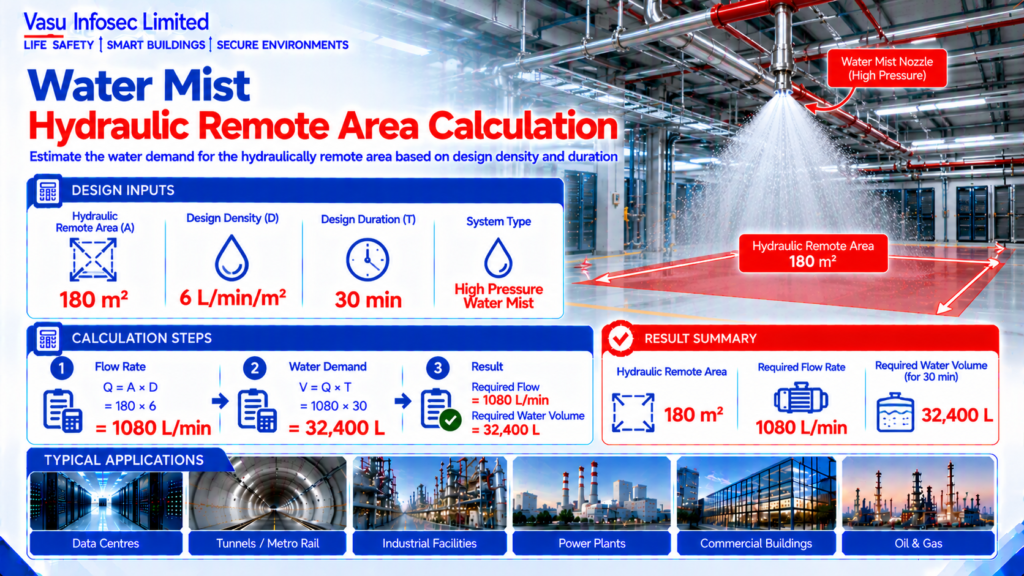
Flow Rate = Hydraulic Remote Area × Design Density
Water Demand = Flow Rate × Design Duration
Flow Rate = 180 × 6 = 1080 L/min
Water Demand = 1080 × 30 = 32,400 L
A hydraulically remote area of 180 m² protected at a density of 6 L/min/m² requires a flow of 1080 L/min and a total water demand of 32,400 litres for a 30-minute operation.
Hydraulic Remote Area: 180 m²
Required Flow: 1080 L/min
Required Water Volume: 32,400 L
Applicable Standards Listed in the Source
| Standard | Description |
| NFPA 750 | Standard on Water Mist Fire Protection Systems |
| EN 14972 | Fixed Firefighting Systems – Water Mist |
| NBC India Part 4 | Fire & Life Safety |
| OEM Hydraulic Software | Remote area hydraulic verification |
Technical Content
- Purpose
To estimate the preliminary hydraulically remote design area for a water mist fire protection system for conceptual hydraulic analysis.
- Engineering Objective
To determine the water demand associated with the hydraulically most demanding area. Final remote area determination shall follow the approved system listing, OEM design manual and hydraulic calculation software.
- Applicable Standards
- Design Inputs
| Parameter | Symbol | Value / Unit |
| Hydraulic Remote Area | A | 180 m² |
| Design Density | D | 6 L/min/m² |
| Design Duration | T | 30 min |
| System Type | High Pressure Water Mist – |
- Assumptions
The hydraulically remote design area operates simultaneously at the specified design density. Final remote area selection shall comply with the approved system listing and OEM design manual.
- Formula(s)
Flow Rate = Hydraulic Remote Area × Design Density
Water Demand = Flow Rate × Design Duration
- Variables Explained
A = Hydraulic remote area (m²); D = Design density (L/min/m²); T = Design duration (min).
- Step-by-Step Calculation
Flow Rate = 180 × 6 = 1080 L/min
Water Demand = 1080 × 30 = 32,400 L
- Worked Engineering Example
A hydraulically remote area of 180 m² protected at a density of 6 L/min/m² requires a flow of 1080 L/min and a total water demand of 32,400 litres for a 30-minute operation.
- Engineering Output
Hydraulic Remote Area: 180 m²
Required Flow: 1080 L/min
Required Water Volume: 32,400 L
- Design Considerations
Verify nozzle spacing, pressure distribution, simultaneous operating area, pump performance and pipe friction losses using OEM hydraulic software.
- Common Design Mistakes
Selecting the wrong remote area, ignoring pressure losses, omitting simultaneous demand and using preliminary calculations for final design.
- Practical Site Notes
Confirm the hydraulically most remote location during detailed design and coordinate routing to minimize unnecessary pressure losses.
- Limitations
This is a preliminary engineering calculation only. Final remote area verification shall be completed using the manufacturer’s approved hydraulic calculation software.
- Related Engineering Systems
Water Mist Pump Unit, Water Storage Tank, Distribution Pipework, Fire Detection & Alarm.
- Cross References
Related FAQ: Water Mist Hydraulic Design
Related White Paper: VEP-003
Related Engineering Diagram: ED-052
- SEO Meta Title
Water Mist Hydraulic Remote Area Calculation | EC-052
- SEO Meta Description
Engineering calculation for preliminary hydraulic remote area determination for water mist systems.
- URL Slug
ec-052-water-mist-hydraulic-remote-area-calculation
- Keywords (15)
Water Mist,Hydraulic Remote Area,NFPA750,EN14972,Hydraulic Calculation,Fire Protection,Engineering Calculation,Design Density,Water Demand,High Pressure Water Mist,EPC,Consultant,Remote Area,Life Safety,Pump
- AI Search Summary
The hydraulically remote area determines the most demanding operating condition for a water mist system. In this example, a 180 m² remote area requires 1080 L/min and 32,400 litres for a 30-minute duration. Final verification must be completed using OEM hydraulic calculation software.
Frequently Asked Questions
What does water mist hydraulic remote area calculation determine?
To estimate the preliminary hydraulically remote design area for a water mist fire protection system for conceptual hydraulic analysis.
Can this preliminary calculation be used as final design approval?
No. This is a preliminary engineering calculation only. Final remote area verification shall be completed using the manufacturer’s approved hydraulic calculation software.
What must be confirmed before final design?
Confirm project inputs, design criteria, equipment data, applicable approvals and the approved manufacturer’s or hydraulic calculation method.
SEO & Publishing Details
SEO Meta Title: Water Mist Hydraulic Remote Area Calculation | EC-052
SEO Meta Description: Engineering calculation for preliminary hydraulic remote area determination for water mist systems.
URL Slug: ec-052-water-mist-hydraulic-remote-area-calculation
Keywords (15): Water Mist,Hydraulic Remote Area,NFPA750,EN14972,Hydraulic Calculation,Fire Protection,Engineering Calculation,Design Density,Water Demand,High Pressure Water Mist,EPC,Consultant,Remote Area,Life Safety,Pump
AI Search Summary: The hydraulically remote area determines the most demanding operating condition for a water mist system. In this example, a 180 m² remote area requires 1080 L/min and 32,400 litres for a 30-minute duration. Final verification must be completed using OEM hydraulic calculation software.