
Product / Technology Explainer
AI-Based Video Analytics Technology – Working Principle, Features & Applications
Nov 2026
1. Introduction
AI-Based Video Analytics is an advanced video surveillance technology that uses Artificial Intelligence (AI), Machine Learning (ML) and computer vision to automatically analyse CCTV video streams.
Unlike conventional CCTV systems that primarily record and display footage, AI-powered video analytics can identify objects, detect unusual activities, recognise predefined events and generate real-time alerts.
This technology helps organisations improve security monitoring, operational efficiency and incident response across critical infrastructure and commercial facilities.
2. Working Principle of AI-Based Video Analytics
AI-based video analytics processes live or recorded video through intelligent algorithms to identify specific objects, activities and events.
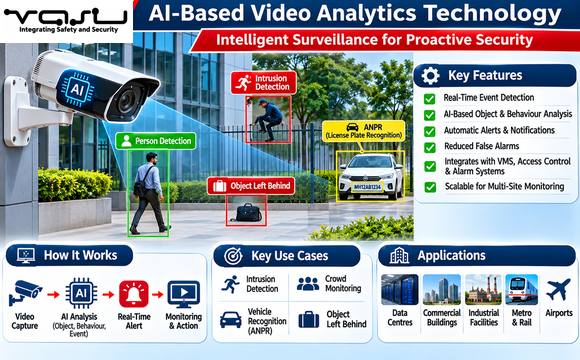
The typical operating sequence is:
- Video Capture: CCTV cameras capture live video from the monitored area.
- Video Processing: The video stream is transmitted to an edge device, server or analytics platform.
- AI-Based Analysis: AI algorithms analyse images and identify people, vehicles, objects and activities.
- Event Detection: The system detects predefined events such as intrusion, loitering, crowd formation or unattended objects.
- Alert Generation: Automated alerts are generated when configured event conditions are met.
- Monitoring & Response: Security personnel review alerts and initiate appropriate action.
3. Main Components
- IP CCTV Cameras
- AI-Enabled Cameras or Edge Devices
- Video Analytics Software
- AI Processing Server / GPU Platform
- Network Switches and Infrastructure
- Video Management System (VMS)
- Network Video Recorder (NVR) or Storage
- Monitoring Workstation
- Alarm and Notification Interface
4. Types of AI-Based Video Analytics
A. Object Detection: Identifies people, vehicles and other predefined objects within video footage.
B. Intrusion Detection: Detects entry into restricted or predefined security zones.
C. Facial Recognition: Compares detected facial features against authorised reference databases, subject to applicable privacy and legal requirements.
D. Automatic Number Plate Recognition (ANPR): Reads vehicle registration plates using image-processing algorithms.
E. Crowd Detection: Identifies crowd density and unusual gathering patterns.
F. Loitering Detection: Identifies individuals remaining within a defined area beyond a configured time.
G. Object Left Behind Detection: Detects objects that remain unattended in monitored areas.
H. Behaviour Analysis: Identifies predefined activities or abnormal movement patterns using configured analytics models.
5. Key Features & Capabilities
- Real-time video event detection.
- Automated security alerts.
- Object and vehicle classification.
- Virtual tripwire and intrusion detection.
- People counting and occupancy monitoring.
- Crowd density analysis.
- Search and retrieval of recorded video.
- Integration with VMS and access control systems.
- Multi-camera and multi-site monitoring.
- Configurable event rules and reporting.
Actual features depend on camera capabilities, software licensing and the selected analytics platform.
6. Applications
AI-based video analytics can be deployed across several industries:
| Sector | Application |
|---|---|
| Data Centres | Restricted-area intrusion detection |
| Airports | Perimeter and crowd monitoring |
| Metro & Railways | Platform monitoring and unattended object detection |
| Commercial Buildings | Occupancy and access monitoring |
| Industrial Facilities | Restricted-zone monitoring |
| Oil & Gas | Perimeter surveillance |
| Warehouses | Inventory-area and movement monitoring |
| Smart Cities | Traffic monitoring and vehicle recognition |
| Banking | Security event monitoring |
| Critical Infrastructure | Intelligent perimeter protection |
7. AI Video Analytics Architecture
A typical system architecture includes:
- IP Cameras capture video streams.
- Network infrastructure transfers video data.
- Edge devices or central servers process video using AI models.
- Analytics software identifies configured events.
- VMS displays video and associated event information.
- Alarm interfaces notify security operators.
- Storage systems retain footage for investigation and review.
AI processing can take place directly inside cameras, at edge computing devices or on centralised servers, depending on system architecture.
8. Benefits of AI-Based Video Analytics
- Proactive Security: Helps identify potential security incidents before they escalate.
- Reduced Manual Monitoring: Automates repetitive video surveillance tasks.
- Faster Incident Response: Generates alerts for predefined events.
- Improved Operational Visibility: Provides insights into movement and occupancy patterns.
- Efficient Investigation: Enables event-based searching of recorded footage.
- Scalable Deployment: Supports expansion across multiple cameras and locations.
- System Integration: Can work with compatible VMS, access control and alarm systems.
AI analytics supports security personnel but does not eliminate the need for human verification and operational response.
9. Design & Implementation Considerations
Before implementing an AI video analytics solution, consider:
- Camera resolution and image quality.
- Camera placement and field of view.
- Lighting and environmental conditions.
- Network bandwidth and latency.
- Edge versus centralised processing requirements.
- AI model accuracy and detection performance.
- Storage and retention requirements.
- VMS and third-party system compatibility.
- Cybersecurity and access control.
- Privacy, data protection and regulatory requirements.
- False-positive and false-negative performance.
- Testing under actual site operating conditions.
10. Integration with Other Security Systems
AI video analytics can be integrated with:
- CCTV and Video Management Systems (VMS).
- Access Control Systems.
- Intrusion Detection Systems.
- Fire Alarm and Emergency Monitoring Systems, where supported.
- Public Address and Alarm Systems.
- Centralised Security Operations Centres.
Integration enables event-based monitoring and coordinated security operations.
11. Testing & Commissioning
The following checks should be completed before system handover:
- Camera connectivity and live video verification.
- AI analytics configuration verification.
- Intrusion detection testing.
- Object and vehicle detection testing.
- ANPR testing, where applicable.
- Alert generation and notification testing.
- VMS integration verification.
- Network performance testing.
- Recording and playback verification.
- User access and cybersecurity checks.
- False-alarm assessment under actual site conditions.
- Final commissioning and documentation.
12. Applicable Standards & References
The following standards and technical references may be relevant depending on the project scope:
- IEC 62676 Series – Video Surveillance Systems for Security Applications.
- ONVIF Specifications – Interoperability of IP-based physical security products.
- IEEE 802.3 – Ethernet and Power over Ethernet (PoE).
- ISO/IEC 27001 – Information Security Management Systems.
- ISO/IEC 27701 – Privacy Information Management.
- Applicable Indian data protection and privacy requirements.
Note: These references cover different aspects of the solution. They should not be interpreted as a single certification standard for AI analytics accuracy.
13. Frequently Asked Questions (FAQs)
Q1. What is AI-Based Video Analytics?
It is a technology that uses artificial intelligence and computer vision to automatically analyse CCTV footage and detect predefined objects, activities and security events.
Q2. How is AI video analytics different from conventional CCTV?
Conventional CCTV primarily records and displays footage, whereas AI video analytics automatically analyses video and generates alerts for configured events.
Q3. Can AI video analytics detect unauthorised entry?
Yes. Intrusion detection analytics can identify movement across predefined virtual boundaries or entry into restricted zones.
Q4. Can AI video analytics identify vehicle number plates?
Yes. ANPR technology can detect and recognise vehicle registration plates under suitable camera, lighting and image-quality conditions.
Q5. Does AI video analytics require special cameras?
Not always. Some solutions support compatible existing IP cameras, while advanced analytics may require AI-enabled cameras or additional processing hardware.
Q6. Can AI video analytics integrate with VMS?
Yes. Compatible analytics platforms can integrate with VMS to display event notifications, video clips and associated camera information.
Q7. Does AI video analytics eliminate human monitoring?
No. It assists security operators by prioritising events and generating alerts, but human verification and response remain important.
14. Conclusion
AI-Based Video Analytics is transforming conventional CCTV surveillance into an intelligent security monitoring solution. Through automated event detection, object classification and real-time alerts, organisations can improve situational awareness and security operations.