
Product / Technology Explainer
FK-5-1-12 Clean Agent Technology – Working Principle, Components & Applications
Nov 2026
1. Introduction
FK-5-1-12 is an advanced fluorinated ketone-based clean agent used in gaseous fire suppression systems. It is designed to protect sensitive electrical, electronic and high-value equipment where conventional water-based fire suppression may cause additional damage.
The agent is stored as a liquid in specially designed pressurized cylinders and discharged into the protected enclosure as a vapour. It suppresses fire primarily through heat absorption, without leaving residue on protected equipment.
FK-5-1-12 is particularly suitable for data centres, server rooms, UPS rooms, electrical control rooms and other critical infrastructure facilities.
2. Working Principle of FK-5-1-12
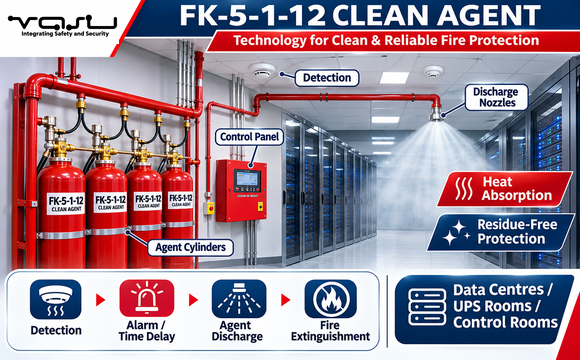
FK-5-1-12 primarily extinguishes fire through a physical cooling mechanism.
The operating sequence is:
- Fire Detection – Smoke or heat detectors identify an abnormal fire condition.
- Alarm Activation – The fire suppression control panel initiates audible and visual alarms.
- Pre-Discharge Delay – A configured time delay allows occupants to evacuate.
- Agent Release – The cylinder valve opens and releases the clean agent through the piping network.
- Agent Distribution – Discharge nozzles distribute the agent throughout the protected enclosure.
- Fire Suppression – The agent absorbs heat from the combustion zone and reduces the temperature below the level required to sustain combustion.
3. Main Components of the System
- FK-5-1-12 Agent Storage Cylinders
- Cylinder Valves and Actuators
- Fire Suppression Control Panel
- Smoke and Heat Detectors
- Discharge Piping Network
- Discharge Nozzles
- Manual Release Station
- Abort Switch, where permitted by the design
- Audible and Visual Alarm Devices
- Pressure Monitoring Devices
- Pressure Relief Vent
- Room Integrity Arrangement
4. Types of FK-5-1-12 Suppression Systems
A. Engineered System
An engineered system uses one or more agent cylinders connected to a specifically designed piping network. Pipe sizes, nozzle locations and agent distribution are calculated for the protected enclosure.
B. Modular System
A modular arrangement uses individual or multiple suppression units to protect designated equipment or smaller enclosed spaces, subject to the manufacturer’s approved design.
5. Applications
FK-5-1-12 systems are commonly considered for:
- Data Centres and Server Rooms
- UPS and Battery Equipment Rooms
- Electrical Switchgear Rooms
- Telecom Facilities
- Control and Monitoring Rooms
- Industrial Automation Facilities
- Archives and Document Storage
- Museums and Critical Asset Protection Areas
6. Key Technical Characteristics
| Parameter | Description |
|---|---|
| Agent Designation | FK-5-1-12 |
| Chemical Name | Dodecafluoro-2-methylpentan-3-one |
| Chemical Formula | CF₃CF₂C(O)CF(CF₃)₂ |
| Molecular Weight | 316.04 g/mol |
| Physical State | Liquid at room temperature |
| Discharge Form | Vapour |
| Electrical Property | Electrically non-conductive |
| Residue | No significant extinguishing-agent residue |
| Ozone Depletion Potential | 0 |
| Fire Suppression Mechanism | Primarily heat absorption |
7. Advantages of FK-5-1-12 Technology
- Electrically non-conductive agent.
- Leaves no significant residue after discharge.
- Suitable for protecting sensitive electronic equipment.
- Suppresses fire through heat absorption.
- Minimises equipment cleanup requirements.
- Can be designed for normally occupied spaces within applicable exposure limits.
- Zero ozone depletion potential.
8. Design & Installation Considerations
Proper system design is essential for effective fire suppression.
Important considerations include:
- Accurate protected room volume calculation.
- Identification of fire hazard classification.
- Determination of required design concentration.
- Cylinder quantity and storage arrangement.
- Hydraulic calculation of piping and nozzle distribution.
- Room integrity and leakage assessment.
- Pressure relief vent requirements.
- Fire detection and alarm integration.
- HVAC shutdown and damper interlocking.
- Personnel safety and evacuation arrangements.
9. Testing & Commissioning Requirements
Before system handover, verify:
- Cylinder and valve inspection.
- Agent quantity and pressure verification.
- Detection and control panel functionality.
- Manual and automatic release testing.
- Pre-discharge alarm and time delay.
- Piping and nozzle inspection.
- Room integrity testing.
- HVAC and damper interlocking.
- Alarm and supervisory signal verification.
- Final commissioning documentation.
10. Applicable Standards & References
- NFPA 2001 – Standard on Clean Agent Fire Extinguishing Systems.
- ISO 14520-1 – Gaseous Fire-Extinguishing Systems: General Requirements.
- ISO 14520-5 – Physical Properties and System Design Requirements for FK-5-1-12.
- EN 15004-1 – Fixed Firefighting Systems: Gas Extinguishing Systems.
- EN 15004-2 – FK-5-1-12 Requirements.
Applicable editions and local statutory requirements should be verified during project design.
11. Safety & Operational Considerations
Although FK-5-1-12 is designed for use in appropriately engineered occupied-space applications, personnel safety must remain a priority.
- Provide pre-discharge audible and visual alarms.
- Ensure adequate evacuation time.
- Display appropriate safety signage.
- Verify design concentration against applicable exposure limits.
- Provide room integrity and pressure relief arrangements.
- Restrict unnecessary entry following discharge.
- Follow manufacturer’s post-discharge safety and re-entry procedures.
FK-5-1-12 is not suitable for every fire hazard. Reactive metals, certain self-oxidising materials and other specialised hazards require separate evaluation.
12. Frequently Asked Questions (FAQs)
Q1. What is FK-5-1-12?
FK-5-1-12 is a fluorinated ketone-based clean fire suppression agent used to protect sensitive equipment and enclosed critical facilities.
Q2. How does FK-5-1-12 extinguish fire?
It primarily extinguishes fire by absorbing heat from the combustion zone and reducing the temperature required to sustain combustion.
Q3. Does FK-5-1-12 leave residue?
No significant extinguishing-agent residue is left after discharge, making it suitable for sensitive electronic environments.
Q4. Where is FK-5-1-12 commonly used?
It is commonly used in data centres, server rooms, UPS rooms, electrical control rooms, telecom facilities and archives.
Q5. Is FK-5-1-12 electrically conductive?
No. FK-5-1-12 is electrically non-conductive and is suitable for appropriately designed electrical and electronic equipment protection.
Q6. Is room integrity testing required?
Room integrity assessment is essential for total-flooding systems to verify that the enclosure can retain the required extinguishing concentration for the specified holding period.
Q7. Which standards apply to FK-5-1-12 systems?
NFPA 2001, ISO 14520-1, ISO 14520-5 and the applicable EN 15004 standards are important technical references.
13. Conclusion
FK-5-1-12 Clean Agent Technology provides an effective fire suppression solution for critical facilities where equipment protection and operational continuity are important.
Correct engineering design, suitable equipment selection, room integrity assessment and systematic commissioning are essential for reliable system performance.