
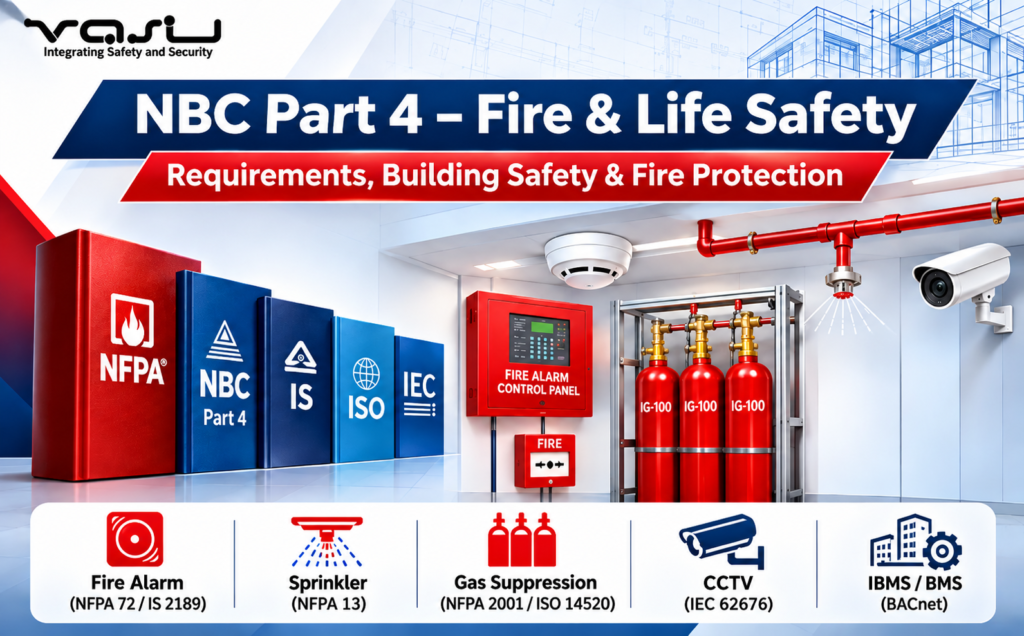
Standard / Code
NBC Part 4 – Fire & Life Safety: Requirements & Guidelines
Nov 2026
1. Introduction to NBC Part 4
The National Building Code of India (NBC) 2016 is published by the Bureau of Indian Standards (BIS). Part 4 specifically addresses Fire & Life Safety requirements for buildings.
Its primary objective is to minimise risks to life and property arising from fire, smoke, fumes and panic. It provides guidance for architects, engineers, fire protection consultants, contractors and building owners.
2. Scope & Applicability
NBC Part 4 covers the following major areas:
- Fire prevention and risk reduction.
- Building occupancy classification.
- Fire-resistant construction and compartmentation.
- Means of escape and emergency evacuation.
- Fire detection and alarm systems.
- Firefighting installations.
- Smoke management and control.
- Inspection and maintenance of fire protection systems.
Its applicability depends on building occupancy, height, floor area, configuration and relevant local building regulations.
3. Fire Prevention & Life Safety
Fire prevention and life safety measures are intended to reduce fire hazards and ensure safe evacuation during emergencies.
Key requirements include:
- Building occupancy classification.
- Fire-resistant walls, floors and doors.
- Fire compartmentation.
- Occupant load assessment.
- Exit access and staircase arrangements.
- Emergency lighting and exit signage.
- Smoke management and ventilation.
- Emergency evacuation procedures.
- Fire safety management and fire drills.
These provisions help minimise fire spread and support safe occupant evacuation.
4. Fire Protection Systems
NBC Part 4 addresses various fire protection installations based on building occupancy and applicable requirements.
| System | Purpose |
|---|---|
| Fire Alarm System | Fire detection and alarm notification |
| Fire Hydrant System | Manual firefighting |
| Sprinkler System | Automatic fire suppression |
| Gas Suppression System | Protection of suitable enclosed special-hazard areas |
| Fire Pump System | Water supply for firefighting installations |
| Smoke Management System | Smoke extraction and control |
| Emergency Lighting | Supports safe evacuation |
The selection and design of these systems must follow applicable code provisions and approved fire safety drawings.
5. Technical & Engineering Requirements
Important engineering considerations include:
1. Occupancy Classification: Identify the building occupancy and applicable fire safety requirements.
2. Means of Egress: Assess occupant load, exit capacity, escape routes and safe discharge arrangements.
3. Fire Compartmentation: Provide appropriate fire-resistant walls, floors, doors and protected openings.
4. Fire Detection & Alarm: Evaluate detectors, control panels, alarm devices and system interfaces.
5. Firefighting Systems: Determine hydrant, sprinkler, fire pump and other applicable installations.
6. Smoke Management: Consider smoke extraction, ventilation and staircase pressurisation.
7. Emergency Power: Review emergency power supply and coordination with building services.
6. Installation, Testing & Commissioning
Fire protection systems should be installed, tested and commissioned according to approved drawings, project specifications and applicable standards.
Installation Requirements:
- Correct positioning of fire detection and firefighting equipment.
- Proper routing of piping and electrical cabling.
- Coordination with architectural and MEP services.
- Equipment accessibility and identification.
- Approved system interfaces and control arrangements.
Testing & Commissioning:
- Fire detector and manual call point testing.
- Alarm notification and interface verification.
- Fire pump operational and performance testing.
- Hydrant and sprinkler system testing.
- Cause-and-effect sequence verification.
- Emergency lighting and exit signage checks.
- Smoke management system functional testing.
- Preparation of commissioning and test reports.
7. Compliance Checklist
The following checklist can be used for preliminary project compliance review.
| Sr. No. | Verification Point |
|---|---|
| 1 | Building occupancy classification reviewed |
| 2 | Applicable NBC provisions identified |
| 3 | Fire safety drawings reviewed |
| 4 | Occupant load and exit arrangements assessed |
| 5 | Staircases and escape routes verified |
| 6 | Fire compartmentation reviewed |
| 7 | Fire detection and alarm requirements checked |
| 8 | Firefighting installations verified |
| 9 | Smoke management requirements reviewed |
| 10 | Testing and commissioning records maintained |
| 11 | Fire safety documentation available |
| 12 | Maintenance arrangements established |
This is a preliminary checklist and not a substitute for statutory compliance verification.
8. Frequently Asked Questions (FAQs)
Q1. What is NBC Part 4?
NBC Part 4 is the Fire & Life Safety section of the National Building Code of India, addressing fire prevention, life safety and fire protection requirements.
Q2. Who publishes NBC?
The National Building Code of India is published by the Bureau of Indian Standards (BIS).
Q3. Which systems are covered under NBC Part 4?
It addresses fire alarm, fire hydrant, sprinkler, fire pump, smoke management and other applicable fire protection installations.
Q4. Is NBC Part 4 applicable to all buildings?
Its applicability depends on the provisions of the relevant edition, building occupancy, height, configuration and local building regulations.
Q5. Why is NBC Part 4 important for EPC contractors?
It provides a reference framework for fire safety planning, engineering coordination, installation, testing, commissioning and compliance review.
Q6. Does NBC Part 4 cover fire alarm systems?
Yes. Fire detection and alarm requirements are included in its fire protection provisions.
Q7. Does NBC compliance automatically guarantee fire approval?
No. Final approval depends on applicable local regulations, competent authority requirements, approved drawings and inspection procedures.
Important Reference
NBC 2016 – Part 4: Fire & Life Safety, Bureau of Indian Standards (BIS).
Official BIS Reference:
National Building Code of India 2016 – BIS Website
Related Reading:
Guide for Using NBC 2016 – Part 4: Fire & Life Safety (PDF)