
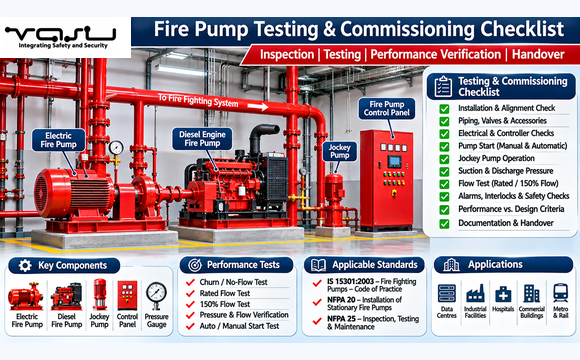
Technical Checklist / Template
Fire Pump Testing & Commissioning Checklist – Inspection, Performance Testing & Handover
Nov 2026
1. Introduction
Fire Pump Testing and Commissioning is an essential activity to verify the operational readiness, hydraulic performance and reliability of a fire protection water supply system.
The commissioning process ensures that electric fire pumps, diesel engine-driven fire pumps, jockey pumps, controllers, piping networks and associated accessories operate according to approved design requirements and manufacturer specifications.
This checklist provides a structured inspection and testing framework for fire pump installation, pre-commissioning, performance verification and final handover.
2. Objective of Fire Pump Testing & Commissioning
The main objectives are:
- Verify correct installation of fire pump equipment.
- Confirm pump performance against approved design parameters.
- Check automatic and manual pump starting.
- Verify electrical and diesel engine operation.
- Test suction and discharge pressure.
- Confirm operation of associated valves and accessories.
- Verify system readiness for emergency fire protection.
3. Fire Pump Testing & Commissioning Checklist
A. Installation Inspection
| Sr. No. | Inspection Parameter | Status |
|---|---|---|
| 1 | Fire pump installation as per approved drawings | ☐ |
| 2 | Pump foundation and grouting completed | ☐ |
| 3 | Pump and motor alignment verified | ☐ |
| 4 | Coupling guard installed | ☐ |
| 5 | Suction and discharge piping connected correctly | ☐ |
| 6 | Pipe supports and anchor arrangements verified | ☐ |
| 7 | Suction and discharge valves installed | ☐ |
| 8 | Pressure gauges installed and functional | ☐ |
| 9 | Pump room ventilation and lighting available | ☐ |
| 10 | Adequate access for operation and maintenance | ☐ |
B. Pre-Commissioning Checks
| Sr. No. | Inspection Parameter | Status |
|---|---|---|
| 1 | Pump and motor nameplate details verified | ☐ |
| 2 | Pump manufacturer’s test certificate available | ☐ |
| 3 | Piping flushing completed | ☐ |
| 4 | Hydrostatic pressure test completed as specified | ☐ |
| 5 | Suction tank water level verified | ☐ |
| 6 | Suction line free from obstruction | ☐ |
| 7 | Electrical cable connections checked | ☐ |
| 8 | Motor earthing verified | ☐ |
| 9 | Phase sequence and rotation checked | ☐ |
| 10 | Diesel fuel and lubrication levels checked | ☐ |
| 11 | Battery and charger condition verified | ☐ |
| 12 | Controller settings checked against approved design | ☐ |
C. Electric Fire Pump Testing
| Sr. No. | Test Parameter | Status |
|---|---|---|
| 1 | Manual starting test | ☐ |
| 2 | Automatic starting test | ☐ |
| 3 | Controller operation verified | ☐ |
| 4 | Motor acceleration checked | ☐ |
| 5 | Motor voltage recorded | ☐ |
| 6 | Running current recorded | ☐ |
| 7 | Suction pressure recorded | ☐ |
| 8 | Discharge pressure recorded | ☐ |
| 9 | Abnormal vibration and noise checked | ☐ |
| 10 | Motor and bearing temperature checked | ☐ |
D. Diesel Engine Fire Pump Testing
| Sr. No. | Test Parameter | Status |
|---|---|---|
| 1 | Manual starting test | ☐ |
| 2 | Automatic starting test | ☐ |
| 3 | Battery starting system checked | ☐ |
| 4 | Fuel supply and tank level verified | ☐ |
| 5 | Lubricating oil pressure checked | ☐ |
| 6 | Engine cooling system checked | ☐ |
| 7 | Engine operating speed verified | ☐ |
| 8 | Exhaust system checked | ☐ |
| 9 | Engine temperature monitored | ☐ |
| 10 | Engine alarms and shutdown indications verified | ☐ |
E. Jockey Pump Testing
| Sr. No. | Test Parameter | Status |
|---|---|---|
| 1 | Automatic starting operation checked | ☐ |
| 2 | Automatic stopping operation checked | ☐ |
| 3 | Pressure switch settings verified | ☐ |
| 4 | Pressure maintenance function verified | ☐ |
| 5 | Leakage and abnormal cycling checked | ☐ |
| 6 | Controller indications verified | ☐ |
F. Hydraulic Performance Testing
| Sr. No. | Test Parameter | Status |
|---|---|---|
| 1 | No-flow / churn pressure recorded | ☐ |
| 2 | Rated flow performance verified | ☐ |
| 3 | 150% rated flow performance verified where applicable | ☐ |
| 4 | Suction pressure recorded at each test point | ☐ |
| 5 | Discharge pressure recorded at each test point | ☐ |
| 6 | Flow rate measured and documented | ☐ |
| 7 | Pump speed recorded | ☐ |
| 8 | Motor voltage and current recorded | ☐ |
| 9 | Diesel engine parameters recorded | ☐ |
| 10 | Results compared with approved pump performance curve | ☐ |
G. Safety & Functional Checks
| Sr. No. | Inspection Parameter | Status |
|---|---|---|
| 1 | Emergency access to pump room available | ☐ |
| 2 | Pump room drainage arrangements verified | ☐ |
| 3 | Fire pump controller alarms checked | ☐ |
| 4 | Automatic transfer switch tested, where applicable | ☐ |
| 5 | Pressure relief and circulation relief arrangements checked | ☐ |
| 6 | Leakage from pump and piping inspected | ☐ |
| 7 | Emergency power supply verified, where applicable | ☐ |
| 8 | All valves restored to normal operating positions | ☐ |
| 9 | Pump controller returned to automatic mode | ☐ |
| 10 | System readiness confirmed | ☐ |
4. Fire Pump Performance Test Record
The following format can be used to document hydraulic performance during commissioning.
| Parameter | Churn / No Flow | Rated Flow | 150% Rated Flow |
|---|---|---|---|
| Flow Rate (LPM) | Record | Record | Record |
| Suction Pressure (bar) | Record | Record | Record |
| Discharge Pressure (bar) | Record | Record | Record |
| Pump Speed (RPM) | Record | Record | Record |
| Motor Voltage (V) | Record | Record | Record |
| Motor Current (A) | Record | Record | Record |
Note: Test points, permissible tolerances and measurement methods must follow the applicable pump standard, approved design and manufacturer’s certified performance curve.
5. Commissioning Documentation
The following documents should be compiled before final handover:
- Approved Fire Pump Installation Drawings.
- Pump and Motor Technical Datasheets.
- Manufacturer’s Performance Test Certificates.
- Electrical Test Reports.
- Piping Hydrostatic Test Reports.
- Piping Flushing Report.
- Fire Pump Performance Test Report.
- Diesel Engine Test Report, where applicable.
- Controller Functional Test Report.
- Commissioning and Inspection Checklist.
- Operation & Maintenance Manuals.
- Equipment Warranty Documents.
- As-Built Drawings.
- Final Commissioning and Handover Certificate.
6. Acceptance Criteria
The fire pump system should be accepted after confirming:
- Installation complies with approved drawings and specifications.
- Pump performance meets the approved design requirements.
- Automatic and manual starting functions operate correctly.
- Electrical and diesel engine parameters are within approved limits.
- Hydraulic test results meet the applicable performance criteria.
- All alarms, controllers and safety arrangements function correctly.
- Outstanding critical observations are resolved.
- All required commissioning records are submitted.
7. Common Issues During Commissioning
| Observation | Possible Cause |
|---|---|
| Pump fails to start | Electrical, controller or starting system fault |
| Low discharge pressure | Suction restriction, air ingress or pump issue |
| Excessive vibration | Misalignment or foundation issue |
| Abnormal motor current | Electrical or mechanical loading issue |
| Diesel engine fails to start | Battery, fuel or starting system issue |
| Frequent jockey pump operation | System leakage or incorrect pressure settings |
| Excessive pump overheating | Cooling, lubrication or operating condition issue |
8. Applicable Standards & References
- IS 15301:2003 – Installation and Maintenance of Fire Fighting Pumps – Code of Practice.
- NFPA 20 – Standard for the Installation of Stationary Pumps for Fire Protection.
- NFPA 25 – Standard for the Inspection, Testing, and Maintenance of Water-Based Fire Protection Systems.
- National Building Code of India (NBC) – Part 4: Fire and Life Safety.
- Relevant CPWD specifications and approved project requirements.
Always verify the latest applicable editions, local fire authority requirements and project specifications.
9. Frequently Asked Questions (FAQs)
Q1. Why is fire pump commissioning important?
It verifies that the pump installation, controls and hydraulic performance meet the approved design requirements before the system is handed over.
Q2. What are the main tests conducted during fire pump commissioning?
Installation inspection, piping flushing, hydrostatic testing, manual and automatic starting, churn testing and hydraulic flow performance testing.
Q3. What is a churn test?
A churn test is a no-flow operating test performed with the pump running and the discharge flow closed or otherwise restricted as permitted by the approved test arrangement. It verifies the pump’s no-flow pressure and operating condition.
Q4. What is the purpose of a jockey pump?
A jockey pump maintains the pressure in the fire protection piping network and compensates for minor pressure losses to avoid unnecessary starting of the main fire pump.
Q5. What is the purpose of the 150% flow test?
It verifies the fire pump’s performance at 150% of its rated flow and helps establish whether the pump meets the applicable performance requirements.
Q6. What should be checked before handing over a fire pump system?
All functional and performance tests, safety checks, valve positions, controller automatic mode, test reports and operation and maintenance documentation should be verified.
10. Conclusion
Fire Pump Testing and Commissioning is a critical quality assurance activity for ensuring dependable firefighting water supply in commercial, industrial and critical infrastructure facilities.
A systematic inspection and testing process helps identify installation defects, verify hydraulic performance and confirm operational readiness.